In the far reaches of northern Sweden, in the snow-laden forests and frozen valleys of Västerbotten, the nights were long and merciless. Winter stretched across the land like a thick white blanket, and the villages huddled along frozen rivers and lakes, smoke curling from the chimneys of wooden cottages. In such desolate stretches, even the faintest rustle of wind through pine branches could sound like a warning, and every shadow seemed to hold a secret.
It was in this harsh and lonely landscape that tales of the Black Dog arose, creatures as old as the forest itself, whose massive forms prowled graveyards and empty roads at night. Some called it a harbinger of death; others saw it as a watchful guardian, a being whose silent presence reminded the living of their duty to respect the dead.
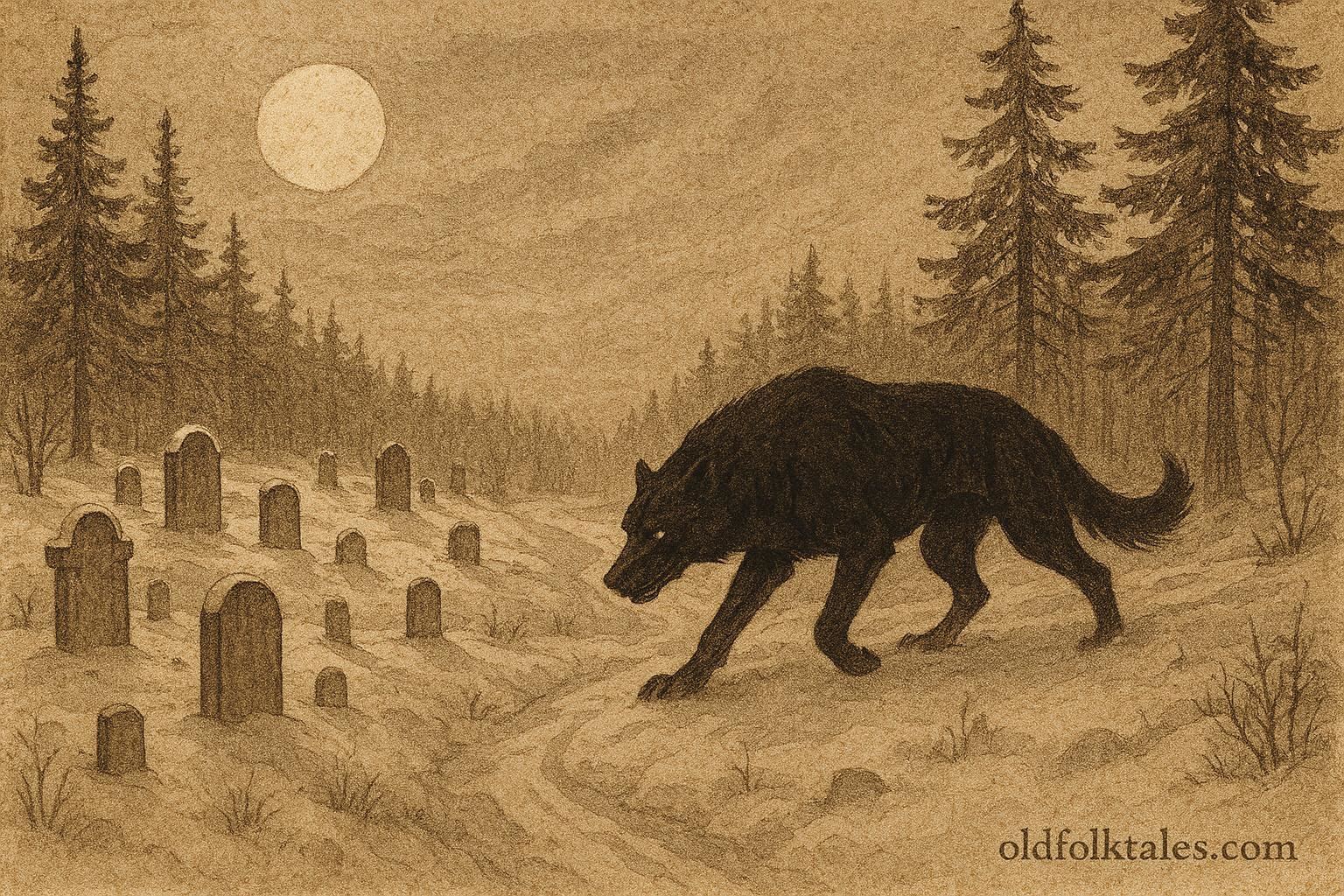
Villagers spoke of the dog in hushed tones. Its coat was black as the deepest night, eyes burning with a fiery awareness that seemed to pierce the soul. Its paws were immense, leaving tracks that sank deep into snow or soft earth, yet it moved with complete silence, like a shadow walking upon the wind. Those who encountered it and acted with respect often survived their journeys unharmed, while those who ignored its presence or mocked the old tales sometimes never returned.
One particularly dark winter, a young man named Lars prepared to journey from his village to a distant relative’s homestead. The path was long and desolate, winding through dense forests where the snow-laden pines blocked the light of the moon. Villagers warned him, “Be careful, Lars. The Black Dog roams tonight, and it watches those who disrespect the dead.” Lars, however, was skeptical. He had heard the stories all his life, but he was a practical man who trusted in his own courage.
He set off with a small lantern in hand, the light flickering weakly against the gathering shadows. As he approached the clearing near the old village graveyard, a sudden chill seeped into his bones. The wind hushed entirely, as if holding its breath, and then he saw it: a massive black dog emerging from the shadows of the gravestones. Its eyes glowed like coals, reflecting the pale moonlight, and its breath steamed in the cold air.
Lars froze, fear gnawing at his heart. The dog did not bark or growl. It simply watched him, moving with a silent authority that seemed to weigh the young man’s soul. Its massive paws left deep impressions in the snow, each step deliberate and measured. The graveyard was eerily still, and the surrounding trees creaked under the weight of frost and ice.
Remembering the warnings of the village elders, Lars bowed slightly and whispered a prayer for the souls resting nearby. He spoke softly to the graves, asking forgiveness for passing through and showing respect for those who had gone before. Slowly, he continued down the path, keeping his steps deliberate, his gaze careful.
The Black Dog followed at a distance, circling the graveyard silently. At times, Lars thought it had disappeared, only to see its eyes gleam from the edge of the shadows. Each step felt like a test, a measure of his reverence and awareness. Fear and awe mingled within him, but he pressed on, determined to honor the living and the dead alike.
As he reached the far edge of the graveyard, the dog paused. Its immense head lowered slightly, and for a moment, Lars felt as if the creature was acknowledging his caution and respect. Then, with a final glance, it vanished into the darkness between the trees, leaving only its deep paw prints behind.
Lars exhaled, relief washing through him, yet he could not shake the weight of the encounter. When he reached his relative’s home and recounted the night’s events, the elders nodded knowingly. They explained that the Black Dog of Västerbotten was a test, a guardian who weighed the respect and prudence of the living. Those who walked heedlessly, mocked the tales, or ignored the warnings were never so fortunate.
Over time, the story of Lars’ encounter became a cautionary tale repeated in every home. Children were taught to be careful near graveyards and to speak softly when passing tombs. Families cleared paths with mindfulness, always leaving small candles or tokens at crossroads or near graves, gestures of respect and prayers for safe passage. Travelers learned that night journeys demanded awareness, reverence, and prudence.
Yet the Black Dog was not a creature of simple malice. Some tales described it guiding lost children back to their homes, protecting them from predators or sudden storms. Others told of it standing silently near the edge of a frozen lake, warning fishermen of thin ice before disaster struck. Its presence was a reminder of the delicate boundary between life and death, between the seen and unseen.
The villagers of Västerbotten learned to live in harmony with both the mortal and mystical worlds. Even on long winter nights, when the wind howled through the pine forests and snow blanketed the land in ghostly white, they walked with attentiveness, whispering prayers to the dead and acknowledging the silent guardian that roamed the shadows.
In time, the Black Dog became a symbol of duality: a harbinger of caution and a protector of the vigilant. Its story reminded the living that life was fragile, that death was ever present, and that respect, prudence, and mindfulness could ensure safety and favor. Those who ignored its lessons risked tragedy; those who honored them often passed through the dark, frozen nights unharmed.
Even today, locals in Västerbotten still speak of the Black Dog, especially in winter when nights are long and solitary roads stretch endlessly through the snow-laden forests. Travelers remember to speak softly near graveyards, to walk carefully along winding paths, and to leave small tokens for the spirits of the departed. The Black Dog remains an enduring presence in folklore, teaching the timeless virtues of respect for the dead, attentiveness, and cautious living.
Moral Lesson
The Black Dog of Västerbotten teaches that respect for the dead, prudence, and caution in daily life are essential. Ignoring the unseen, mocking tradition, or acting recklessly invites misfortune, while awareness and reverence bring protection and harmony.
Knowledge Check
1. Who is the Black Dog in Västerbotten folklore?
A massive, silent dog that prowls graveyards and lonely roads, serving as both guardian and omen.
2. What warning does the Black Dog give villagers?
It reminds travelers to respect the dead and walk cautiously, as carelessness can bring misfortune.
3. What theme is central to this folktale?
Respect for the dead, prudence, and awareness of the boundary between life and death.
4. How does the Black Dog interact with careful travelers?
It may silently watch or guide them, sometimes protecting them from danger.
5. Where does this folktale originate?
Northern Sweden, specifically the Västerbotten region.
6. What lesson do villagers and travelers learn from the Black Dog?
That attentiveness, respect, and caution ensure safety in a world where the living and the unseen coexist.
Source: Collected in Svenska folksagor by Gunnar Olof Hyltén-Cavallius, 1840s.
Cultural Origin: Västerbotten, northern Sweden.