Deep within the Carpathian hills of Hungary, where jagged peaks pierced the sky and mist swirled around hidden valleys, there lay a secret known to few. Tales spoke of a castle veiled by enchantment, invisible to ordinary eyes and protected by riddles, traps, and magical guardians. It was said that only the clever, brave, and perceptive could discover the castle, rescue its captive princess, and inherit the treasures concealed within its walls.
In a small village at the base of these hills lived a young man named László, known for his quick mind and nimble wit. Though not wealthy, he was admired for his cleverness and resourcefulness, often devising solutions to problems that confounded others. From an early age, he had heard the villagers whisper of the hidden castle, tales told by wandering storytellers who claimed to have glimpsed its towers glimmering through the mist at dawn.
One autumn morning, as golden leaves swirled along the forest paths, László set out for the hills. He carried only a satchel with bread, cheese, and a flask of water, and in his heart burned a desire for adventure. “If the tales are true,” he thought, “then perhaps my mind will be the key where strength alone cannot prevail.”
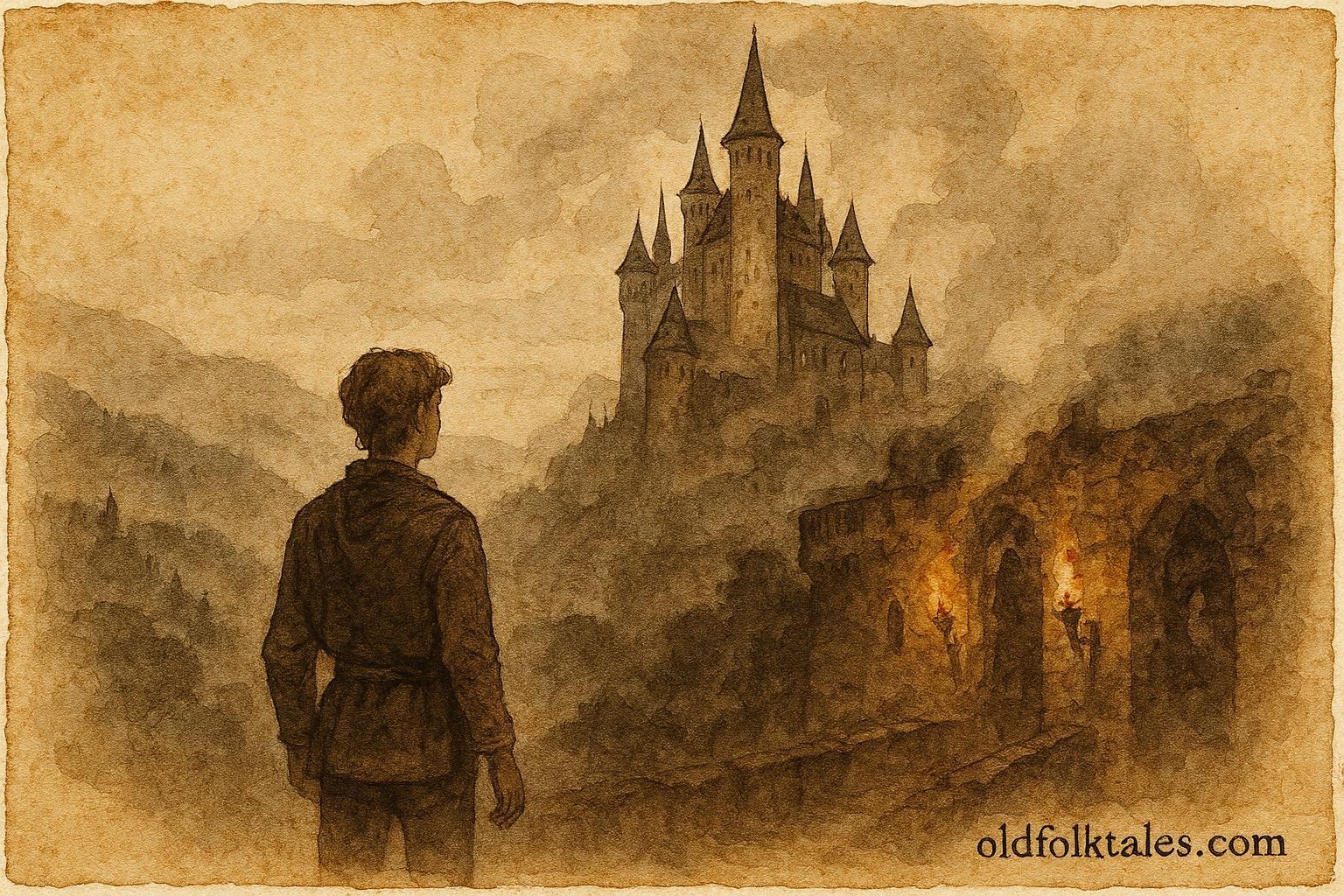
Hours of climbing led him to a valley shrouded in heavy mist. Shapes shifted in the fog, and the wind whispered strange, lilting tones through the pines and beeches. Suddenly, as he rounded a bend, a tower appeared through the rolling mist, a tall, spire-like structure carved of grey stone, with ivy creeping along its walls. The castle seemed to float between the hills, appearing solid yet impossibly hidden, as though the hills themselves guarded it.
At the castle’s entrance stood an enormous wooden door, banded with iron and covered in strange symbols. László examined it carefully, noting a riddle inscribed upon the archway:
“I speak without a tongue,
I see without eyes,
I move without feet,
Yet guide all who are wise.
What am I?”
László paused, considering. He knew the answer would grant him entry. Smiling, he whispered, “The wind.”
At once, the symbols glowed softly, and the heavy door creaked open, revealing a vast hall filled with flickering torchlight. Marble floors stretched toward towering staircases, and tapestries depicted scenes of magical battles and ancient kings. Yet the castle was not empty. Magical traps lay in wait: enchanted steps that shifted when stepped upon incorrectly, doors that led in circles, and invisible threads that triggered alarms of clanging bells.
László’s sharp eyes and careful movements guided him past each danger. He noticed patterns in the shifting floors, remembered the echoes of his own footsteps, and even used reflections from polished armor to see hidden threads. Step by careful step, he advanced deeper into the castle, where whispers of a captive princess grew louder with each corridor.
At last, he arrived at a chamber where a beautiful young princess sat, her golden hair glimmering like sunlight trapped behind the castle’s walls. She was surrounded by an illusion of mirrors and shifting shadows, designed to confuse intruders.
“Who approaches?” she called, her voice both soft and commanding.
“I am László, a traveler seeking truth and courage,” he replied. “I have solved the riddle of the gate and navigated your castle’s trials. I come to free you.”
The princess studied him carefully. “Many have tried,” she said. “All who relied on strength alone have failed. Only wit can undo this enchantment.”
Together, they confronted the final trial: a maze of mirrors that reflected not reality, but fear and doubt. László remembered the lessons from the castle’s corridors—observe patterns, trust what reason reveals, and ignore illusions meant to confuse the mind. He guided the princess through, touching each mirror in a careful sequence, turning reflections into doors, until they reached a final chamber where a chest of gold, jewels, and ancient scrolls lay unguarded.
The princess smiled. “You have passed the trials not by strength, but by cleverness and courage. The castle’s magic is yours to command, as is my hand, if you wish.”
László bowed respectfully. “The wisdom gained here is greater than any treasure,” he said. “I will honor it with care and justice.”
Word of László’s feat spread through the valleys and villages. The castle, once hidden and feared, became a place where cleverness and courage were celebrated. Young villagers traveled to its gates, inspired not by wealth or power, but by the lessons of wit, patience, and clever problem-solving.
The princess and László ruled together, not with iron and force, but through intelligence, fairness, and careful judgment. The castle’s magical defenses remained, not as traps to punish, but as guides for those willing to learn that wisdom and courage always outweigh brute strength.
Generations later, storytellers in the Carpathian hills would recount the tale of the hidden castle, a young man, and a princess, emphasizing that the mind and heart, when aligned, can unlock doors no sword can open.
Even now, when mist drifts over the hills at dawn, villagers say a lone tower emerges through the fog, awaiting those clever and brave enough to follow its riddles, prove their wit, and discover the treasures hidden within.
Moral Lesson
The Hidden Castle in the Hills teaches that intelligence, cleverness, and courage are often more powerful than sheer strength. Challenges are overcome by careful thinking, observation, and ingenuity, and true rewards come to those who solve problems with wisdom rather than force.
Knowledge Check
1. Who is László?
A young, clever man from a Hungarian village who discovers the hidden castle.
2. How does László enter the castle?
By solving the riddle of the gate: “I speak without a tongue… What am I?” – the answer is the wind.
3. What obstacles does he face inside the castle?
Shifting floors, magical doors, invisible threads, mirror illusions, and other enchantments meant to test cleverness.
4. How does László rescue the princess?
By navigating the magical maze of mirrors with logic, patience, and observation, showing wit over strength.
5. Where does this folktale originate?
Hungary, specifically the Carpathian region; collected in the late 19th century.
6. What is the central theme of the story?
Intelligence, bravery, clever problem-solving, and the triumph of wit over brute force.
Source: Collected from Hungarian storytellers in the Carpathian region, late 19th century (c. 1885).
Cultural Origin: Hungarian (Magyar) folk tradition