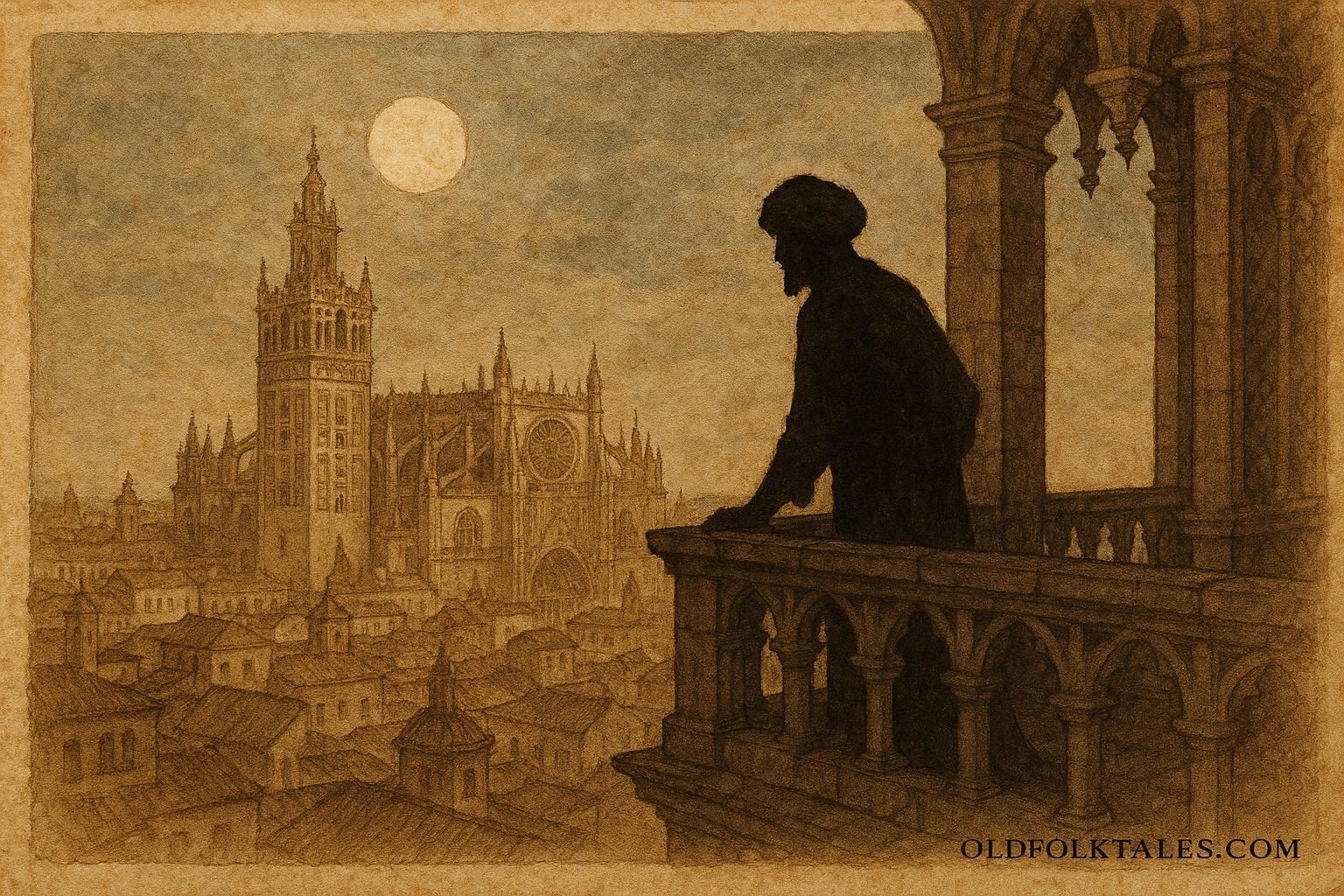
In the heart of the historic city of Seville rises one of Spain’s most recognizable landmarks, the majestic Giralda. Towering high above the narrow streets and tiled rooftops of the old city, the Giralda has watched over Seville for centuries.
Today it stands as the bell tower of the grand Seville Cathedral, but its origins reach back to an earlier time, when the city was part of the great Moorish civilization of Al-Andalus.
In the twelfth century, the tower was built as a minaret for the city’s mosque. From its heights, the call to prayer once echoed across the city, carried by the wind over courtyards filled with orange trees and fountains.
The Giralda was not only a place of worship but also a symbol of power and protection.
From its upper balconies, guards could watch the surrounding countryside and the winding course of the Guadalquivir River, which flowed past the city walls. The tower allowed watchmen to see approaching travelers, traders, and sometimes enemies.
Among those who once served in this role, according to legend, was a loyal Moorish guardian whose name has long been lost to history.
He was known simply as the Watcher of the Tower.
The Watcher had devoted his life to protecting the city. Day and night, he climbed the long interior ramps of the Giralda to stand at its summit. From there he scanned the horizon, alert for danger and determined to keep the city safe.
Those who lived in Seville during those years said the guardian was tireless in his duty.
Even during the coldest nights, when the wind swept across the rooftops and the moon hung pale above the city, he remained at his post. The light of lanterns often glowed near the top of the tower, marking the place where he continued his silent vigil.
But history, like the course of a river, rarely remains still.
In the year 1248, the Christian forces of Ferdinand III of Castile captured Seville after a long siege, bringing the era of Moorish rule in the city to an end.
The mosque was eventually transformed into a cathedral, and the Giralda remained standing as part of the new structure. Over time, bells replaced the call to prayer, and the city entered a new chapter of its history.
But according to legend, one thing did not change.
The Watcher of the Tower never abandoned his post.
Some say that during the final days of the siege, the loyal guardian continued his watch even as the fate of the city was sealed. Refusing to leave the tower he had sworn to protect, he remained there until the very end.
When the battle was over, he was gone.
No one knew exactly what had happened to him.
Yet not long afterward, strange stories began to circulate among the people of Seville.
At night, when the streets grew quiet and the wind whispered through the cathedral square, some claimed to see a shadow moving along the upper balcony of the Giralda.
The figure appeared tall and solitary.
It moved slowly along the edge of the tower, pausing now and then as if gazing out across the city.
Those who glimpsed it from the streets below often felt a strange mixture of awe and unease.
The shadow seemed to be pacing.
Watching.
Guarding.
At first, many dismissed the sightings as imagination or tricks of moonlight. After all, the Giralda was a towering structure, and shifting clouds could easily create strange shapes upon its walls.
But over the years, the stories continued.
Night watchmen patrolling the quiet streets sometimes reported hearing faint footsteps echoing high above them.
Visitors leaving the cathedral late in the evening occasionally thought they saw movement near the top of the tower, even though no one was allowed there after dark.
And shepherds traveling along the roads outside the city sometimes claimed that, on especially clear nights, they could see a lone figure standing at the summit of the Giralda.
Always watching.
Always silent.
One of the most often repeated tales comes from a young apprentice who once worked in the cathedral during the eighteenth century.
Late one evening, after finishing his duties, the boy crossed the courtyard beside the tower. The moon hung bright above the rooftops, casting long shadows across the stone pavement.
As he passed the base of the Giralda, he happened to glance upward.
There, outlined against the pale sky, stood a dark figure near the tower’s upper railing.
The apprentice stopped walking.
The shape appeared unmistakably human.
The figure did not move for several moments. Then, slowly, it began to walk along the balcony, its steps calm and deliberate.
The boy watched in silence, his heart pounding.
There were no lanterns burning above. No guards were assigned to the tower that night.
Yet the shadow continued its silent patrol.
Suddenly, the figure paused.
For a moment, it seemed to look outward toward the distant countryside, just as the ancient watchmen once had.
Then the shadow faded into the darkness.
When the boy finally found the courage to speak about what he had seen, many older residents of Seville simply nodded.
“You saw the guardian,” they said.
According to the legend, the spirit of the Moorish watchman had never truly left the tower.
Even though centuries had passed since the fall of Al-Andalus in Seville, the loyal guardian continued his vigil.
Not out of anger or resentment, but out of devotion to the land he had once sworn to protect.
To many people, the ghost of the Giralda became more than a frightening story.
It was a reminder of the city’s long and complex history, a place where different cultures, traditions, and faiths had shaped the character of Seville.
The tower itself stood as a symbol of that history.
Built by Moorish architects, transformed by Christian rulers, and admired by generations of residents and travelers alike, the Giralda had become a living monument to the passage of time.
And somewhere within that history, the Watcher of the Tower remained.
Even today, when the evening fog drifts through the streets and the bells of Seville Cathedral echo across the city, some residents still glance toward the top of the Giralda.
Most nights the tower stands quiet beneath the stars.
But on rare occasions, people say they see a dark figure walking slowly along the high balcony.
A solitary guardian.
A spirit bound by loyalty.
Still watching over the city he once served.
Moral Lesson
The legend of the Giralda’s ghost reminds us that loyalty and devotion can leave lasting echoes in history. Even as cultures and generations change, the memories of those who served their communities may continue to live on.
Knowledge Check
1. What famous landmark is associated with this legend?
The story centers on the Giralda in Seville.
2. Who is believed to haunt the tower?
A loyal Moorish guardian who once watched over the city from the tower.
3. What was the original purpose of the Giralda?
It was built as a minaret for a mosque during the period of Moorish rule in Seville.
4. What historical event changed the city’s rule in 1248?
The capture of Seville by Ferdinand III of Castile.
5. What do witnesses claim to see at night?
A shadowy figure pacing the tower’s balcony as if still guarding the city.
6. What does the legend symbolize in Andalusian culture?
It reflects the cultural memory and historical legacy of Al-Andalus in Seville.
Source: Adapted from Leyendas y tradiciones sevillanas by José María de Mena, 1973.
Cultural Origin: Seville, Andalusia