In the misty valleys of Gwynedd, where rivers wind like silver ribbons through dark woods and hills rise abruptly against the sky, there lived a young prince with a hound of extraordinary loyalty. The hound’s name was Gelert, a creature of unmatched courage and intelligence, whose glossy coat gleamed like midnight and whose eyes reflected a rare understanding of the world around him.
Gelert had been the prince’s constant companion. The hound accompanied him on hunts through heathered slopes and dense forests, sleeping at the foot of his bed, and guarding the castle gates when the prince ventured into the village. Every villager knew of Gelert’s bravery and wisdom; many whispered that he possessed more understanding than most men.
One day, the prince left his newborn son in the care of Gelert while he went on a brief hunt. Returning unexpectedly, the prince was greeted by a dreadful scene. Gelert stood over the crib, blood upon his muzzle, fur bristling with tension, and the infant was nowhere to be seen. Rage and fear seized the prince’s heart. In the space of a heartbeat, he assumed the worst: his beloved hound had killed the child.
Without hesitation, the prince drew his sword and struck Gelert down. The hound fell, lifeless, his faithful eyes filled with confusion and sorrow. As the prince knelt in anguish over the hound’s body, a faint rustling from the corner of the room drew his gaze. There, in the shadows, lay the infant, unharmed, and beside him, a dead wolf, its teeth stained with blood. Gelert had saved the child from a deadly predator, sacrificing his life in the process.
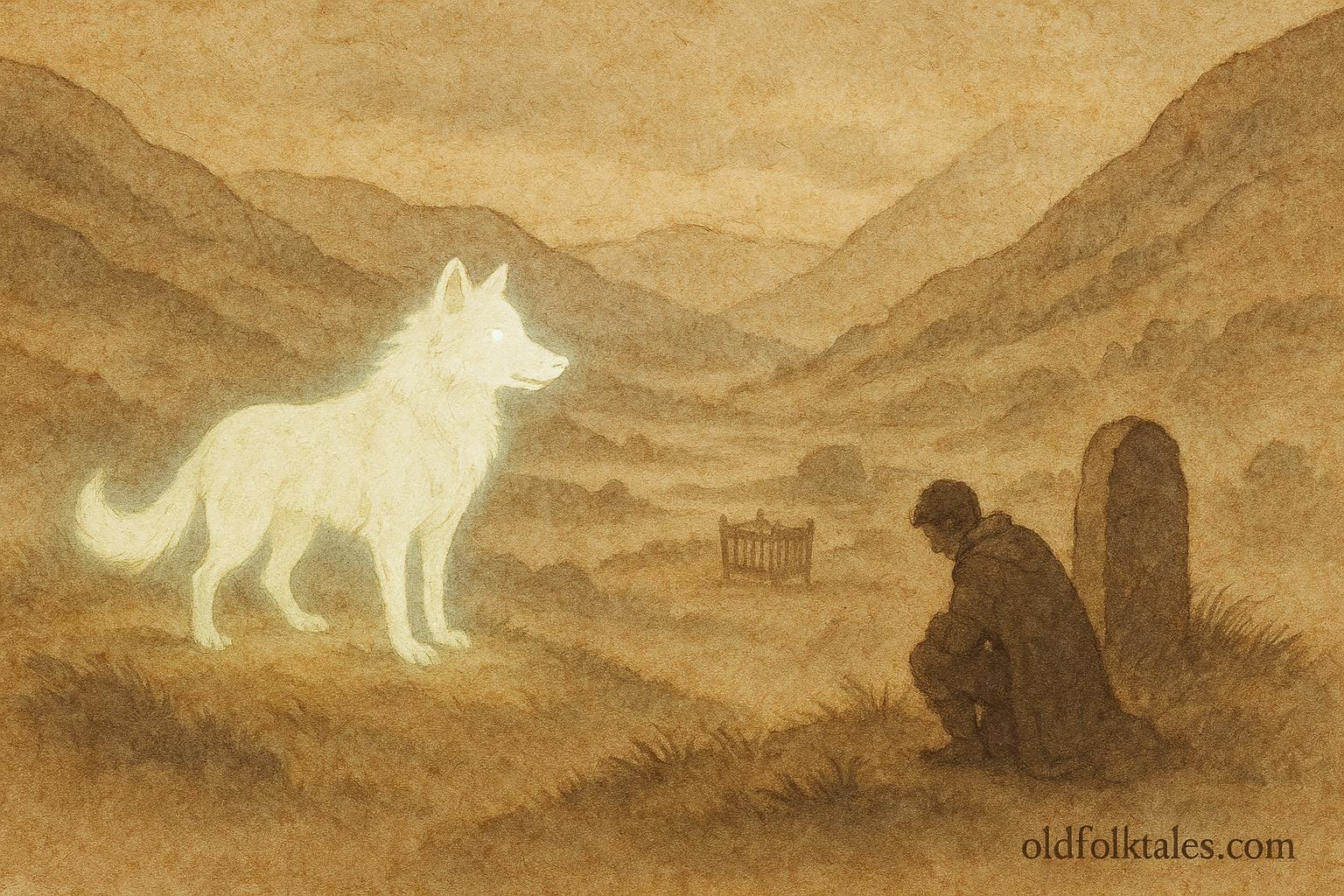
The prince’s grief was boundless. He buried Gelert beneath a mound on the hillside overlooking the valley, marking the grave with a simple stone. From that day forth, his sorrow was eternal, and villagers still spoke of the prince’s loyal hound, whose devotion had been tragically misunderstood.
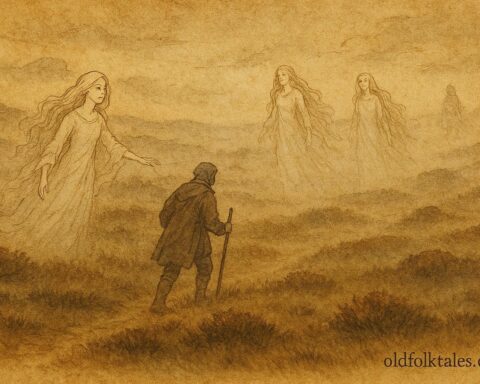
But the story did not end with Gelert’s death. For in the quiet of moonlit nights, travelers in the valley began to speak of a spectral wolf roaming the hills. Some claimed to see him crouched in the fog along narrow paths, his glowing eyes scanning the shadows. Others heard the low growl of a hound warning them to avoid dangerous stretches of river or steep cliffs.
The villagers whispered that Gelert’s spirit had not left the valley, that he had returned as a protective wolf. He was no longer the ordinary hound of flesh and blood, but a supernatural guardian, seeking to prevent the misfortune that had once led to his own wrongful death.
Stories spread of children who wandered too close to the riverbanks or the deep woods, only to be guided safely back by the shadow of a grey, spectral wolf. Parents spoke in hushed tones of hearing a low, warning growl when a predator or stranger approached the village. Even the hunters who had once mocked the prince’s devotion to Gelert grew respectful, leaving offerings of bread and milk at the edge of the forest to honor the spirit who watched over the valley.
Some nights, when the fog hung thick over the hills and the moon shone pale and cold, travelers reported a more extraordinary sight. A wolf with fur like shadow and eyes like fire would appear on a ridge, crouched in silent vigilance, before vanishing as mysteriously as it had come. Those who dared follow the spectral creature were led away from danger, toward safe paths, hidden by rocks and thickets, or away from sudden torrents swelling the river from distant rains.
In time, the legend grew. Gelert was no longer remembered merely as a loyal hound or a tragic figure of misjudgment. He became a guardian spirit, a protector of the innocent and a spectral reminder of loyalty, courage, and justice. Parents told their children to heed the warning growls in the night, to respect the unseen forces of the wild, and to honor those who had shown devotion and bravery, even if the price of loyalty was great.
Yet the tale also carried a stern warning. Villagers remembered that human rashness and hasty judgment had caused the death of Gelert. They spoke of the importance of caution, of not letting anger or fear cloud judgment. Gelert’s revenge was not a vengeance of cruelty, but a cautionary legacy: that the innocent deserve protection, and that wrongful acts, even unintentional, carry consequences.
As centuries passed, the legend of Gelert’s spectral return spread across Gwynedd, whispered by firelight in stone cottages, sung by travelers on mountain paths, and recorded in local lore by storytellers. Scholars and folklorists alike noted that the story reflected a deeply held belief in the supernatural, the loyalty of animals, and the moral lessons tied to caution, vigilance, and justice.
Even today, it is said that those who walk the valley paths at dusk might feel a sudden chill or hear the distant rustle of paws across the heather. They do not fear the spectral wolf; rather, they bow in respect. Gelert’s spirit remains, guarding children, guiding travelers, and reminding all who dwell in or pass through the valleys of Gwynedd that loyalty and courage transcend even death.
Moral Lesson
Gelert’s Revenge and the Wolf Spirit teaches that loyalty and courage may endure beyond death. Rash judgment can lead to tragedy, but devotion, vigilance, and protective courage are rewarded. Respect for both the natural and supernatural worlds ensures safety and moral integrity.
Knowledge Check
1. Where does the legend of Gelert’s Revenge originate?
In Gwynedd, Wales.
2. Why did the prince kill Gelert?
He mistakenly believed Gelert had killed his child when the hound had actually protected him from a wolf.
3. How did Gelert return after his death?
As a spectral wolf, guarding children and warning travelers of danger.
4. What themes are central to the story?
Loyalty, injustice, supernatural guardianship, cautionary morality.
5. How did villagers respond to Gelert’s spirit?
They showed respect, told children to heed its warnings, and left offerings for protection.
6. What lesson does the tale convey about judgment and vigilance?
That rash or fearful judgment can cause tragedy, and that vigilance, courage, and loyalty are virtues to honor.
Source: Adapted from Welsh Folk-Lore: Legendary Tales and Traditions by Elias Owen, 1887.
Cultural Origin: Gwynedd, Wales