In a quiet village in the countryside of France, where stone cottages leaned gently into narrow lanes and fields stretched toward distant hedgerows, there lived a man known to all simply as Martin.
Martin was not cruel, nor lazy, nor unkind. He worked when asked, greeted neighbors with a cheerful nod, and rarely caused trouble. But he was known for something else, something that followed him wherever he went.
Experience legends where mountains breathe magic and heroes face moral choices that shape destiny
He had very little sense.
If there was a simple way to do something, Martin would find a complicated one. If there was a clear explanation, he would misunderstand it. And if there was a lesson to be learned, he would learn it only after the longest and most winding path possible.
The villagers tolerated him, often with a mixture of amusement and frustration. Some laughed openly at his blunders; others shook their heads and muttered, “That one will never learn.”
But as with many such tales told in the Breton countryside and beyond, Martin’s foolishness would soon lead him into a situation so absurd that it would be remembered for generations.
A Problem of Light
One late autumn, the days grew shorter and the nights longer. Darkness crept into the village earlier each evening, and the people adjusted their routines accordingly.
But Martin found this deeply troubling.
He disliked the dark. He disliked how it made the world feel uncertain and unfamiliar. He disliked how he could no longer see the road clearly or recognize the faces of those he passed.
“There must be a way to fix this,” he said one evening, sitting outside his cottage as the last light of the sun slipped behind the horizon.
An old neighbor, who had heard many of Martin’s ideas before, chuckled softly. “The sun will return in the morning, as it always does.”
“But why must it leave at all?” Martin insisted. “If we could keep it here, we would never need to stumble in the dark again.”
The neighbor shook his head. “That is not how the world works.”
But Martin was already thinking.
The Plan
The next morning, he rose early, earlier than he ever had before, and stood facing the east as the first light of dawn spread across the sky.
There it was. The sun.
Bright, warm, and powerful.
“If I can keep it,” Martin said to himself, “then the night will never come.”
The idea seemed perfectly reasonable, to him.
He hurried back into his cottage and gathered what he believed would be the necessary tools: a large sack, a sturdy rope, and a wooden pole. If the sun could not be stopped in the sky, then perhaps it could be captured when it came close enough.
And so, as the sun climbed higher, Martin followed it across the fields, squinting and shielding his eyes, convinced that he was drawing closer to his goal.
Chasing the Impossible
By midday, the sun blazed overhead, and Martin, sweating and determined, stood in the middle of a wide field.
“This must be the moment,” he declared.
He opened his sack, held it high, and attempted to “catch” the sunlight. He moved the sack back and forth, trying to scoop the brightness into it as though it were grain or water.
But no matter how hard he tried, the sack remained empty.
Frustrated, he changed tactics. He tied the rope to the wooden pole and began waving it toward the sky, as though he might hook the sun and pull it down.
From a distance, a group of villagers watched, barely able to contain their laughter.
“What is he doing now?” one asked.
“Trying to catch the sun, it seems,” another replied.
“Let him be,” said an older man. “He will learn soon enough.”
The Illusion
As the afternoon wore on, Martin grew tired. The sun began its slow descent, casting long shadows across the field.
Then, something remarkable happened, at least, to Martin’s eyes.
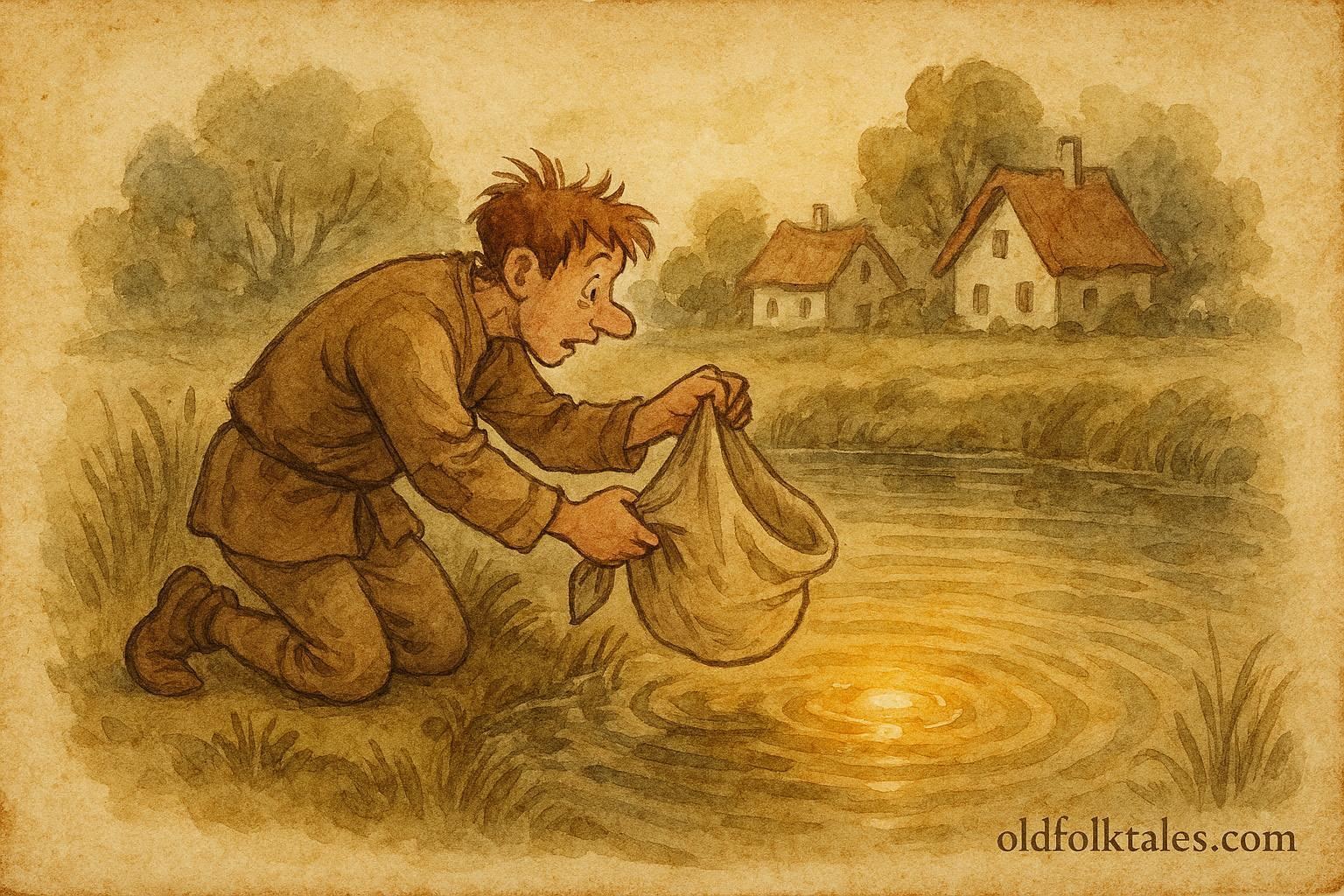
He noticed the sunlight reflecting brightly in a nearby pond. The surface of the water shimmered with golden light, as though the sun itself had come down to rest upon it.
“There!” he cried. “I have found it!”
Without hesitation, he rushed to the pond, knelt at its edge, and plunged his sack into the water, trying to capture the glowing reflection.
He pulled the sack out quickly and tied it shut, convinced that he had succeeded.
“I have it now,” he said proudly. “The sun will stay with me.”
He carried the dripping sack back to his cottage, careful not to open it.
The Great Discovery
Inside, Martin prepared for the night. He closed his shutters, lit a small candle, and placed the sack in the center of the room.
“When darkness falls,” he said, “I will release the sun, and it will light my home forever.”
At last, the sky outside darkened. Night settled over the village.
With great anticipation, Martin untied the sack and opened it wide.
Nothing happened.
No light. No warmth. No sun.
Only damp cloth and a small puddle of water on the floor.
Martin stared in confusion.
“But… it was there,” he said. “I saw it.”
At that moment, his neighbor, who had come to check on him, stepped into the doorway.
“You saw its reflection,” the neighbor explained gently. “Not the sun itself.”
Martin blinked. The realization came slowly, like dawn after a long night.
“So… the sun cannot be caught?”
“No,” the neighbor said, smiling. “Some things are beyond our grasp. But understanding them—that is what matters.”
Laughter and Learning
The story of Martin’s attempt to carry the sun spread quickly through the village and beyond. People laughed, as they always did, at the foolishness of his plan.
Yet beneath the laughter was something more.
For Martin, though slow to understand, had learned something important.
He no longer chased impossible ideas without thought. He began to ask questions, to listen more carefully, and to consider whether his plans made sense before acting on them.
He was still not the wisest man in the village, but he was wiser than before.
And that, as the elders would say, was enough.
Explore the wit and wisdom of Western Europe, where humor and virtue often go hand in hand
Moral Lesson
Foolishness, when met with reflection, can lead to wisdom. Practical thinking and understanding are more valuable than blind effort, and not all problems have simple or immediate solutions.
Knowledge Check
1. Who is the main character in the story?
Martin, a man known for his foolish but harmless nature.
2. What problem did Martin try to solve?
He wanted to prevent darkness by keeping the sun.
3. How did he attempt to capture the sun?
By using a sack and later trying to trap its reflection in water.
4. Why did his plan fail?
Because he mistook the sun’s reflection for the sun itself.
5. What theme does the story highlight?
Wisdom through humor and the consequences of ignorance.
6. What lesson did Martin learn?
To think more carefully and understand before acting.
Source: Adapted from Contes populaires de la France by Paul Sébillot, 1880.
Cultural Origin: France (Breton and wider regional oral traditions)