In the shadow of Salzburg’s gentle hills, where the earth rises in soft green folds and the air carries the quiet hush of old stories, there are whispers of a hidden world just beneath the surface. To the unknowing eye, the land appears peaceful and ordinary, fields stretching wide, cottages nestled close, and narrow paths worn smooth by generations of passing feet.
But those who have lived long enough in these parts, and those who listen carefully when the night grows still, will tell you that the hills are not empty.
They are inhabited.
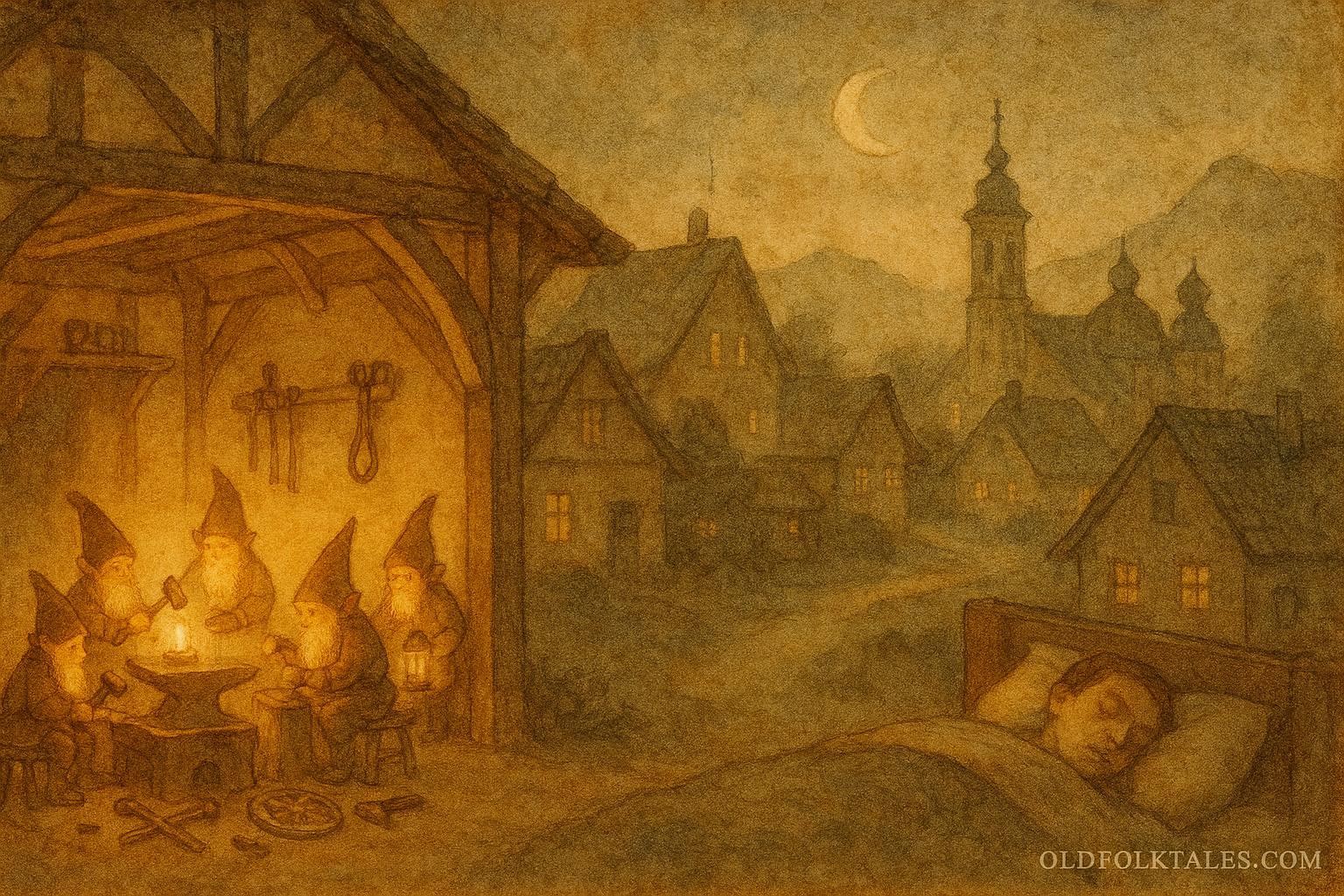
Beneath the soil and stone, beyond what human eyes can see, dwell the Zwergl, small, elusive dwarfs who have long been a part of Salzburg’s oldest tales. They are not creatures of noise or spectacle. They do not show themselves openly, nor do they seek attention. Instead, they move in secrecy, their presence known only through the quiet traces they leave behind.
And though they are rarely seen, their work is unmistakable.
Long ago, in villages scattered across Salzburg, people began to notice something strange. Tasks left unfinished at night would be completed by morning. Tools carefully set aside would be found in better condition than before, sharper, cleaner, more finely crafted than any villager remembered making them.
A farmer might leave a broken fence at dusk, intending to repair it the next day, only to find it standing firm and strong at sunrise. A shoemaker, struggling to meet his orders, would awaken to discover his leather perfectly cut and stitched, each piece finished with a skill that surpassed his own.
At first, such occurrences were dismissed as luck, or perhaps the work of helpful neighbors. But as they became more frequent, and more precise, it grew clear that something else was at work.
Something unseen.
It was the elders who first spoke the name aloud.
The Zwergl.
They said these dwarfs had lived beneath the hills long before the villages were built. They knew the land in ways no human ever could, and they moved through hidden passages deep underground, emerging only under the cover of night.
They were masters of craft, skilled beyond measure in woodwork, metalwork, and all manner of labor. But they did not work for recognition. They did not ask for payment.
They worked for those who were kind.
Word spread quietly among the villagers, though always with a note of caution. The Zwergl, it was said, were not to be disturbed. They must never be watched, followed, or called out. Their work was a gift, freely given, and like all such gifts, it demanded respect.
Those who honored this unspoken rule found themselves quietly aided. Their burdens grew lighter, their work more manageable, their lives subtly improved by hands they would never see.
But not everyone understood.
There was once a man in one of the villages, a craftsman by trade, who began to suspect the truth behind his good fortune. Night after night, he found his unfinished work completed with a perfection he could not match. At first, he felt gratitude, even wonder.
But over time, his curiosity grew into something sharper.
He wanted to see.
One evening, instead of leaving his workshop as usual, he hid himself in the shadows, determined to uncover the secret. The night deepened, and for a long while, nothing stirred. The silence pressed in around him, heavy and still.
Then, at last, he heard it, a faint sound, like the soft tapping of tools against wood.
From beneath the floor, or perhaps from the walls themselves, they came.
The Zwergl.
Small figures emerged, moving with quiet purpose, their movements swift and practiced. They set to work immediately, their hands shaping, mending, refining. The craftsman watched, hardly daring to breathe, as his work was transformed before his eyes.
It was more than skill, it was something close to magic.
But in that moment, hidden in the dark, the man forgot the warning.
He forgot that some things are not meant to be taken.
Unable to contain himself, he stepped forward.
“Who are you?” he demanded, his voice breaking the stillness.
The effect was immediate.
The Zwergl froze.
For a heartbeat, the room seemed to hold its breath. Then, without a word, the dwarfs vanished, slipping back into the unseen spaces from which they had come.
The workshop fell silent once more.
And they never returned.
From that day on, the craftsman’s work remained his own. No unseen hands came to finish what he began. No quiet assistance eased his burdens. Though he worked as diligently as ever, he could not match the perfection he had once known.
What had been given freely was gone.
And it would not be given again.
There were other stories, too, whispered more cautiously, as though even speaking them required care.
Some told of villagers who, having discovered the Zwergl’s help, sought to take advantage of it. They left greater and greater tasks undone, expecting the dwarfs to complete them. They began to rely not on their own effort, but on the unseen labor beneath their feet.
For a time, the help continued.
Then, one night, it stopped.
The tools remained untouched. The work lay unfinished. And no matter how long they waited, the Zwergl did not return.
Greed, it seemed, was as unwelcome as curiosity.
And then there were the oldest tales, the ones that spoke not only of the Zwergl’s work, but of what they guarded.
Deep beneath the hills, beyond the reach of any human path, it was said that the dwarfs kept watch over ancient treasures. Not treasures of gold alone, though some claimed such riches existed, but something far older, secrets buried with the land itself.
These treasures were not meant for human hands.
Those who sought them, driven by desire rather than respect, found nothing. The hills gave no sign, no passage, no reward. The deeper one searched, the more the land seemed to close in on itself, as though protecting what lay beneath.
The Zwergl, silent and unseen, remained their guardians.
Over time, the people of Salzburg came to understand what the stories had always tried to teach them.
The Zwergl were not servants.
They were not to be commanded, nor followed, nor exposed.
They were part of the land, its hidden keepers, its quiet craftsmen, its unseen companions.
To those who lived with kindness and humility, they offered help.
To those who sought to control or exploit them, they offered nothing at all.
Even now, there are those who claim that on certain nights, if the world grows quiet enough, faint sounds can still be heard beneath the hills. The soft rhythm of tools at work. The whisper of movement where no one stands.
A task left unfinished may yet be completed by morning.
But only for those who do not expect it.
Only for those who understand that some gifts cannot be demanded, only received with gratitude.
Moral Lesson
The story of the Zwergl teaches that kindness and respect invite unseen blessings, while greed, curiosity, and exploitation drive them away. What is freely given must never be taken for granted.
Knowledge Check
1. Who are the Zwergl in Salzburg folklore?
The Zwergl are small, hidden dwarfs believed to live beneath Salzburg’s hills and secretly help kind villagers at night.
2. What kind of work do the Zwergl perform?
They assist with chores, craftsmanship, and repairs, often completing tasks left unfinished.
3. Why do the Zwergl disappear in the folktale?
They vanish when they are mocked, exposed, or exploited by humans.
4. What lesson does the Zwergl story teach?
It emphasizes kindness, gratitude, and respect for unseen forces, warning against greed.
5. Do the Zwergl guard treasures?
Some legends claim they protect ancient underground treasures hidden beneath Salzburg.
6. Where does the Zwergl folktale originate?
It originates from Salzburg, Austria, based on folk records collected in 1902.
Source: Collected in Salzburg folk records by Karl Adrian (1902)
Cultural Origin: Salzburg, Austria