High among the Austrian Alps, where jagged peaks cut into the sky and winter lays its long, unyielding hand upon the land, there are nights when the world seems to stand on the edge of something unseen. Snow falls thick and silent, forests groan beneath the weight of ice, and the wind moves like a living thing through the mountain passes.
It is on such nights, when storms gather and darkness deepens beyond comfort, that the old warnings are remembered.
For this is when the Wild Hunt rides.
The villagers of the Alpine regions have long known that winter is not merely a season of cold, but a time when the boundary between the living world and something far older grows thin. Fires are kept burning, doors are bolted tight, and no one lingers outside once the storm begins to rise.
Not out of simple fear of the weather.
But because of what the storm may carry.
It begins with the wind.
At first, it howls as any mountain wind might, sharp, restless, cutting through valleys and over ridges with a force that seems almost purposeful. But then, beneath its cry, another sound emerges.
Distant.
Faint.
Unmistakable.
The sound of horns.
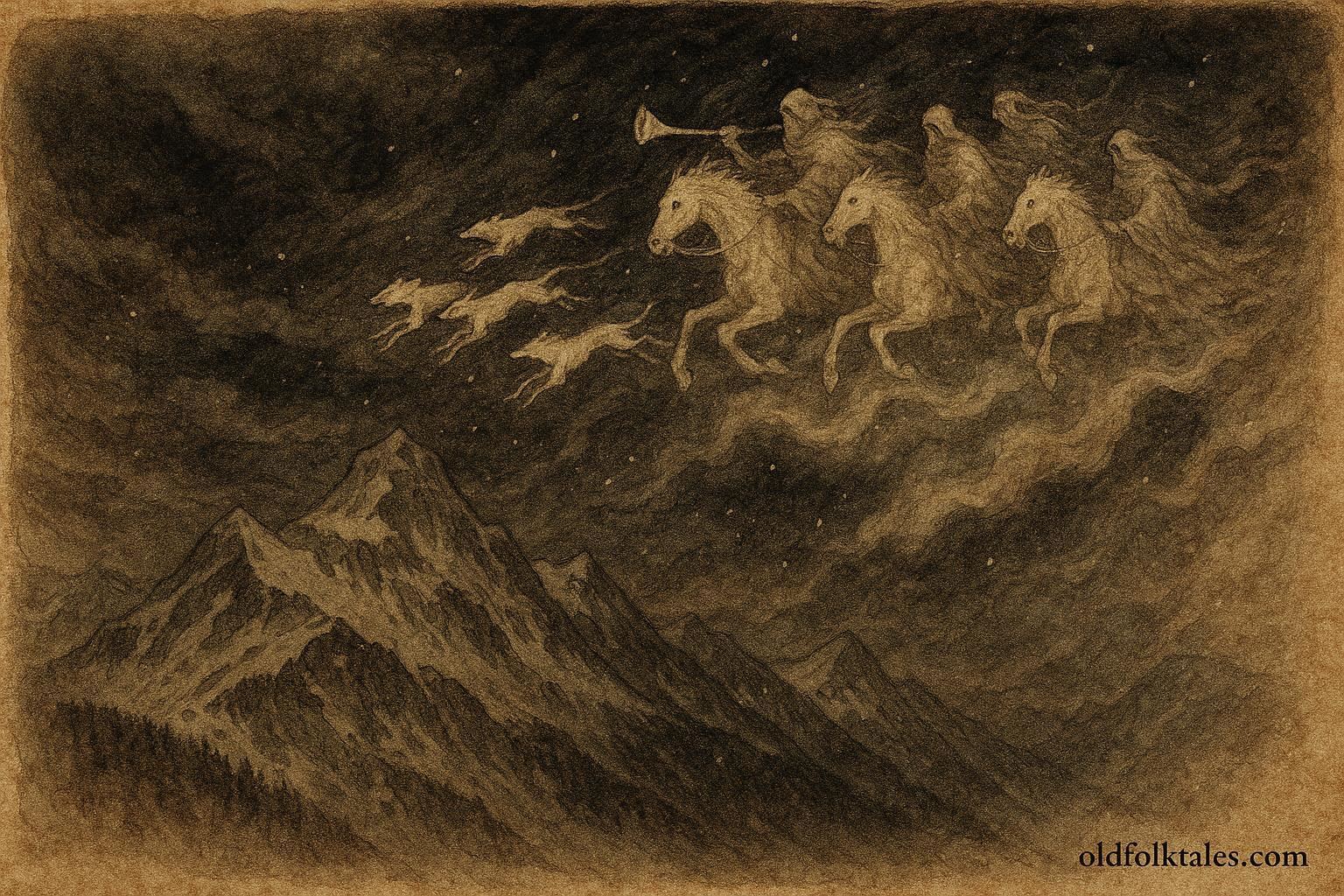
Those who have heard it say the horns do not echo as ordinary sounds do. They seem to come from everywhere at once, from the peaks above, from the valleys below, from the very air itself. They call out across the storm, long and hollow, as though summoning something that cannot be seen.
Then come the hounds.
Their barking cuts through the wind, wild, relentless, and filled with a fury that no earthly animal could sustain. It rises and falls in waves, drawing closer with each passing moment, as though an unseen pack is racing through the sky itself.
And with them,
The riders.
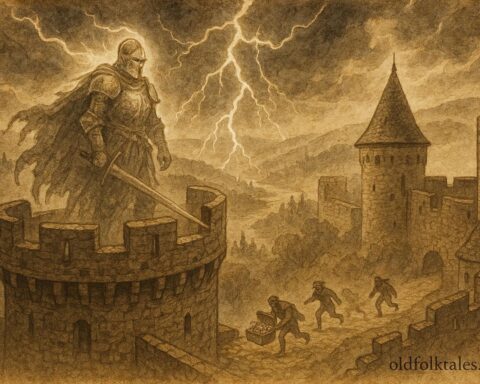
Though few dare to look, those who have glimpsed the Wild Hunt speak of a terrible procession sweeping across the heavens. Shapes move against the storm clouds, dark figures on spectral horses, their forms blurred by snow and shadow. They ride with a speed that defies the natural world, crossing vast distances in the blink of an eye.
At their head is a leader.
Some say it is a cursed nobleman, condemned to ride for eternity for crimes long forgotten by the living. Others believe it is something far older, an ancient god of the hunt, whose presence still lingers in the wild places of the earth.
No one agrees.
And no one wishes to know for certain.
For the Wild Hunt is not a sight meant for mortal eyes.
Those who see it do so at great cost.
There is a tale told in hushed voices of a traveler who once ignored the warnings. He had come from beyond the mountains and knew nothing of the old stories, nor did he heed the caution of those who urged him to remain indoors when the storm began.
The wind had risen quickly that evening, carrying with it a strange unease. The villagers barred their doors, drawing their families close to the warmth of the hearth.
But the traveler, restless and unafraid, chose to continue on his path.
He had not gone far when he heard it, the distant call of horns.
At first, he paused, uncertain. The sound was unlike anything he had known, yet curiosity pushed him forward. Then came the barking of hounds, echoing through the storm with a force that seemed to shake the very air.
Still, he did not turn back.
The snow thickened. The wind grew wilder.
And then, above him, the sky seemed to move.
The traveler looked up, and saw them.
Riders, dark and swift, racing across the storm as though the heavens themselves were their road. The hounds followed, their forms barely visible, their voices filling the night with a sound that was neither entirely animal nor entirely spirit.
At the front rode the leader, towering and terrible, his presence commanding the storm itself.
For a moment, the traveler stood frozen, caught between awe and terror.
Then the Hunt saw him.
What happened next was never fully told.
Some say the traveler was swept from the ground, carried away by the rushing force of the Hunt, never to be seen again. Others claim he was left behind, but not unchanged. That when he returned, he spoke little, his eyes fixed always on some distant point, as though he still heard the echo of horns no one else could hear.
And there are those who insist that he bore a mark, something unseen, yet deeply felt, a misfortune that followed him for the rest of his days.
Whatever the truth, his fate was enough.
From that time on, no one doubted the warnings.
The elders taught their children well: when the storm rises and the horns begin to sound, you do not look to the sky. You do not step beyond your door. You do not call out, no matter what you think you hear.
You stay inside.
You keep the fire burning.
And you pray.
For the Wild Hunt is not merely a passing specter. It is a force, ancient, restless, and beyond the understanding of those who live beneath the mountains. It does not come for any single purpose that humans can grasp. It moves according to its own will, bound to laws older than memory.
And those who cross its path do so at their own peril.
Yet the Hunt is not without meaning.
To some, it is a warning, a reminder that the world is not fully known, that there are forces beyond human control that demand respect. To others, it is a sign of the turning of seasons, a shadow cast by the long winter nights that once held deeper significance for those who lived closer to the rhythms of the land.
It is both fear and memory.
Both myth and presence.
Even now, in the high Alpine regions, there are those who claim the Wild Hunt still rides.
On nights when the storm is fierce and the wind carries a strange, hollow note, people listen closely. And if, beneath the howl of the gale, they hear the distant sound of horns…
They do not question it.
They do not seek it.
They simply close their doors, draw near to the warmth of their homes, and wait for the storm to pass.
Because some things are not meant to be followed.
Some paths are not meant for human feet.
And some hunts are not meant for human eyes.
Moral Lesson
The Wild Hunt teaches that not all forces in the world are meant to be understood or challenged. Respect for the unseen and obedience to ancient warnings can protect us from dangers beyond our control.
Knowledge Check
1. What is the Wild Hunt in Alpine folklore?
The Wild Hunt is a ghostly procession of hunters, hounds, and spirits seen or heard racing through stormy winter skies.
2. Who leads the Wild Hunt in Austrian legends?
It is believed to be led by either a cursed nobleman or an ancient god of the hunt.
3. What happens if someone witnesses the Wild Hunt?
They risk being swept away, marked by misfortune, or deeply affected by the encounter.
4. When does the Wild Hunt usually appear?
It is said to occur during stormy winter nights in the Alpine regions.
5. What should villagers do when they hear the Wild Hunt?
They should stay indoors, avoid looking outside, and pray for protection.
6. What does the Wild Hunt symbolize?
It represents fear of the unknown, respect for supernatural forces, and the dangers of ignoring ancient warnings.
Source: Jacob Grimm, Deutsche Mythologie (1835)
Cultural Origin: Austrian Alpine regions (shared Germanic tradition)