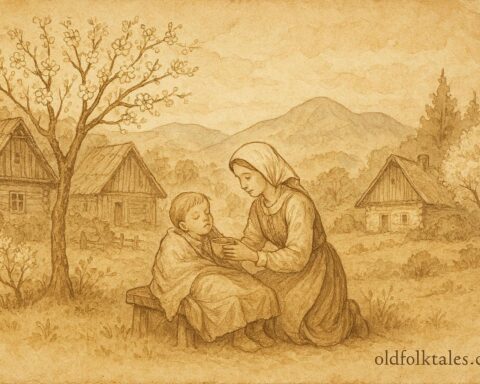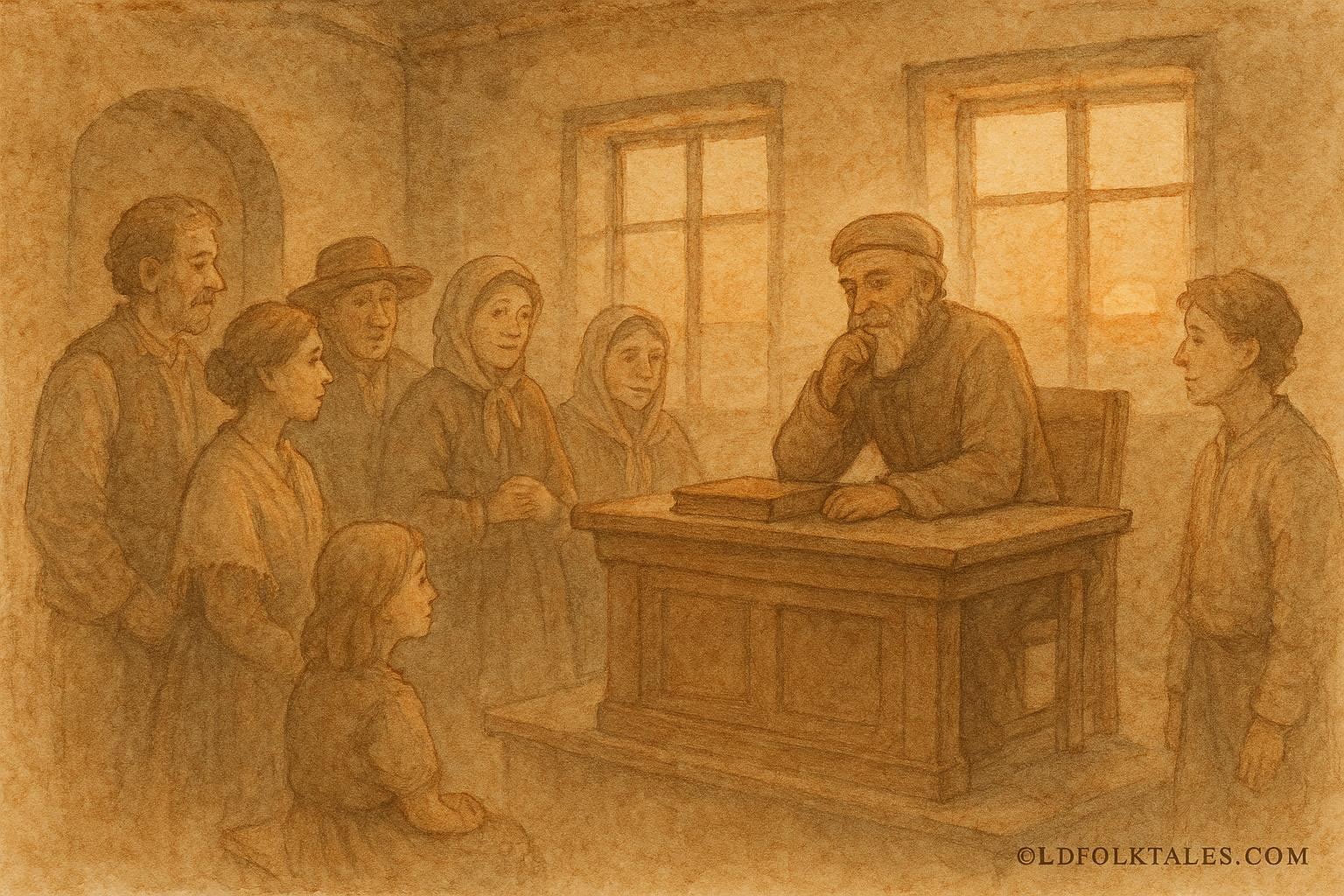
In a quiet village nestled among the rolling hills of Slovakia, there lived a judge unlike any other. He was not wealthy, nor did he possess noble blood or grand estates. His home was simple, his clothing plain, and his manner unassuming. Yet, within this modest man resided a mind so keen and a heart so understanding that villagers came from far and wide seeking his guidance. They called him Múdry sudca, the Wise Judge.
The judge’s fame did not arise from force or authority, but from his uncanny ability to solve disputes that seemed impossible. When villagers quarreled over land, livestock, or words spoken in anger, the outcome often appeared impossible to determine. Others might have demanded penalties, imposed fines, or sent offenders away in frustration. But the Wise Judge approached each problem differently.
He listened, not merely to the words spoken, but to the silences in between. He watched gestures, considered emotions, and understood human nature better than anyone else in the region. Often, the solution he proposed was not what either party expected, but it was always fair, and it always left the villagers satisfied.
One day, a peculiar dispute arose. Two farmers came before the judge, each claiming ownership of a prized cow. Both had evidence, both swore oaths, yet the cow stood stubbornly in the middle, seemingly indifferent to human claims. The villagers whispered that no judge could resolve such a matter without angering one party.
The Wise Judge pondered silently. He asked a simple question: “Who can milk the cow first?” The farmers agreed to try. As each approached, the cow mooed and stepped back from the first man, but allowed the second to milk her calmly. The judge nodded. “The cow has chosen her keeper,” he declared, and the village applauded the fairness of the decision. No deceit, no argument, only insight and patience.
Word of his clever reasoning spread beyond the village. Merchants, travelers, and even officials from neighboring regions brought him matters that had long resisted resolution. A merchant accused a neighbor of stealing grain; a widow claimed her late husband’s inheritance had been taken unfairly; children quarreled over playground disputes. In every case, the Wise Judge listened carefully, asked questions that seemed simple but revealed hidden truths, and delivered judgments that satisfied both law and morality.
What set him apart was his use of riddles and logic. Rather than punishing immediately, he would pose a question or create a scenario that encouraged both parties to see the situation from the other’s perspective. This method often revealed honesty, deceit, or the natural resolution hidden within the problem itself. By doing so, he taught the villagers not only the law but also compassion, reasoning, and the importance of understanding one another.
One particularly memorable case involved a baker and a tailor. The baker accused the tailor of taking more than his fair share of bread during a festival, while the tailor insisted he had paid appropriately. Instead of simply demanding proof or punishing one man, the judge instructed them both to carry a basket of bread to the village square. There, he asked each to divide the bread in front of the other, silently observing. When the tailor made a careful and generous division, the baker admitted his own misunderstanding and apologized for hastily accusing him. Justice had been served, yet harmony remained intact.
It was said that the Wise Judge did not rely on punishment or intimidation, but on moral intelligence. His judgments reflected fairness (انصاف) rather than fear. He understood that the law was not merely a set of rules, but a living principle meant to guide human behavior and nurture community trust. In every case, he balanced authority with empathy, ensuring that the villagers learned from disputes rather than simply suffering their consequences.
Over the years, the village became known not only for its fertile land and hardworking people but also for its justice. Travelers would marvel at the fairness of its rulings and the wisdom of its humble judge. Even those who came to challenge him left with respect, often smiling at the cleverness with which he had resolved matters that seemed unsolvable.
The legend of Múdry sudca endured through generations. Parents recounted his judgments to their children, teaching the values of fairness, patience, and wisdom. Farmers, merchants, and villagers alike remembered that disputes could be resolved without anger or harm if one approached them thoughtfully and with an understanding of human nature. Even today, the story remains a testament to the power of moral intelligence over mere authority, reminding all that fairness and empathy can guide the law as effectively as punishment or command.
Moral Lesson
The Wise Judge teaches that true justice arises from wisdom, empathy, and understanding human nature. Fairness is not enforced through power alone but through insight, patience, and moral intelligence.
Knowledge Check
1. Who is Múdry sudca in Slovak folklore?
He is the Wise Judge, a humble village official known for resolving disputes with clever reasoning and fairness.
2. How does the Wise Judge resolve conflicts?
He uses insight, observation, riddles, and moral intelligence to reach fair and balanced solutions.
3. What makes his judgments remarkable?
They satisfy both the law and morality, often teaching villagers empathy and understanding.
4. What themes are central to the Múdry sudca folktale?
Themes include fairness (انصاف), wisdom over authority, and moral intelligence.
5. What kinds of disputes did the Wise Judge handle?
He resolved conflicts over property, accusations, inheritance, and personal disagreements within the village.
6. Where does the story of the Wise Judge originate?
It originates from Slovak folklore, collected by Pavol Dobšinský in 1880.
Source: Pavol Dobšinský, Prostonárodné slovenské povesti (1880)
Cultural Origin: Slovak folklore