In a small town in Germany, where narrow streets curved between modest homes and the rhythm of daily life was steady but humble, there lived a shoemaker and his wife. They were honest people, known for their kindness and quiet dignity, but their lives had grown increasingly difficult.
The shoemaker had once earned a modest but steady living. His hands were skilled, his work dependable, and his shoes well regarded. Yet, as time passed, misfortune seemed to settle upon them. Orders became fewer, materials more expensive, and one hardship followed another until, at last, they found themselves with barely enough to continue.
Discover the spiritual depth and wisdom hidden in the ancient folklore of Eastern and Balkan Europe
One evening, the shoemaker counted what little leather remained in his possession.
It was just enough to make a single pair of shoes.
With care and patience, he measured and cut the leather, preparing every piece with precision. Though tired, he took pride in his work, ensuring that even this final pair would be made as well as any before it.
“I will finish them in the morning,” he said to his wife, setting the prepared pieces neatly upon his workbench.
There was nothing more he could do that night.
With heavy hearts but quiet hope, they went to bed.
When morning came, the shoemaker entered his workshop, and stopped in astonishment.
There, upon his bench, stood a finished pair of shoes.
Not merely completed, but crafted with such skill and perfection that he could scarcely believe his eyes. The stitching was flawless, the shape elegant, the leather polished to a fine sheen.
“These are finer than any I have ever made,” he whispered.
His wife could only nod in wonder.
They placed the shoes in the shop window, unsure of what else to do. Before long, a customer passed by, admired the craftsmanship, and purchased them at a generous price.
With the money, the shoemaker was able to buy enough leather for two pairs.
That evening, he prepared the pieces once again, cutting them carefully and leaving them on the bench as before.
The next morning, the same miracle awaited him.
Two pairs of shoes, perfectly made.
And so, it continued.
Each night, the shoemaker prepared the leather. Each morning, he found the work completed, always with a skill that surpassed his own. The shoes sold quickly, bringing in enough money to buy more materials, and then more again.
What had begun as a single pair soon grew into a steady livelihood.
The shoemaker and his wife, once burdened by worry, now found themselves living comfortably once more.
Yet, though their fortune had changed, they did not forget their gratitude.
“Someone is helping us,” the wife said one evening. “We must discover who it is.”
The shoemaker agreed.
That night, instead of going to bed, they hid quietly in the corner of the workshop, waiting.
The room was still, lit only by the faint glow of a dying candle. Hours passed, and the silence deepened.
Then, at midnight, they heard it,
A soft sound.
Movement.
From the shadows emerged two small figures.
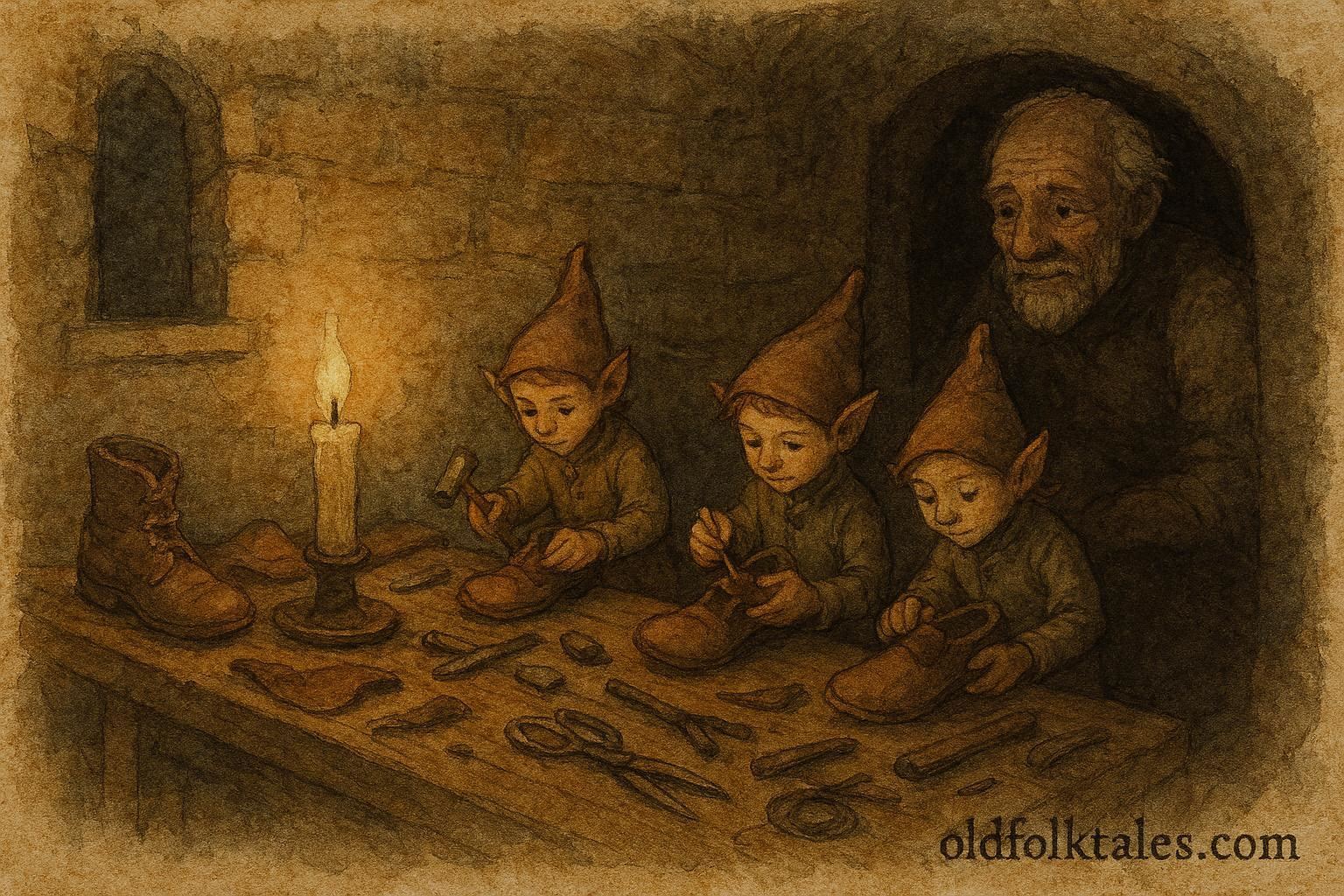
They were elves, tiny, nimble, and quick of hand. They wore no shoes, no proper clothing, and their small bodies moved swiftly across the workbench as they set to work.
With remarkable skill, they stitched and shaped the leather, their hands moving with speed and precision. There was no hesitation, no wasted motion, only perfect craftsmanship carried out in silence.
The shoemaker and his wife watched in amazement.
At last, as dawn approached, the elves finished their work and disappeared as quietly as they had come.
The couple remained still for a long moment after the workshop fell silent again.
“They have done so much for us,” the wife said softly. “And yet they have nothing.”
The shoemaker nodded.
“We must repay them,” he said.
The next day, instead of preparing leather, they set to work on something else.
The shoemaker crafted two small pairs of shoes, carefully sized and shaped. His wife, with equal care, sewed tiny garments, warm, well-made, and suited to the little figures they had seen.
That evening, they placed the gifts upon the workbench.
Then they waited.
At midnight, the elves returned.
They approached the bench as before, ready to begin their work—but instead, they found the clothes laid out before them.
For a moment, they paused.
Then, one by one, they picked up the garments.
With visible delight, they dressed themselves, slipping into the finely made clothes and shoes with joy and excitement. They laughed softly, turning and admiring their new attire.
And then, hand in hand, they danced.
Around the workshop they moved, light and carefree, their laughter filling the room. No longer burdened by their silent labor, they seemed transformed, free and content.
At last, they made their way toward the door.
And before disappearing into the night, they left the workshop for the final time.
The shoemaker and his wife waited until morning, but the elves did not return.
At first, there was a quiet sadness in their absence.
But it was soon replaced by understanding.
The elves had not left out of displeasure, but because their work was complete.
From that day forward, the shoemaker continued his craft on his own. Though the mysterious help was gone, his skill had grown, and his reputation had been firmly established.
Customers continued to come, drawn by the quality of his work.
And the shoemaker and his wife never again fell into poverty.
They lived well, not through magic alone, but through the kindness they had shown, and the gratitude they had never forgotten.
And though the elves were never seen again, their presence remained in memory, a reminder that even the smallest acts of generosity can carry the greatest rewards.
Experience legends where mountains breathe magic and heroes face moral choices that shape destiny
Moral Lesson
The Elves and the Shoemaker teaches that kindness and gratitude create lasting blessings. When help is given freely, it should be met with generosity, for true prosperity comes from humility and reciprocity.
Knowledge Check
1. What is The Elves and the Shoemaker folktale about?
It tells the story of a poor shoemaker helped by elves who secretly craft shoes at night.
2. Who wrote The Elves and the Shoemaker?
It was collected by the Brothers Grimm in Kinder- und Hausmärchen (1812).
3. Why did the elves help the shoemaker?
They helped him quietly, likely out of kindness and appreciation for his honest work.
4. How did the shoemaker repay the elves?
He and his wife made clothes and shoes for the elves as a gift of gratitude.
5. Why did the elves leave after receiving the gifts?
They were satisfied and no longer needed to help, departing happily after being appreciated.
6. What is the main lesson of the story?
It teaches gratitude, kindness, and the value of giving back for blessings received.
Source: Kinder- und Hausmärchen by Jacob and Wilhelm Grimm (1812)
Cultural Origin: German folklore