In the sun-drenched hills of the Peloponnese, where the air smells of salt and soil and the ground is dotted with silver-leaved olive trees, there lived a poor farmer named Nikos. His small plot of land barely sustained his family, yet he tended it with care, speaking gently to the trees and working from dawn until the sun dipped behind the distant hills.
Despite his diligence, the yield of his olives was modest. Each harvest fed his household, but there was never enough to spare. Yet Nikos’s heart was content, for he cherished the quiet rhythm of life among his trees and the simple joys it provided.
One warm evening, as the sun cast a golden glow across his grove, Nikos noticed something unusual. A soft rustling moved among the branches, yet the wind was still. Shadows shifted in ways that did not correspond with the shapes of the trees. And then he heard a whisper, gentle, melodic, almost like the rustle of leaves singing in the breeze.
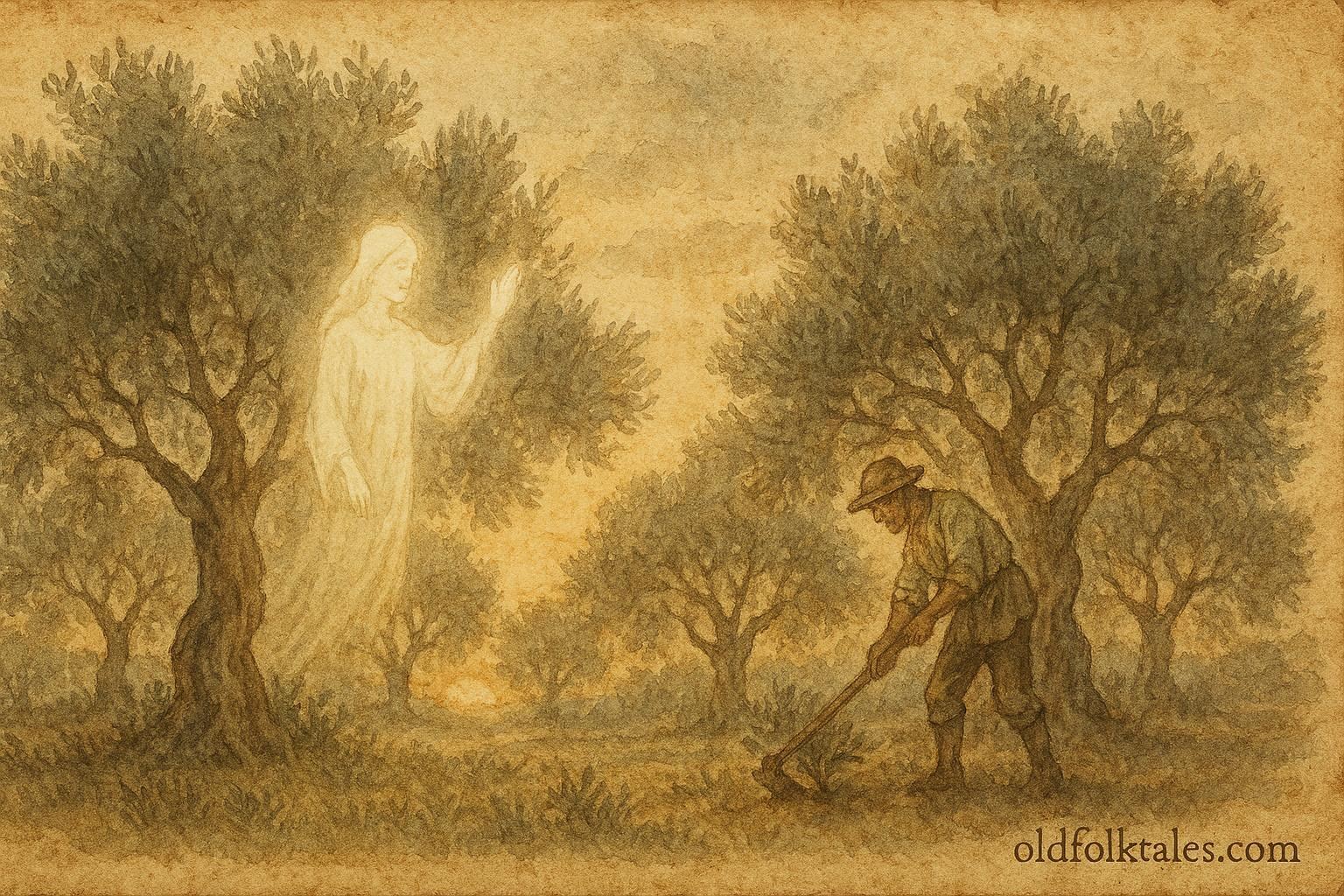
He turned, half-afraid and half-curious, and there, amid the oldest olive tree at the center of the grove, he saw a faint, shimmering figure. Its form was delicate, its features luminous, and it moved as if floating upon the air itself. Nikos understood at once: this was no ordinary visitor. A spirit lived among his trees.
The spirit did not speak with words at first. Instead, it gestured, guiding Nikos’s hands as he tended the grove. Under its subtle influence, the soil seemed richer, the trees grew sturdier, and the olives ripened with an abundance he had never known. Nikos’s heart swelled with gratitude, but he never forgot to show humility. Each day, he would leave small offerings, fresh water, grains, and gentle words of thanks, honoring the presence that had blessed his land.
Word of Nikos’s flourishing grove soon spread to neighboring farmers. Some were impressed, but others were envious. They wondered how one poor man could harvest such bounty while their own lands struggled. Greed took root in their hearts, and they conspired to discover the secret behind Nikos’s good fortune.
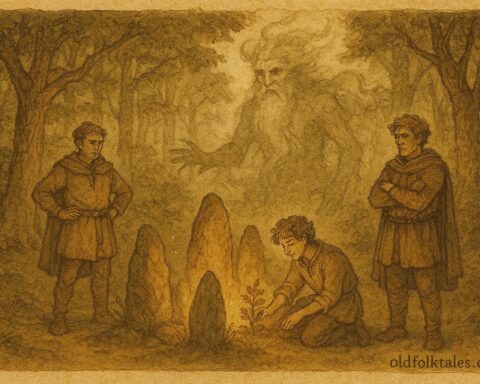
One moonless night, three farmers crept silently into Nikos’s grove, determined to find and steal whatever magic sustained his olives. They approached the ancient tree where the spirit was said to dwell, their minds focused solely on profit.
The spirit, however, had long observed human hearts. It did not need to speak to perceive intent. As the intruders neared, the air grew chillier, the shadows deepened, and a subtle tremor ran through the earth. Leaves twisted unnaturally, catching the moonlight and casting eerie reflections across the ground.
The greedy farmers faltered. A strange force seemed to hold them in place, their limbs stiff, their breaths shallow. And then, as if the grove itself had awakened, the spirit revealed its form in full. Radiant and commanding, it glimmered with the silver of the olive leaves and the gold of the setting sun.
“Why do you come here?” the spirit asked, not with anger, but with calm authority that cut through the fear in their hearts.
The men stammered, claiming curiosity, yet their intentions were clear. The spirit’s eyes, soft yet piercing, seemed to look into the very desire within them.
With a wave of its hand, the consequences of greed were made manifest. The three intruders found themselves slipping upon the soil, tripping over roots, and becoming entangled in thorny brambles. Their baskets of stolen fruit turned to dust, and a bitter wind swept through the grove, driving them out. Not a single tree was harmed, but the men would never forget the lesson they had learned.
Nikos watched in awe and reverence. He understood then the true nature of the spirit: it did not reward only skill, nor punish only failure, it judged the heart. Those who approached with humility and respect were given abundance, while those who sought to take without regard were met with protection that could sting like a warning yet harm nothing else.
From that day onward, Nikos’s grove flourished more than ever. He harvested enough to feed his family, share with neighbors in need, and plant new trees for future generations. The spirit’s presence remained subtle, always guiding, always watching, and Nikos never sought to reveal its secrets, knowing that its magic was not his to command.
The villagers came to speak of the grove in hushed admiration. They would leave small offerings when passing through, for even those who did not see the spirit felt its influence in the vibrant branches and bountiful fruit. And though many wondered why Nikos’s olives thrived while others struggled, few dared act with greed, remembering the tale of the night the grove defended itself.
And so, the grove became a symbol, not merely of fruit and sustenance, but of the sacred bond between humans and nature. The land, when treated with respect, returns generosity; when treated with greed, it resists and teaches a quiet, unforgettable lesson.
Discover the spiritual depth and wisdom hidden in the ancient folklore of Eastern and Balkan Europe
Moral Lesson
The Tale of the Olive Tree Spirit teaches that harmony with nature and respect for the unseen rewards humility and integrity, while greed and selfishness lead only to loss. True prosperity arises from cooperation with the land, not domination over it.
Knowledge Check
1. Who appears in the olive grove to help the farmer?
A spirit inhabits the olive trees, guiding and blessing the farmer’s crops.
2. How does the spirit reward Nikos?
By making his soil fertile and his olives abundant, allowing him to feed his family and help neighbors.
3. What happens to greedy neighboring farmers?
They are repelled and thwarted by the spirit, teaching them a lesson about greed.
4. What do the offerings and respect shown to the spirit symbolize?
They symbolize gratitude, humility, and harmony with nature.
5. What themes are central to this Greek folktale?
Respect for nature, reward for humility, and the dangers of greed.
6. Where does this folktale originate?
From the Peloponnese region of Greece, documented in Greek Folk Tales by Georgios A. Megas around 1953.
Source: Greek Folk Tales by Georgios A. Megas, c. 1953 CE
Cultural Origin: Greece (Peloponnese)