Long ago, in the verdant lands of Wallachia, where rolling hills melted into dense forests and the rivers sparkled like silver under the sun, there was a prosperous village. Its people tilled the fertile soil, raised flocks of sheep, and lived in harmony with the land. The village, though humble, had endured many hardships over the years: harsh winters, droughts, and the occasional roaming band of thieves. Yet through it all, the villagers relied on their courage, skill, and solidarity to survive.
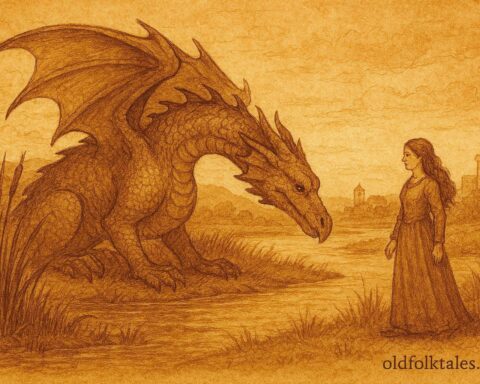
Peace, however, is often fragile. One fateful spring, a terrible calamity descended upon the village. From the distant mountains came a creature so fearsome that even the bravest villagers trembled at the sound of its approach. It was a seven-headed dragon, with scales that shimmered like molten bronze and eyes that glowed with fire. Each head breathed flames that could scorch entire fields in moments. Every night, the dragon would sweep down from its lair on the rocky cliffs, leaving charred earth, destroyed homes, and terrified villagers in its wake.
Discover the moral heart and wild spirit of the north through timeless Nordic storytelling
No ordinary weapons could harm it. Swords shattered against its scales, spears bent before its strength, and the bravest warriors of the village either fled or perished in their attempts to protect their homes. Soon, despair gripped the people, and whispers of doom spread through the town like wildfire. Some claimed the dragon had been sent by the gods as punishment; others spoke of an ancient curse awakened in the mountains.
Word of the dragon’s terror reached the royal court, where a young prince named Alexandru resided. Alexandru was known not only for his courage but also for his intelligence. Unlike many warriors, he did not rely solely on strength or brute force. He believed that cleverness and strategy, combined with bravery, could triumph over the most formidable enemies.
When Alexandru heard of the village’s plight, he vowed to confront the dragon and restore peace. Before leaving, he sought the counsel of a wise sage who lived in the edge of the forest, a man whose knowledge of magical creatures and enchanted artifacts was unmatched. The sage greeted him in a hut shrouded by ivy and moss, the air thick with the scent of herbs and smoke.
“You cannot defeat the dragon with mere strength,” the sage warned. “Its seven heads are cunning and fierce. Each has its own mind and will fight with intelligence as well as fury. To prevail, you will need more than valor, you will need strategy, patience, and magical aid.”
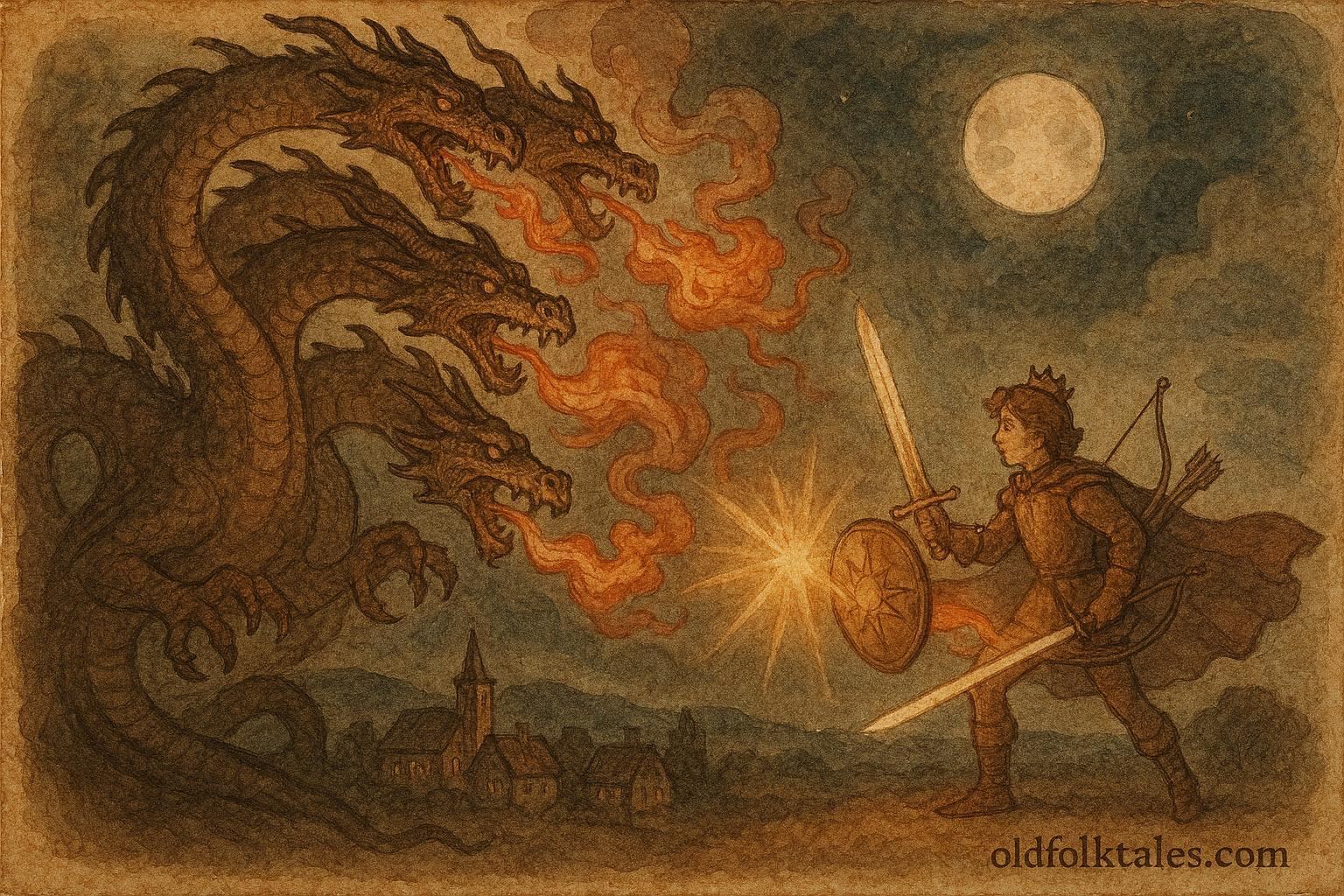
From beneath the folds of his cloak, the sage produced a set of enchanted weapons. He handed Alexandru a sword that glowed with a soft silver light, capable of striking with unerring precision. A shield of polished steel, imbued to repel fire and deflect even the sharpest claws, was placed in his hands. Lastly, the sage gave him a bow with enchanted arrows that never missed their mark.
“Use them wisely,” the sage said. “Bravery without thought can destroy you. Cleverness without courage will do nothing. But courage guided by wisdom, and wisdom tempered by bravery, can conquer even the impossible.”
Armed with these magical tools, Alexandru traveled to the village. The fields lay blackened in some areas, partially burned by the dragon’s fire. Smoke still drifted from the rooftops, and the villagers greeted the prince with a mix of awe and fear. They told him how each head of the dragon emerged at different times, guarding its treasure and terrorizing specific parts of the village. Some heads were fiery and ferocious, others sly and calculating, and all seemed almost aware of human tactics. Alexandru realized that charging blindly into battle would be suicide.
On the first night, Alexandru approached the dragon’s western head. Using the moonlight to conceal his movements, he dodged the fiery blasts, moving with patience and care. Each step required perfect timing, each breath measured to avoid detection. He waited for the dragon to exhale, then, with the glowing sword, struck the head cleanly. It let out a deafening roar before collapsing, the first victory in a long struggle.
The villagers watched in awe from the hilltops, marveling that a single young man could face such a beast. Some feared the battle was far from over. And they were right. The remaining six heads still terrorized the village.
The next nights became a careful sequence of planning and execution. Alexandru observed the dragon’s movements, noting how each head reacted to noise, light, and the approaches of humans. Using the bow and its enchanted arrows, he struck targets to lure specific heads into traps. For one particularly sly head, he dug a pit covered with branches and leaves. As the dragon lunged, it fell into the trap, unable to escape. Another head, aggressive and hot-tempered, was distracted with reflections from the silver shield, allowing Alexandru to strike a decisive blow.
Each battle tested his courage, intelligence, and stamina. Exhaustion weighed heavily on him, yet he persevered, knowing that the village’s safety depended not just on his skill but on his careful, strategic approach.
Finally, only one head remained: the seventh and most fearsome. It was larger, fiercer, and more cunning than any Alexandru had faced. Its eyes blazed like molten lava, its breath hotter than any previous attack, and its movements were almost human in intelligence. Alexandru remembered the sage’s words: “It is not strength alone that will conquer, but wisdom applied at the right moment.”
He studied the final head for hours, watching how it responded to the moonlight and the sounds of the forest. He realized that this head, unlike the others, could be disoriented by illusions and subtle distractions. Alexandru used his shield to reflect the moonlight directly into the dragon’s eyes and fired arrows in carefully measured sequences that created the illusion of movement across the battlefield. Confused and blinded by the reflections and sounds, the dragon lashed out in fury, but Alexandru stayed calm.
With perfect timing, he lunged forward with the glowing sword. The blade, imbued with the sage’s magic, struck true, severing the final head in one swift, clean stroke. A deafening roar shook the mountains before silence fell. The dragon’s reign of terror was over.
The villagers emerged from hiding, their joy uncontainable. They celebrated Alexandru not only for his bravery but also for his wisdom, patience, and cunning. He had shown them that true heroism is not simply measured by strength, but by intelligence, strategy, and courage in equal measure. Peace returned to the village, and the once-charred fields began to heal under the sun’s nurturing light.
In time, the story of Alexandru and the seven-headed dragon spread across Wallachia. Bards sang of his daring battles, mothers told their children of his clever strategies, and leaders learned that careful planning and courage were just as important as might. Alexandru, humble despite his fame, continued to serve his people, demonstrating that heroism is as much about protecting others wisely as it is about vanquishing evil.
Even the ruins of the dragon’s lair were eventually cleared, and flowers and trees began to grow once more. The villagers built small shrines in memory of the victory, honoring the balance of bravery and cleverness that had saved them. And so, the legend endured through generations, a reminder that courage guided by intelligence can overcome even the most monstrous challenges.
Discover the spiritual depth and wisdom hidden in the ancient folklore of Eastern and Balkan Europe
Moral Lesson
The Prince and the Seven-Headed Dragon teaches that true courage must be paired with strategy and intelligence. Perseverance, cleverness, and bravery together can overcome even the most overwhelming challenges, proving that the triumph of good over evil requires both wit and valor.
Knowledge Check
1. Who is the hero of the story?
Prince Alexandru, a young, brave, and clever Wallachian prince.
2. How does Alexandru defeat the dragon’s seven heads?
Through observation, strategy, traps, and the use of magical weapons gifted by a sage.
3. What magical weapons help the prince?
A glowing sword, a fire-repelling shield, and a perfect-aim bow with enchanted arrows.
4. What makes the seventh head especially dangerous?
It is the largest, fiercest, and most intelligent, requiring careful strategy to defeat.
5. What central themes are explored in this Romanian folktale?
Bravery, strategy, perseverance, the clever use of magical tools, and the triumph of good over evil.
6. Where and when was this folktale collected?
From Wallachia, Romania, collected by Petre Ispirescu in Legende sau basmele românilor, 1882.
Source: Collected in Legende sau basmele românilor by Petre Ispirescu, 1882
Cultural Origin: Romanian folklore, Wallachia, 19th century