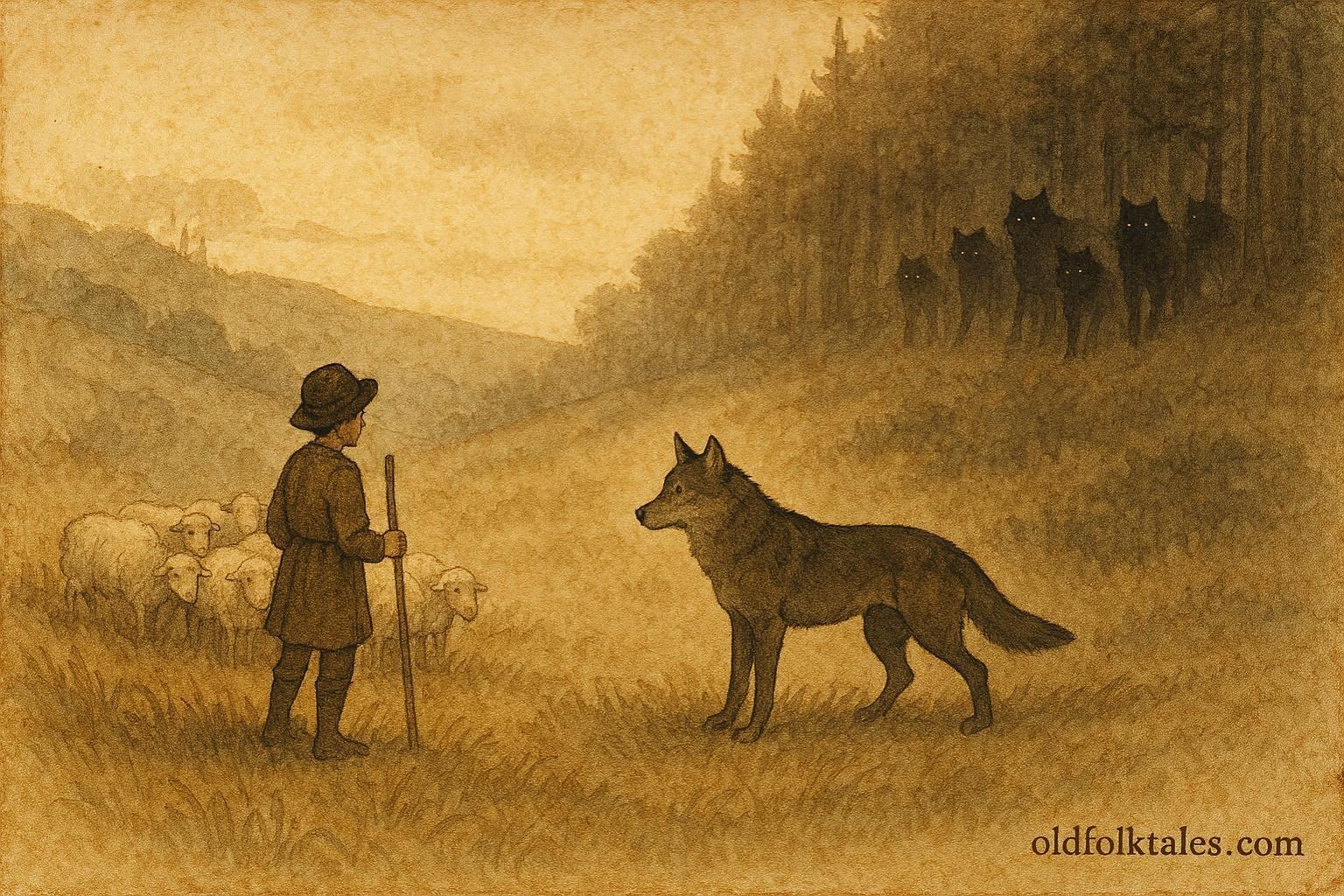
In the rolling highlands of rural Serbia, where the wind moved softly through tall grasses and sheep bells echoed across valleys, there lived a humble shepherd and his young son. Their home stood at the edge of a small village, where the land stretched wide and untamed, bordered by forests that villagers spoke of in hushed tones.
Those forests were known not only for their beauty, but for the wolves that lived within them.
The shepherd, a quiet and weathered man, had spent his entire life tending sheep. He knew the rhythms of the land, the moods of the sky, and the dangers that lurked beyond the safety of the pasture. Among those dangers, none was more feared than the wolf.
“Remember this,” he would often tell his son as they guided their flock across the hills. “A wolf is not your friend. It watches, it waits, and when it comes, it takes without mercy.”
The boy listened, as all children do, but unlike others, he did not feel fear take root in his heart. Instead, he felt something else, curiosity.
Each day, he walked beside his father, learning the duties of a shepherd: how to guide the sheep, how to read their restlessness, how to listen to the wind. But his eyes often wandered beyond the flock, toward the shadowed edges of the forest.
It was there, one quiet afternoon, that he first saw the wolf.
The boy had strayed a little from the flock, following the gentle slope of a hill. The air was still, the sheep calm, and the distant forest seemed almost inviting. Then, from between the trees, a figure emerged.
A wolf.
It stood at a distance, its grey coat blending with the shadows, its eyes fixed on the boy. For a moment, time seemed to pause. The boy remembered his father’s warnings, the stories whispered in the village, tales of lost sheep, of silent nights broken by distant howls.
Yet, as he looked at the creature before him, he saw no immediate threat. The wolf did not lunge or growl. It simply watched.
The boy did something no one in the village would have dared.
He did not run.
Instead, he stood still, his heart steady, his gaze unwavering. Slowly, cautiously, he took a step back—not in panic, but in quiet acknowledgment. The wolf tilted its head slightly, as though studying him in return.
Then, just as silently as it had appeared, it turned and disappeared into the forest.
That night, the boy said nothing of what he had seen.
Days passed, and then weeks. The boy returned often to that same place, drawn by something he could not fully explain. And each time, the wolf appeared again.
At first, always at a distance.
Then, a little closer.
An unspoken understanding began to grow between them. The boy never approached too quickly, and the wolf never showed aggression. There were no sudden movements, no reckless gestures, only patience.
One day, the boy brought a small piece of bread from home. He placed it on the ground and stepped back. The wolf approached slowly, sniffed the offering, and took it.
From that moment, the bond between them deepened.
Seasons began to shift. The golden warmth of late summer faded into the cool breath of autumn. Leaves turned and fell, and the hills grew quieter. Still, the boy and the wolf met.
The boy would sit upon a rock, watching the sheep graze, while the wolf lingered at the edge of the clearing. Sometimes, they would simply exist in silence, sharing the same space without fear.
The boy began to see the wolf not as a creature of danger, but as a living being—alert, cautious, and bound to the same land as he was.
But in the village, the stories remained unchanged.
One evening, as the sun dipped low and the shepherds returned with their flocks, тревожные whispers spread among the villagers. A sheep had gone missing from a nearby pasture. Tracks had been found, wolf tracks.
Fear took hold quickly.
“We cannot ignore this,” said one of the elders. “The wolves grow bold.”
“They will come closer,” another added. “Next, it will not be sheep.”
The boy listened as the voices rose, each one adding weight to the growing fear. He felt a knot form within him, a quiet conflict he could not yet voice.
He knew the wolf.
And yet, he could not deny what the others believed.
That night, his father spoke more firmly than ever before.
“If you see a wolf,” he said, “you must stay away. Do not trust it. These creatures do not change.”
The boy lowered his gaze, but said nothing.
The following days were tense. The shepherds stayed closer together, their eyes scanning the hills, their movements cautious. The dogs barked more often, sensing the unease in their masters.
And still, the boy went to the clearing.
When the wolf appeared, something was different.
It seemed restless, its movements sharper, its attention divided. The boy noticed this immediately. He remained still, watching, waiting.
Then, in the distance, he heard something.
A sound not of the wind, nor of the sheep.
A low, unfamiliar growl.
The wolf’s ears lifted. Its body stiffened. It turned its head toward the forest, then back to the boy.
For the first time, the boy felt fear.
But it was not fear of the wolf before him.
It was fear of something else.
From the trees, shadows began to move, more wolves.
A pack.
The boy’s breath caught in his throat. This was no longer the quiet, solitary creature he had come to know. This was the force the villagers had always feared.
The flock began to stir, sensing the danger. Sheep clustered together, their unease spreading like a ripple across the field.
The boy stood frozen.
The lone wolf stepped forward, placing itself between the boy and the approaching pack.
A low growl escaped its throat, not directed at the boy, but at its own kind.
The pack hesitated.
The moment stretched, heavy with tension.
The boy understood then.
The wolf was not there to harm him.
It was there to protect him.
The pack pressed forward, testing the boundary. The lone wolf stood its ground, unwavering. Its body was tense, its eyes sharp, its presence firm.
The boy knew he could not stay.
Slowly, carefully, he began to move backward, keeping his eyes on the scene before him. Step by step, he retreated toward the flock, then beyond it, toward the path that led home.
Behind him, the tension broke.
The sounds of snarls and movement filled the air, but the boy did not turn back. He ran.
He ran until he reached the village, his breath ragged, his heart pounding.
“The wolves!” he cried. “A pack, they are near the pasture!”
The villagers sprang into action. Men gathered tools, staffs, and torches. The shepherds called their dogs. Fear had become urgency.
They moved together toward the hills.
When they arrived, the scene had changed.
The pack was gone.
The sheep, though shaken, remained unharmed.
And at the edge of the clearing, the lone wolf stood.
For a moment, no one moved.
The villagers raised their weapons, their instincts guiding them.
But the boy stepped forward.
“No,” he said, his voice steady despite the weight of the moment. “It did not harm us.”
The villagers hesitated.
The shepherd looked at his son, confusion and concern crossing his face.
The boy spoke again, this time with quiet conviction.
“It stood against the others. It kept them away.”
Murmurs spread through the group. Doubt lingered, but so did something else,uncertainty.
The wolf, as if understanding the shift, slowly turned and began to walk back toward the forest.
It did not run.
It did not look back.
It simply left.
The villagers lowered their weapons, one by one.
In the days that followed, no more sheep went missing. The tension that had gripped the village began to ease, replaced by something unfamiliar.
Reflection.
The boy’s story spread, carried from one home to another. Some believed it fully. Others held onto their doubts. But none could ignore what had happened.
The shepherd, too, found himself reconsidering the lessons he had long held as truth.
One evening, as he and his son stood watching the flock beneath a quiet sky, he spoke softly.
“Perhaps,” he said, “there is more to the world than what we fear.”
The boy smiled, his gaze drifting once more toward the distant forest.
He never saw the wolf again.
But he never forgot it.
Moral Lesson
True understanding begins where fear ends. When we look beyond prejudice and approach the unknown with patience and respect, we may discover unexpected allies and deeper harmony with the world around us.
Knowledge Check
1. What is the main theme of “The Wolf and the Shepherd’s Son”?
The story emphasizes compassion over fear and the importance of breaking prejudice through understanding.
2. Why did the villagers fear the wolf?
The villagers feared wolves due to their history of attacking livestock and longstanding cultural beliefs about their danger.
3. How did the boy’s actions differ from the other villagers?
Instead of fearing or attacking the wolf, the boy approached it with patience and curiosity, building trust over time.
4. What role did the wolf play when the pack approached?
The wolf protected the boy and the flock by standing against the approaching pack.
5. What does the wolf symbolize in the story?
The wolf represents the misunderstood unknown and challenges assumptions rooted in fear.
6. What lesson did the village learn from this event?
They learned that not all fears are justified and that understanding can lead to unexpected trust and coexistence.
Source: Serbian oral tradition documented in folklore studies, mid-19th century documentation
Cultural Origin: Serbian (pastoral folklore tradition)