In a small village surrounded by the deep, whispering forests of Belarus, there lived a quiet girl who was known more for her silence than for her words. The village itself rested gently between fields and woodland, where the seasons painted the land in soft greens, golden ambers, and silent whites. Life there followed a steady rhythm, tilling the soil, gathering firewood, tending animals, and listening, always listening, to the sounds of the forest.
But while others heard only rustling leaves and birdsong, the girl listened more closely.
She lived with her mother in a modest wooden cottage at the edge of the village, where the forest seemed to begin just beyond their door. Unlike the other children, who played loudly in the open fields, she preferred to wander quietly beneath the tall trees, where light filtered softly through the branches and the air carried the delicate calls of birds.
The villagers often wondered about her.
“She is too quiet,” some would say.
“She listens too much,” others whispered.
But the girl was not troubled by their words. She found comfort in stillness, in watching the way the world moved when no one tried to control it.
One day, as the sun hung gently in the sky and the forest seemed especially alive with sound, the girl wandered farther than she ever had before. The trees grew thicker, their trunks taller, and the path beneath her feet faded into soft earth and fallen leaves.
It was there, in a small clearing, that something unusual happened.
A bird lay on the ground before her.
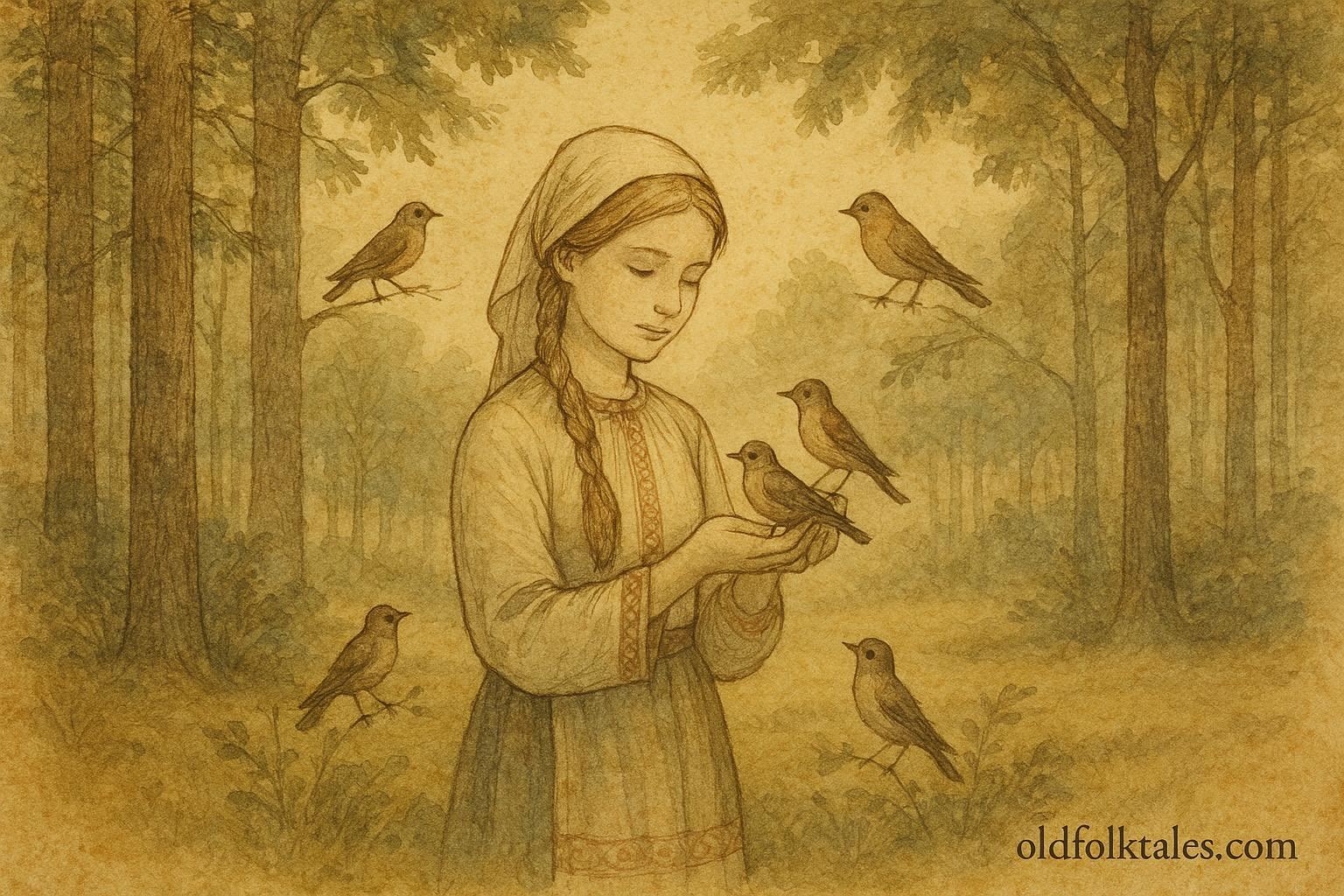
Its wings were spread unevenly, and its small body trembled as though caught between strength and weakness. The girl approached slowly, her steps careful, her breath steady. She knelt beside the creature, her eyes filled not with fear, but with concern.
Without hesitation, she reached out and gently lifted the bird.
Its feathers were warm but fragile, its heartbeat faint but present. The girl cradled it in her hands, speaking softly, not in words meant to be understood, but in a tone of calm and care.
She stayed with it there, in that quiet clearing, until the bird gathered enough strength to stir.
When it finally opened its eyes, something changed.
The forest seemed to fall into a deeper silence, as though holding its breath.
Then, the bird spoke.
Not in chirps or songs, but in words the girl could understand.
“Kind one,” it said softly, “you have shown care without fear. For this, you will hear what others cannot.”
The girl did not react with shock. She simply listened.
“The voices of the sky and the trees will be known to you,” the bird continued. “But remember, such a gift is not meant for all ears. It must be held with care, or it will fade.”
With that, the bird lifted itself from her hands, its wings beating gently as it rose into the air and disappeared into the canopy above.
The girl remained still for a moment, absorbing what had just occurred. Then, slowly, she returned home.
At first, nothing seemed different.
But the next morning, as she stepped outside, she heard it.
The birds were speaking.
Perched on branches, circling above rooftops, resting along fences, they spoke to one another in clear, unmistakable words. They spoke of the wind, of the forest, of distant places and unseen dangers.
The girl stood quietly, her heart steady, her mind open.
She did not rush to tell anyone.
Instead, she listened.
Days passed, and the girl began to understand the weight of what she had been given. The birds did not speak idly. Their voices carried knowledge, of storms gathering beyond the hills, of animals moving restlessly through the woods, of subtle changes in the world that no human eye could easily see.
One afternoon, as she sat near the edge of the forest, she heard a group of birds speaking urgently.
“The waters will rise,” one said.
“The river will not stay within its banks,” said another.
“It will come before the next moon,” a third warned.
The girl felt a quiet urgency settle within her. She rose and returned to the village, her steps calm but purposeful.
She approached the elders and spoke gently.
“The river will flood,” she said. “We must prepare.”
The villagers looked at her with confusion.
“How do you know this?” one asked.
The girl paused.
“I have been listening,” she replied simply.
Some dismissed her words. Others, remembering her quiet nature and careful observation, chose to consider them.
The elders, uncertain but cautious, decided to act.
They reinforced the riverbanks, moved supplies to higher ground, and warned the villagers to remain alert.
Days later, just as the birds had said, the river swelled.
Rain fell heavily, and the waters rose beyond their usual limits. But the village was ready. What could have been destruction became only a test of preparation.
From that day on, the villagers began to watch the girl more closely.
Not with suspicion at first, but with curiosity.
And then, with expectation.
Soon after, another warning came, this time of a harsh winter arriving earlier than usual. Again, the girl spoke. Again, the village prepared. And again, the warning proved true.
Gratitude grew among the people.
But so did something else.
Desire.
“How does she know these things?” they began to ask.
“There must be a secret,” others said.
The girl remained as she always had been, quiet, careful, and restrained. She never explained more than she needed to. She never revealed the source of her knowledge.
But the more she helped, the more the villagers wanted to know.
One evening, a group gathered near her home.
“You must tell us,” one insisted. “This knowledge belongs to all.”
“It is not right to keep such things hidden,” another added.
The girl listened, her expression calm.
“It is not mine to give freely,” she said.
Her words, though gentle, did not satisfy them.
Days turned into weeks, and the pressure grew.
Some villagers approached her kindly, hoping to persuade her. Others grew impatient, their curiosity turning into frustration.
“Are we not your people?” one demanded.
“Do you not trust us?” asked another.
The girl felt the weight of their voices, the pull of their expectations. But she remembered the bird’s warning.
Such a gift must be held with care.
One night, unable to rest, she stepped outside and looked toward the trees. The birds were there, as always, watching, listening.
“They want to know,” she said softly.
A small bird fluttered down beside her.
“Not all who ask are ready to hear,” it replied.
The girl closed her eyes for a moment.
“I do not wish to lose this,” she said.
“Then do not give it where it is not understood,” the bird answered.
But the village did not relent.
At last, worn down by their insistence, the girl made a choice.
She would speak.
The following day, she gathered the villagers and stood before them.
“You wish to know how I hear what I hear,” she began.
They leaned in, their attention fixed upon her.
She hesitated.
In that moment, the forest grew quiet.
The birds fell silent.
Still, the girl spoke.
She told them of the bird she had helped, of the gift she had been given, of the voices she had come to understand.
For a moment, there was silence.
Then, murmurs.
Some were amazed. Others skeptical. A few laughed, unable to believe what they had heard.
But as the voices rose, the girl felt something shift.
The sounds around her began to fade.
She turned her head slightly, listening.
The birds were still there, but their voices were no longer clear.
Only chirps.
Only distant songs.
The meaning was gone.
The girl stood very still.
She understood what had happened.
The gift had faded.
Days passed, and the girl no longer brought warnings. The village, once guided by her quiet knowledge, returned to its old ways, watching the skies, reading the land, relying only on what could be seen and heard.
Some regretted what had been lost.
Others dismissed it as imagination.
But the girl remained unchanged in one way.
She still walked the forest paths. She still listened.
Even if she could no longer understand, she respected the voices she once knew.
And in time, the villagers, too, came to understand something deeper.
Not all gifts are meant to be shared without care.
And not all truths grow stronger when exposed.
Moral Lesson
True gifts require respect, restraint, and trust. When something rare is forced into the open without understanding, it may be lost forever.
Knowledge Check
1. What gift did the girl receive in the Belarusian folktale?
She gained the ability to understand and interpret the language of birds after helping an injured one.
2. How did the girl use her ability to help the village?
She listened to the birds’ warnings and alerted the villagers about disasters like floods and harsh winters.
3. Why did the villagers become suspicious of the girl?
They grew curious and demanded to know the source of her knowledge as her predictions repeatedly proved true.
4. What caused the girl to lose her gift?
She revealed the secret of her ability under pressure, breaking the condition that it be kept with care.
5. What do the birds symbolize in this folktale?
They represent nature’s wisdom and hidden knowledge available only to those who listen with respect.
6. What is the central lesson of the story?
The story teaches that rare gifts must be protected and not forced into public understanding without care.
Source: Collected by Pavel Shein, Belarusian Folk Narratives (1896)
Cultural Origin: Belarusian woodland folklore and oral storytelling