In the fertile countryside of rural Poland, where fields stretched far beyond the horizon and the rhythm of life followed the turning of the seasons, there lived a poor peasant whose only wealth was his small plot of land.
It was not much, just a modest field bordered by low wooden fences and a narrow path that led back to his humble cottage. The soil was good, but the seasons were uncertain, and the work was hard. Each year, the peasant labored from dawn until dusk, hoping that the harvest would be enough to sustain him through the long winters.
Yet despite his efforts, he remained poor.
Still, he was not without one advantage.
He was clever.
Not the kind of cleverness that comes from books or learning, but the quiet, watchful intelligence of a man who has lived close to the land, who understands its patterns, and who knows how to make the most of what little he has.
One autumn evening, as the peasant stood in his field, looking over the remnants of a modest harvest, he sighed deeply.
“If only I had a little more,” he murmured to himself. “Just enough to ease the burden.”
The air around him grew still.
Then, from the edge of the field, a figure appeared.
It was not a man of the village, nor any traveler he had seen before. The stranger’s presence was unsettling, though his smile was calm and deliberate.
“I hear your troubles,” the figure said.
The peasant did not startle. He simply turned and looked at him carefully.
“I have many,” the peasant replied. “Which one do you speak of?”
The stranger’s smile widened slightly.
“The one that keeps you here, working without reward.”
The peasant studied him for a moment longer. There was something in the man’s eyes, something too sharp, too knowing.
“You are not from here,” the peasant said.
“No,” the figure replied. “But I have come to make you an offer.”
The peasant crossed his arms.
“An offer?”
“Yes,” the stranger said. “We shall make a bargain over your field. I will help ensure a great harvest, greater than any you have known. In return, we will divide the yield between us.”
The peasant’s gaze did not waver.
“And how shall it be divided?”
The stranger gestured toward the ground.
“This year,” he said, “I will take what grows above the ground, and you may keep what grows beneath it.”
The peasant was silent for a moment.
Then, slowly, he nodded.
“Agreed.”
The bargain was made.
As the stranger turned to leave, the peasant spoke again.
“What shall I plant?”
The figure paused, a faint smile returning.
“That is for you to decide,” he said, before disappearing into the fading light.
The peasant stood alone once more.
Then, he smiled.
When spring came, he planted his field—not with grain, as he had often done, but with root crops.
Potatoes.
Carrots.
Turnips.
All that grew beneath the soil.
The months passed, and the field flourished. Green leaves spread across the earth, promising a rich harvest.
At last, the time came to gather the crops.
The stranger returned.
He walked through the field, his expression confident as he looked upon the abundance above ground.
“You have done well,” he said.
“Yes,” the peasant replied calmly.
“Then I will take my share,” the stranger continued, reaching for the leafy tops.
He gathered them, pulling them free with satisfaction.
But as he did, the truth became clear.
The value of the crop lay not in the leaves, but in what was buried beneath.
The peasant, meanwhile, dug into the soil, revealing the true harvest.
The stranger’s expression darkened.
“You have tricked me,” he said.
The peasant shrugged lightly.
“We agreed,” he replied. “You would take what grows above.”
The stranger narrowed his eyes.
“Very well,” he said after a moment. “We will try again.”
The peasant nodded.
“What are your terms?”
“This time,” the stranger said, his voice more measured, “I will take what grows beneath the ground. You may keep what grows above.”
The peasant considered this.
Then, once again, he agreed.
Spring returned.
And this time, the peasant planted wheat.
Barley.
Grain that rose tall above the soil, golden and full.
When harvest came, the field shimmered beneath the sun, the crops heavy and ripe.
The stranger appeared once more, his confidence restored.
“You have planted well,” he said.
“Yes,” the peasant replied.
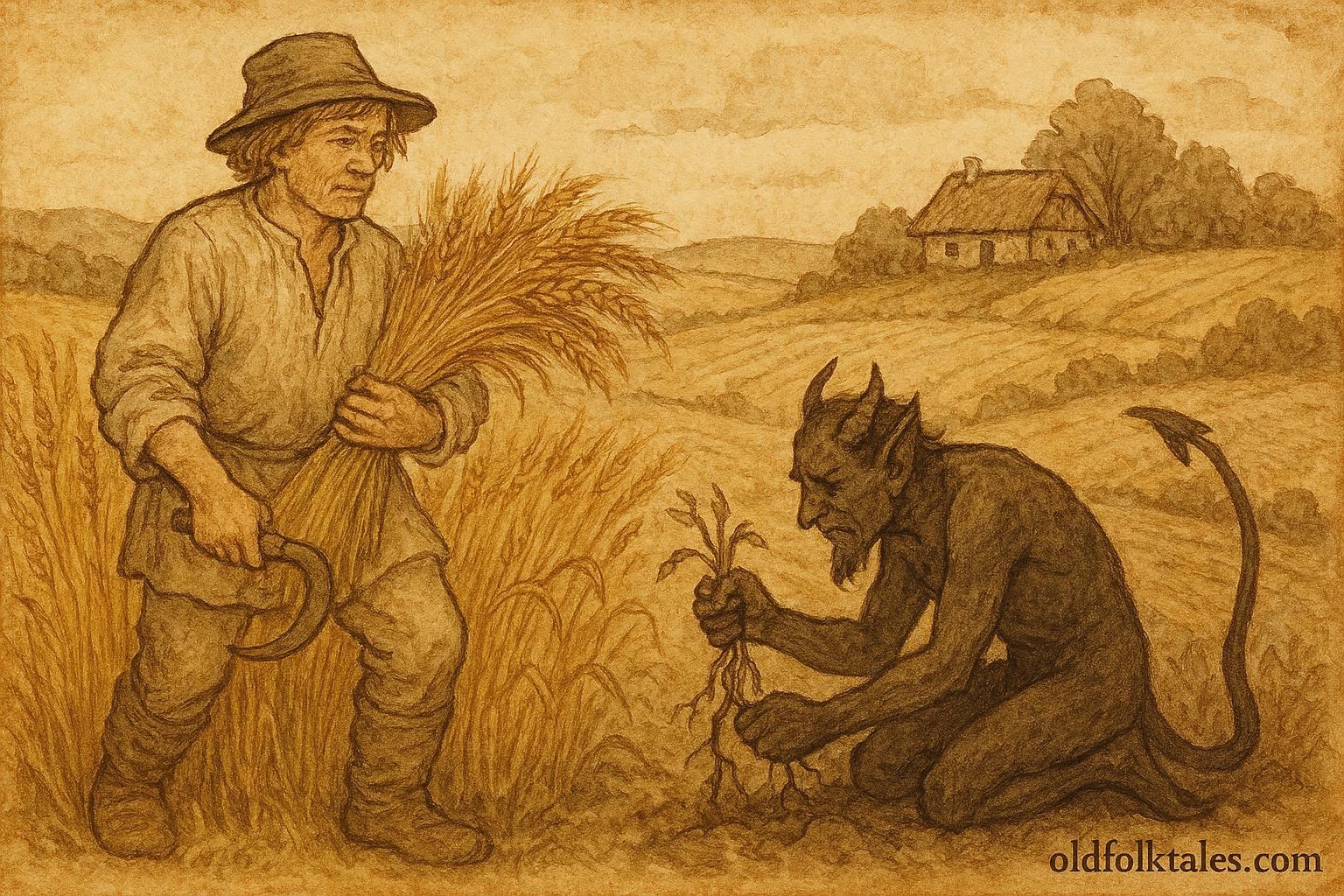
The stranger knelt, reaching eagerly into the earth to claim his share.
He pulled up roots.
Dry, worthless roots.
Meanwhile, the peasant cut the tall stalks above, gathering the true wealth of the field.
The stranger stood slowly, his frustration now unmistakable.
“You have done it again.”
The peasant met his gaze without fear.
“We agreed,” he said simply.
For a long moment, the stranger said nothing.
Then, at last, he let out a quiet breath.
“You are a clever man,” he admitted.
“And you,” the peasant replied, “should choose your bargains more carefully.”
The stranger gave a faint, reluctant smile.
“Perhaps I should.”
With that, he turned and left the field.
This time, he did not return.
The peasant stood among his harvest, the golden grain swaying gently in the breeze. For the first time in many years, he knew that the coming winter would not bring hardship.
And though he remained a simple man with a small plot of land, he had proven something greater than wealth.
That wit, when used wisely, can stand even against the most powerful forces.
Step into the enchanted forests and mystical realms of the Slavic imagination
Moral Lesson
Intelligence and careful thinking can overcome even the greatest challenges. True strength lies not in power, but in the ability to use wisdom and strategy.
Knowledge Check
1. What kind of bargain did the peasant make with the devil?
He agreed to divide the harvest based on what grew above or below the ground.
2. How did the peasant outsmart the devil the first time?
He planted root crops, keeping the valuable underground produce while the devil took the useless tops.
3. What happened in the second agreement?
The devil chose what grew beneath the ground, but the peasant planted grain, keeping the valuable part above.
4. What does the devil represent in the story?
He symbolizes power and temptation that can be overcome through intelligence.
5. What is the central theme of the folktale?
The story highlights intelligence over power and survival through clever thinking.
6. Why does the devil fail in both bargains?
He underestimates the peasant’s understanding of agriculture and strategy.
Source: Included in Klechdy domowe by Lucjan Siemieński (1845)
Cultural Origin: Rural Poland (widespread variants)