In a wide stretch of the Russian countryside, where fields lay open beneath vast skies and villages stood humble yet enduring, there lived a poor peasant and his young daughter. Their home was small, their means were few, but within that modest household lived a mind as sharp as any in the land.
The girl was known among neighbors for her quiet attentiveness. She did not speak often, but when she did, her words carried thought and precision. While others saw only her youth and simple clothing, those who listened closely recognized something far greater.
Explore the warmth and wit of Mediterranean storytelling, where love and wisdom intertwine
Her father, however, was a simple man.
He worked hard in the fields, rising before dawn and returning long after the sun had set. Though honest and diligent, he was not a man of quick wit. He trusted easily, spoke plainly, and often found himself at a disadvantage when faced with cunning or authority.
One day, a dispute arose that would change their lives.
The peasant had come into possession of a young horse, how it had come to him was a matter of argument, for another man claimed it as his own. The two brought their case before the Tsar, ruler of the land, whose word was final in all such matters.
The Tsar, known for testing not only truth but intelligence, listened carefully to both sides. Instead of deciding immediately, he chose to set a challenge.
“You shall return in three days,” he said, “and bring me answers to my riddles. He who answers correctly shall be judged in the right.”
The peasant’s heart sank.
Riddles were not his strength.
But he had no choice.
That evening, he returned home, troubled and uncertain. His daughter noticed the weight upon his shoulders and asked what had happened.
The peasant sighed deeply and told her everything, the dispute, the Tsar’s command, and the riddles he had been given.
The girl listened quietly.
“Tell me the riddles,” she said.
The peasant did so, repeating them as best he could.
“What is the strongest and fastest thing in the world?” he recited.
“What is the fattest thing in the world?”
“And what is the softest?”
He shook his head.
“I do not know how to answer such things,” he admitted. “We will lose.”
But the girl only smiled faintly.
“The strongest and fastest thing,” she said, “is the wind. Nothing can outrun it.”
Her father blinked.
“The fattest thing,” she continued, “is the earth itself. It feeds all and holds everything.”
He nodded slowly.
“And the softest thing,” she said at last, “is a human hand, for though it may seem firm, it can comfort, create, and soothe.”
The peasant stared at her in amazement.
“Are you certain?” he asked.
“I am,” she replied calmly.
The next day, he stood once more before the Tsar and gave the answers exactly as his daughter had said.
The Tsar listened.
Then, he nodded.
“These are good answers,” he said. “But tell me, did you think of them yourself?”
The peasant hesitated.
He was not a man skilled in deception.
“My daughter helped me,” he admitted.
A murmur passed through the court.
The Tsar leaned forward slightly, his interest piqued.
“Then bring your daughter to me,” he said. “For I would see this clever mind for myself.”
When the girl arrived at the palace, she did not appear frightened. She walked with quiet confidence, her gaze steady, her presence composed.
The Tsar observed her carefully.
“I am told you are wise,” he said. “Let us see if this is true.”
He paused, then spoke again.
“You shall come to me tomorrow,” he said, “but not on foot, and not on horseback. Not naked, and not clothed. Not alone, and not accompanied. If you can do this, I will believe in your wisdom.”
The court fell silent.
The conditions seemed impossible.
But the girl simply inclined her head.
“I will come,” she said.
The following day, the Tsar and his court gathered, waiting to see what would happen.
Then, at last, the girl appeared.
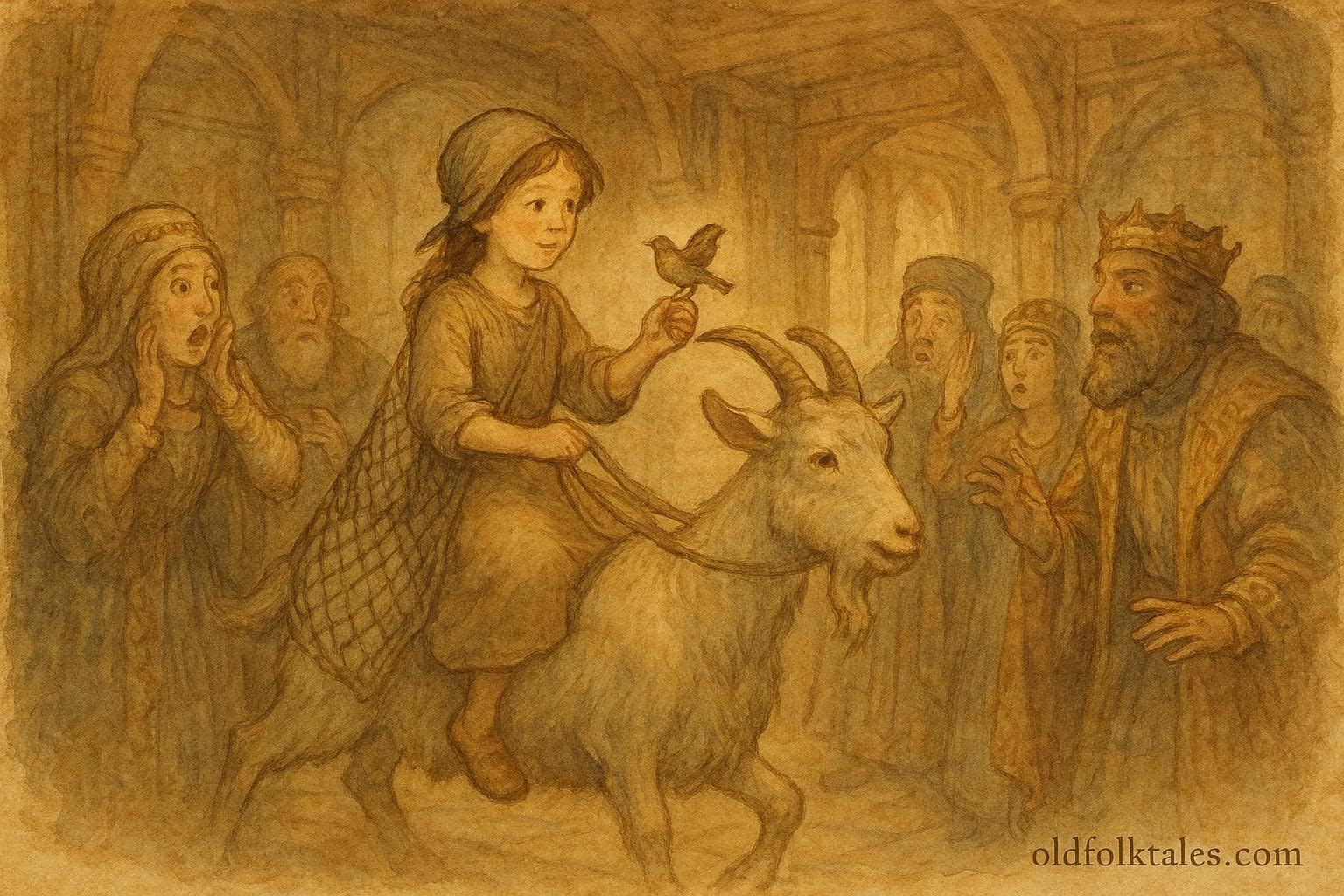
She came riding on a small goat, not quite a horse, yet not on foot. She wore a fishing net, neither fully clothed nor naked. And beside her, she carried a small bird in her arms.
As she entered the court, she released the bird, letting it fly ahead of her.
Thus, she came neither alone nor truly accompanied.
The court erupted in astonished murmurs.
The Tsar, though impressed, maintained his composure.
“You have answered well,” he said. “You have fulfilled my conditions.”
From that day, the girl’s reputation spread far beyond her village. Her wisdom became known, and even the Tsar himself held her in high regard.
In time, she was brought closer to the court, her counsel valued for its clarity and fairness.
Yet the Tsar, though impressed, was not without caution.
“One must not rely too much on cleverness,” he said to her one day. “There are limits to all things.”
The girl listened, but said nothing.
Soon after, a new situation arose.
A dispute was brought before the Tsar, one that seemed difficult to judge. The girl, hearing of it, quietly offered her advice, ensuring that justice was done.
But when the Tsar learned that she had intervened without being asked, he grew stern.
“I told you,” he said, “that there must be limits.”
As a result, he set a final condition.
“You must return to your father’s home,” he said, “and you may take with you only one thing that you value most from here.”
The court watched closely.
The condition seemed simple, but its meaning was not.
The girl bowed her head.
“As you command,” she said.
That evening, she prepared to leave.
Before departing, she offered the Tsar a drink, as was customary. He accepted, unaware of her intention.
The drink was strong, and soon, the Tsar fell into a deep sleep.
Carefully, respectfully, the girl arranged for him to be carried with her back to her father’s home.
When the Tsar awoke, he found himself in a place far removed from his palace.
He sat up, confusion giving way to realization.
The girl stood nearby.
“You said I could take what I valued most,” she said gently.
“And that is you.”
For a long moment, the Tsar said nothing.
Then, slowly, a smile formed.
He could not deny her reasoning.
“You have proven your wisdom once again,” he said.
From that day on, he placed his trust in her more fully, not as a curiosity, but as someone whose intelligence could guide and support just rule.
And the girl, though still humble in her ways, became known as one whose mind could not be easily matched.
Discover Polish, Russian, Ukrainian, and Belarusian folktales where magic and morality meet
Moral Lesson
True wisdom does not depend on status or wealth. Intelligence, when guided by fairness and courage, can overcome even the greatest challenges and bring justice where it is needed most.
Knowledge Check
1. What challenge did the Tsar first give the peasant?
He asked him to solve three riddles to determine the outcome of a dispute.
2. Who actually solved the riddles?
The peasant’s daughter provided the correct answers.
3. How did the girl meet the Tsar’s unusual conditions?
She rode a goat, wore a net, and carried a bird, fulfilling all conditions cleverly.
4. Why was the girl later sent back home?
She gave advice without being asked, going against the Tsar’s instructions.
5. How did she prove her wisdom one final time?
She brought the Tsar himself with her, as he was what she valued most.
6. What is the central theme of the story?
The story emphasizes intelligence over status and the importance of justice.
Source: Russian folk tale recorded in Alexander Afanasyev’s collections (1850s)
Cultural Origin: Russian peasant tradition