In a quiet Norwegian village, where wooden cottages stood against the backdrop of forests and mountains, there lived a poor farmer with his three sons.
The two elder sons were strong, confident, and certain of their place in the world. They carried themselves with pride, spoke loudly of their ambitions, and believed that success would naturally follow their strength.
Discover the spiritual depth and wisdom hidden in the ancient folklore of Eastern and Balkan Europe
The youngest son, however, was different.
He was called the Ash Lad.
Not because it was his name, but because of where he was most often found, sitting near the hearth, tending the fire, his clothes marked with ash. While his brothers trained, worked, and boasted of their abilities, he remained quiet, watching, listening, and thinking.
To many, he seemed lazy.
To his brothers, he seemed useless.
But the Ash Lad never argued.
He simply waited.
One day, word spread across the land of a great opportunity.
The king had declared that whoever could complete a series of difficult tasks would win the hand of the princess. Many had already tried and failed, for the tasks were said to be nearly impossible.
The elder brothers were quick to act.
“This is our chance,” they said. “We will go to the king’s court and prove ourselves.”
They prepared carefully, dressing in their finest clothes, choosing what they believed would help them succeed.
The Ash Lad listened.
“I will go as well,” he said.
His brothers laughed.
“You?” they said. “You will not make it past the gates.”
But he did not respond.
At last, perhaps out of amusement, they allowed him to follow.
And so, the three brothers set out together.
The road to the king’s court was long, winding through forests and across fields. Along the way, they came across small, seemingly insignificant things, a broken object, a piece of discarded material, something others might ignore.
Each time, the Ash Lad paused.
He picked these things up, examining them carefully before placing them in his bag.
“What are you doing?” his brothers asked.
“These are worthless,” one said.
“You carry rubbish,” said the other.
The Ash Lad only smiled slightly.
“You never know what might be useful,” he replied.
They shook their heads and walked on.
When they arrived at the court, they found many others gathered there, men who had come from distant places, each hoping to succeed where others had failed.
The tasks were explained.
They required not only strength, but thought, creativity, and patience.
The elder brothers stepped forward first.
They approached each task with confidence, but also with haste. They acted quickly, relying on what they believed they already knew.
But one by one, they failed.
Their strength was not enough.
Their confidence did not carry them through.
The Ash Lad waited.
He did not rush forward.
He watched.
He listened.
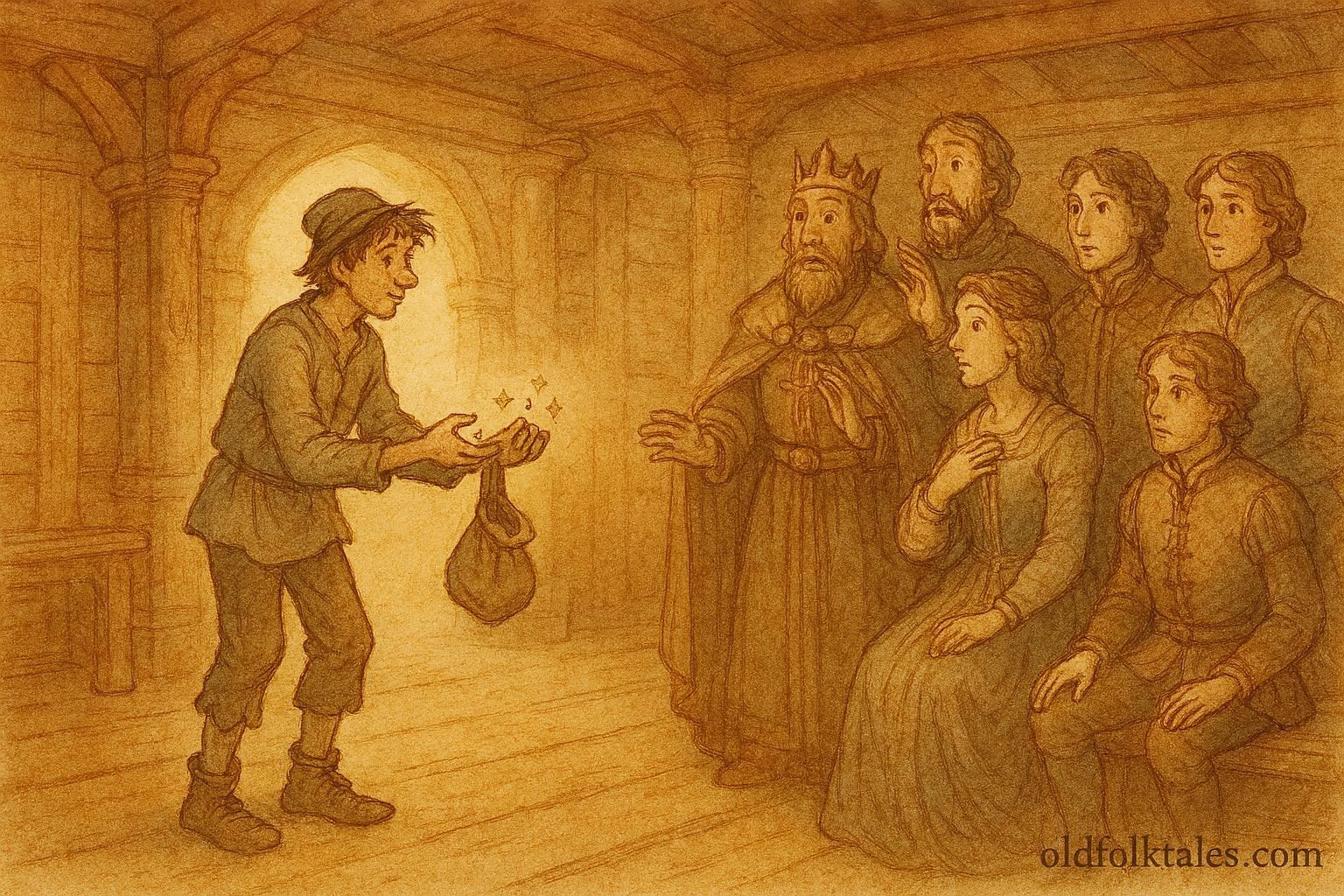
When his turn came, he stepped forward quietly, his bag of small, collected items at his side.
The first task seemed simple, yet it was not.
It required something that was not immediately obvious, something the others had overlooked.
The Ash Lad reached into his bag and took out one of the items he had gathered along the road.
He used it in a way that no one had expected.
And he succeeded.
A murmur passed through the court.
The second task was more difficult.
Again, the Ash Lad did not rely on strength alone.
He thought carefully.
He chose wisely.
And once more, he reached into his bag.
What others had dismissed as useless became the very thing that allowed him to complete the task.
The court grew quiet.
The king watched closely now.
The elder brothers stood at the side, their expressions shifting from amusement to disbelief.
The final task was the most difficult of all.
It required not only cleverness, but courage.
For a moment, the Ash Lad stood still.
Then he moved forward.
He used what he had learned.
He used what he had gathered.
And he completed the task.
When it was done, silence filled the hall.
Then, slowly, it gave way to recognition.
The king stood.
“You have done what others could not,” he said.
The Ash Lad bowed his head.
“I did what I could,” he replied.
There was no pride in his voice.
No boasting.
Only quiet truth.
The princess, who had watched everything, stepped forward.
She had seen many come and fail.
But she had also seen something different in him, not just success, but the way he had achieved it.
With thought.
With patience.
With humility.
And so, the promise was fulfilled.
The Ash Lad, once dismissed and overlooked, stood as the one who had succeeded.
His brothers, who had once laughed at him, now stood silent.
For they had seen what they had not understood before.
That true strength is not always visible.
That cleverness, kindness, and the willingness to see value where others do not can lead to success beyond expectation.
In time, the Ash Lad’s story spread across the land.
Not as a tale of sudden fortune, but as a reminder.
That those who are underestimated may carry the greatest potential of all.
And that sometimes, the smallest things, when seen with the right mind, can make all the difference.
Moral Lesson
True success comes from intelligence, patience, and humility. Those who value small things and think carefully can achieve what strength and arrogance cannot.
Knowledge Check
1. Why is the youngest son called the Ash Lad?
Because he spends his time near the hearth, often covered in ash.
2. What opportunity do the brothers pursue?
They attempt to complete tasks set by the king to win the princess’s hand.
3. What do the older brothers do differently from the Ash Lad?
They rely on strength and confidence, while he uses observation and cleverness.
4. Why does the Ash Lad collect small items on the journey?
He believes they may become useful later.
5. How does the Ash Lad succeed in the tasks?
By using creativity, patience, and the items he collected.
6. What is the main theme of the story?
Intelligence and humility triumph over arrogance and strength.
Source: Asbjørnsen and Moe, Norske Folkeeventyr (1841–1844)
Cultural Origin: Norwegian folklore