On the island of Gozo, where the Mediterranean Sea glimmers like liquid sapphire and the cliffs rise proudly above restless waves, there lies a cavern hidden within the rugged coastline. Known to locals as Calypso’s Cave, it is a place where myth and memory intertwine, where whispers of the ancient world still echo through stone and sea.
Long before the island was mapped or named, when sailors steered their vessels by the stars alone, tales spread of a divine nymph who dwelled within a sea-girt grotto. Her name was Calypso, and her beauty was said to rival the dawn itself. She was not merely a creature of myth, but a spirit woven into the very fabric of the island, guardian of hidden caves, keeper of the sea’s quiet secrets.
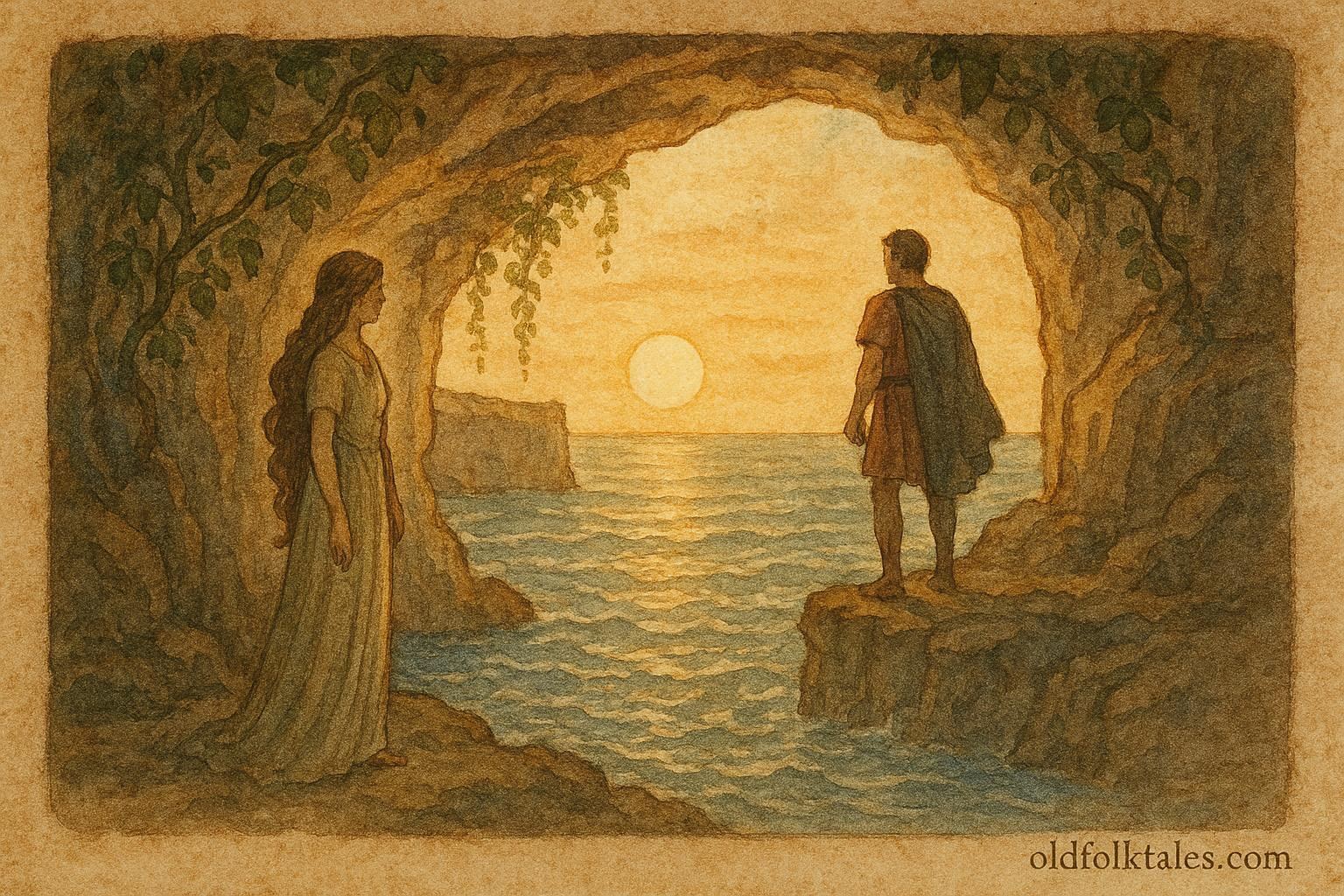
The cave she inhabited was no ordinary hollow in the rock. It opened toward the endless horizon, where the sky met the sea in a shimmering embrace. Within, its walls glowed faintly with the soft hues of amber and gold, as though touched by a perpetual sunset. Wild vines crept along the stone, their leaves trembling in the salty breeze, and pools of fresh water gathered in quiet corners, reflecting the light like polished glass.
It was here, according to legend, that Calypso once received a visitor unlike any other, a man cast ashore by fate and storm.
Odysseus, the weary king of Ithaca, had wandered the seas for years after the fall of Troy. His journey was long and fraught with trials, each wave carrying him farther from home. When at last he reached the shores of Gozo, he was broken by exhaustion, his spirit weighed down by longing for his homeland and his family.
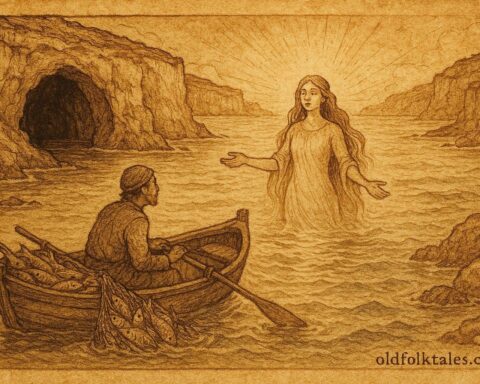
The sea, relentless in its power, cast him upon the island’s rocky edge. There, half-conscious and trembling with fatigue, he was found by Calypso.
The nymph gazed upon him with curiosity and wonder. She had seen many sailors pass by her island, their ships cutting through the waters like fleeting shadows. But none had come so close to her sanctuary, and none had stirred her interest so deeply. There was something in Odysseus’ weary eyes, a quiet strength, a resilience that even the sea had not been able to break.
With gentle care, she carried him into her cave, tending to his wounds and offering him shelter. The grotto, already a place of enchantment, seemed to come alive in his presence. The air grew warmer, the light softer, as though the cave itself welcomed its new inhabitant.
Days passed, and Odysseus regained his strength. Calypso spoke to him in soft, melodic tones, her voice echoing like music against the cavern walls. She offered him food, drawn from the richness of the land and sea, and water from the hidden springs within the grotto. In her presence, time seemed to slow, each moment stretching into something eternal.
Yet, even as his body healed, Odysseus’ heart remained restless.
He would sit at the mouth of the cave, gazing out at the vast expanse of sea. The horizon called to him, a silent reminder of the home he longed to reach. Though the island was beautiful beyond measure, it was not Ithaca. Though Calypso was kind and radiant, she was not the wife he had left behind.
Calypso saw this longing and felt its quiet sting. She had offered him everything within her power, comfort, safety, even companionship. In some versions of the tale, she is said to have loved him deeply, her affection growing with each passing day. Yet she also understood that his heart belonged to another world, one beyond her reach.
Still, she could not bring herself to let him go.
The island, under her watchful presence, seemed to conspire in her favor. Gentle winds lulled the sea into calm, preventing ships from passing too close. The paths leading away from the cave twisted through the land in confusing ways, as though guided by unseen hands. Even the beauty of Gozo itself, the golden light, the fragrant air, the endless song of the sea, worked to enchant and hold him.
In Maltese tradition, Calypso is not merely a captor, but a guardian spirit, bound to the island as much as the rocks and waves themselves. Her actions are not driven by cruelty, but by a deep connection to her domain and a desire to preserve its hidden wonders.
Odysseus remained in the cave for what felt like an eternity. Days turned to months, months to years, though time itself seemed uncertain within the enchanted grotto. The rhythm of the outside world faded, replaced by the steady whisper of the sea and the soft glow of the cave’s eternal light.
Yet longing is not so easily silenced.
Each day, Odysseus returned to the cave’s entrance, his gaze fixed on the horizon. He spoke often of his homeland, of olive trees and sunlit hills, of his loyal wife and the life he had left behind. His voice carried both hope and sorrow, a reminder that even the most beautiful prison is still a prison.
At last, the balance between hospitality and captivity began to shift.
Calypso, who had once delighted in his presence, grew quiet and contemplative. She wandered the depths of her cave, her thoughts echoing as softly as her footsteps. She knew that love, if it was truly love, could not be forced or confined. The sea itself, which she had long guarded, was a symbol of freedom, vast, unbounded, and ever-moving.
To keep him any longer would be to deny the very nature of the world she was part of.
One evening, as the sun dipped low and painted the sky in shades of gold and crimson, Calypso approached Odysseus at the cave’s edge. He stood as he often did, gazing out at the endless sea.
For a moment, neither spoke.
Then, with a voice both gentle and resolute, Calypso told him he was free to leave.
The words hung in the air like a fragile spell. Odysseus turned to her, disbelief and gratitude mingling in his expression. He understood the weight of her decision, the sacrifice it required, the quiet sorrow it carried.
Calypso did not weep, though her heart was heavy. Instead, she helped him prepare for his journey. She guided him to the shore, where the sea awaited, its surface shimmering under the fading light. In some tellings, she is said to have aided him in building a raft, providing what he needed to continue his voyage.
As Odysseus set out upon the water once more, he looked back toward the island. The cave, nestled within the cliffs, seemed almost to glow, a silent witness to their shared time.
Calypso stood at its entrance, her figure framed by shadow and light. She watched until he disappeared beyond the horizon, her presence blending once more with the island she called home.
Though Odysseus would continue his journey, eventually returning to Ithaca, the memory of the cave, and the nymph who dwelled within it, remained with him.
And on the island of Gozo, the legend endured.
To this day, locals speak of Calypso’s Cave as more than a place of stone and shadow. It is a symbol of the island’s deep connection to the sea, a reminder of the delicate balance between holding on and letting go. The winds that pass through its chambers carry echoes of ancient voices, and the waves below whisper stories of love, longing, and freedom.
Some say that if you stand at the cave’s edge at sunset, you may still feel her presence, a quiet, watchful spirit, guarding the secrets of the island and the memories of a love that could not be kept.
Explore the warmth and wit of Mediterranean storytelling, where love and wisdom intertwine
Moral Lesson
True love cannot exist without freedom. Even the deepest affection must allow space for choice, for longing, and for the journey each soul is destined to take.
Knowledge Check
- Who is Calypso in Maltese folklore?
Answer: Calypso is a sea nymph and guardian spirit of Gozo’s caves, inspired by Greek mythology. - Which famous hero did Calypso keep in her cave?
Answer: Odysseus, the king of Ithaca from classical Greek myth. - What does Calypso’s Cave symbolize in Maltese tradition?
Answer: It represents enchantment, hospitality, and the tension between love and freedom. - Why did Odysseus want to leave the cave?
Answer: He longed to return home to Ithaca and reunite with his family. - How is Maltese folklore different from the original Greek myth?
Answer: It portrays Calypso more as a guardian spirit connected to the island rather than just a captor. - What central theme does the legend teach?
Answer: That love must allow freedom, and true longing cannot be silenced by comfort or beauty.
Source: Adapted from Maltese oral tradition and folklore studies, including Ġużè Cassar Pullicino’s Malta: Prehistory and Temples (mid-20th century).
Cultural Origin: Maltese folk tradition influenced by Greek and Mediterranean myth.