Far out in the vast Atlantic Ocean, beyond the well-worn paths of merchants and fishermen, lies a region long feared and revered by sailors, the waters surrounding the Azores. These islands, scattered like emeralds upon the sea, have guided travelers for centuries. Yet among them exists a legend of another island, one that does not belong to any map.
It is said to appear only in mist.
Step into the enchanted forests and mystical realms of the Slavic imagination
The sailors of old spoke of it in hushed voices, calling it the Enchanted Island, a place neither wholly real nor entirely imagined, drifting between worlds. Some claimed it was a refuge for the lost, others that it was a snare laid by forces beyond human understanding.
Whatever the truth, one thing remained certain: those who found it were never the same again.
The tale begins, as many do, with a ship far from shore.
A small vessel, weathered by countless voyages, had set sail from the Azores under fair skies. Its crew was experienced, men who knew the language of the sea, the shift of wind, the rise of waves, the subtle warnings carried in the air.
For days, their journey was uneventful.
Then came the mist.
It rolled in without warning, thick and impenetrable, swallowing the horizon and dimming the sun until day and night became indistinguishable. The sea grew unnaturally calm, its surface smooth as polished stone. Even the wind seemed to vanish, leaving the ship adrift in an eerie stillness.
The crew grew uneasy.
They had encountered fog before, but never like this. It was as though the world had been reduced to a single moment, stretched endlessly without change. Sound carried strangely, each creak of the ship echoing too loudly, each whisper seeming to linger in the air.
Time itself began to feel uncertain.
Hours passed, or perhaps days. No one could be sure.
Then, from the silence, a shape emerged.
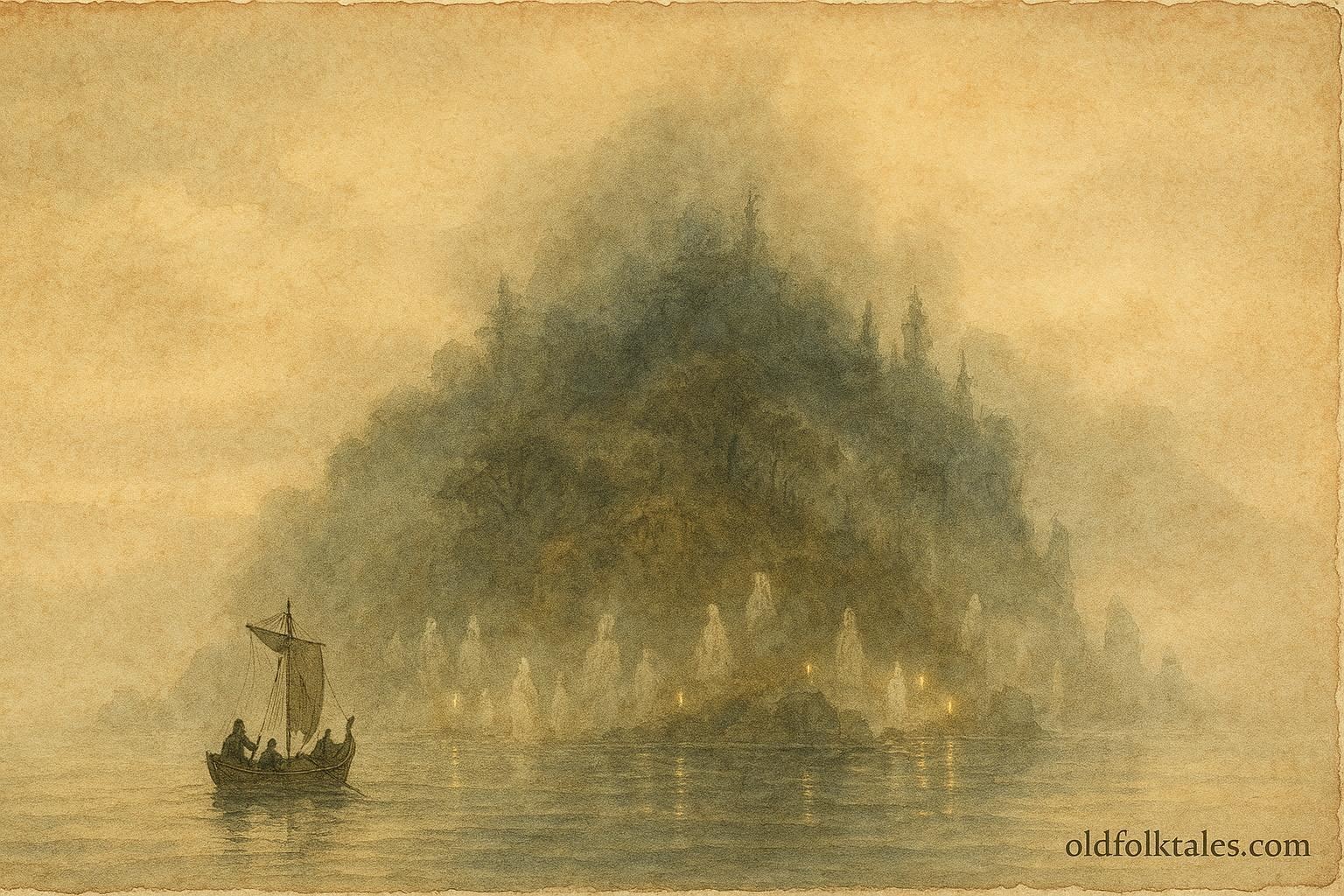
At first, it was nothing more than a shadow within the mist, a darker presence against the pale grey. But as the ship drifted closer, the outline sharpened, revealing the form of an island.
Its cliffs rose steeply from the water, crowned with greenery that seemed untouched by storm or season. Strange light filtered through the mist, casting a soft glow upon the land. It was beautiful, too beautiful, some thought, to be real.
A murmur passed through the crew.
They had heard the stories.
Some urged caution, warning that this must be the Enchanted Island. Others, weary from the endless drift, saw in it a chance for rest, perhaps even salvation.
In the end, curiosity, and desperation, won.
They guided the ship toward the shore.
As they set foot upon the island, an unsettling calm settled over them. The air was warm and still, carrying a faint sweetness unlike anything they had known. The ground beneath their feet felt solid, yet strangely soft, as though it yielded ever so slightly with each step.
There were no signs of ordinary life, no birds, no insects, no movement among the trees.
And yet, they were not alone.
From within the island’s depths came voices.
Soft at first, barely more than whispers, they seemed to drift through the air without direction. The sailors turned, searching for their source, but saw nothing.
Then the voices grew clearer.
They spoke in familiar tones.
Some heard the voices of loved ones long lost, wives, mothers, children calling them by name. Others heard the laughter of friends, the echoes of memories thought buried beneath years of hardship and distance.
The island, it seemed, knew them.
Drawn by these voices, the sailors wandered further inland. The mist clung to the edges of the land, never fully lifting, as though guarding the island from the outside world.
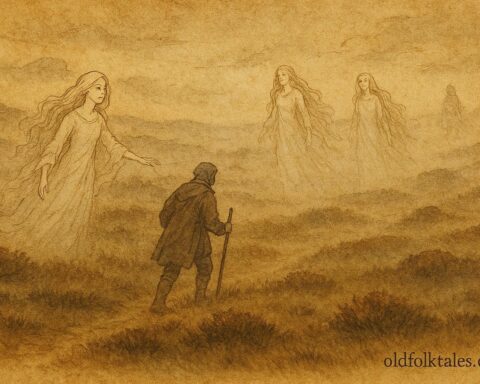
There, among the trees and stone, they began to see figures.
They appeared as shapes at first, barely distinguishable from the shifting light. But slowly, they took form, figures of those who had once been lost to the sea.
Their expressions were calm, almost serene.
Some beckoned silently, their gestures gentle yet insistent. Others spoke in quiet riddles, their words filled with meaning that seemed just beyond understanding.
“Why return,” one voice asked, “when all you seek is here?”
“Time does not bind you,” said another. “Stay, and be at peace.”
The sailors felt a pull unlike anything they had known, a sense of belonging, of release from the endless struggle of the sea. Here, there was no danger, no hunger, no longing.
Only stillness.
Some of the crew, overcome by this feeling, began to linger. They followed the voices deeper into the island, their steps slow and deliberate, as though guided by an unseen hand.
Others hesitated.
Among them was the ship’s captain, a man seasoned by years of navigating uncertain waters. He felt the island’s pull, but also sensed its danger. There was something unnatural in its perfection, something unsettling in the way time seemed to hold its breath.
He called out to his crew, urging them to return.
“Look around you,” he said. “This place offers comfort, but at what cost?”
Some listened.
Reluctantly, they turned away from the voices, from the figures that beckoned them to stay. They made their way back toward the shore, each step heavier than the last.
But not all returned.
A few remained behind, their forms fading into the mist as though they had always belonged there.
When the remaining sailors reached their ship, they found the sea unchanged, still calm, still silent. They wasted no time in setting sail, pushing away from the island with a mixture of relief and sorrow.
As the ship drifted back into the mist, the island began to fade.
Its cliffs dissolved into shadow, its light dimmed, until it was no more than a memory swallowed by the sea.
When at last the mist lifted, the sailors found themselves once more upon open waters, the familiar stars guiding their way.
They returned to the Azores, but their story was met with both awe and doubt.
Those who had seen the island spoke of it in quiet tones, their words often winding into riddles, as though the experience could not be fully explained. They described a place where time stood still, where the past and present intertwined, where the line between reality and illusion blurred beyond recognition.
And always, they spoke of those who had stayed behind.
To this day, sailors in the Atlantic tell of the Enchanted Island. They watch the mist with wary eyes, listening for whispers carried across the water.
Some seek it, drawn by curiosity or the promise of something beyond the ordinary.
Others avoid it, knowing that not all who find it are meant to leave.
For the sea, in all its vastness, holds many mysteries.
And among them is a place where time stands still, where the lost may find peace, or lose themselves forever.
Explore the warmth and wit of Mediterranean storytelling, where love and wisdom intertwine
Moral Lesson
Not all that offers comfort is meant to be embraced. Wisdom lies in discerning illusion from reality and choosing the path that preserves one’s purpose and freedom.
Knowledge Check
- What is the Enchanted Island in Azorean folklore?
Answer: A phantom island that appears in mist, where time stands still and spirits dwell. - What do sailors experience on the island?
Answer: They hear voices of lost loved ones and encounter mysterious spirits offering guidance or temptation. - Why is the island considered dangerous?
Answer: It lures travelers to stay forever, blurring reality and trapping them in illusion. - What happens to sailors who remain on the island?
Answer: They disappear, becoming part of the island’s timeless existence. - What theme does the island represent?
Answer: The tension between illusion and reality, and the mystery of the sea. - Where does this folktale originate?
Answer: The Azores, Portugal, rooted in maritime tradition.
Source: Saudades da Terra (1590).
Cultural Origin: Azores, Portugal.