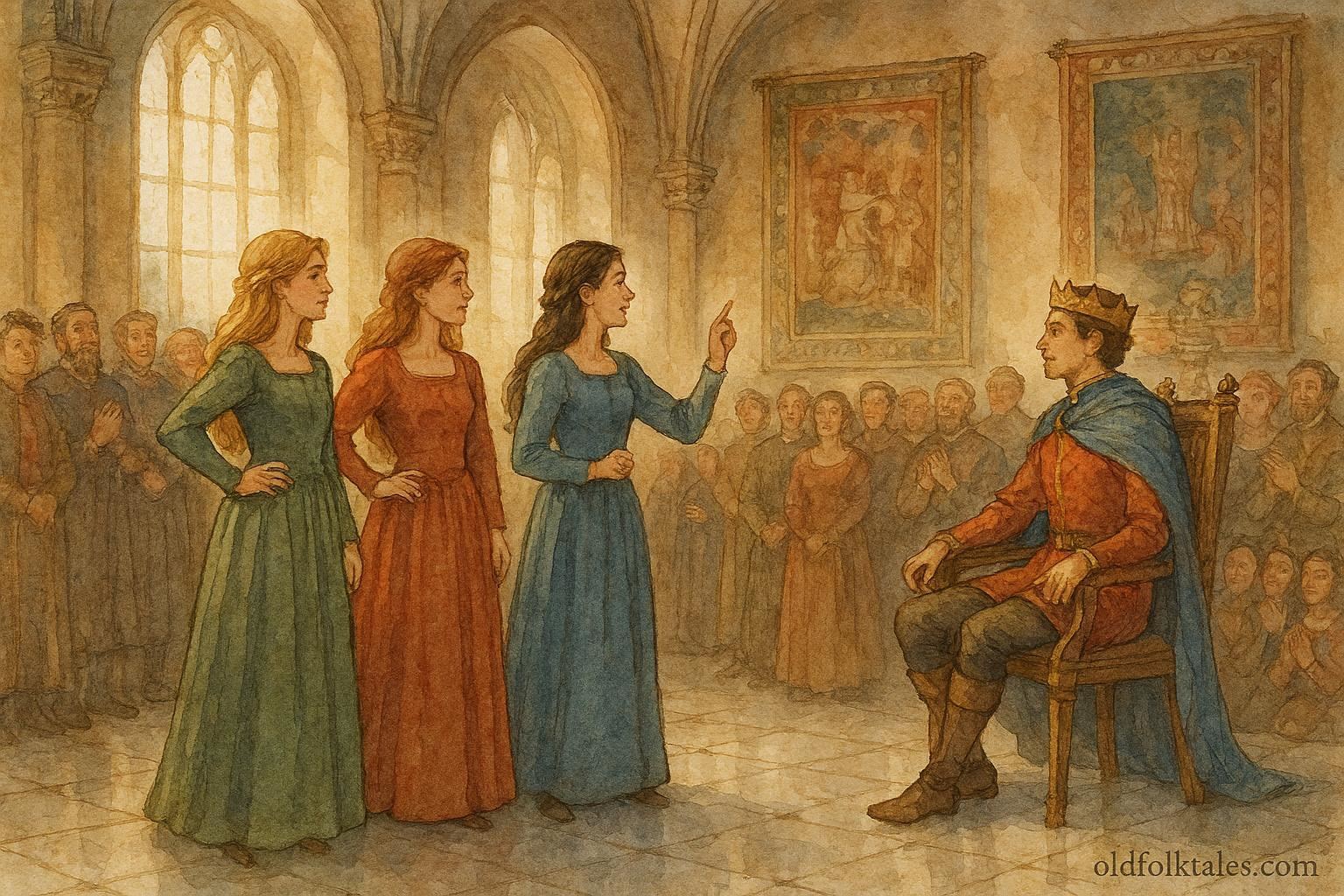
In the rolling hills and misty valleys of Luxembourg, where rivers glimmered under the morning sun and dense forests whispered secrets of old, there lived three sisters, Isabelle, Marguerite, and Elise. Though their family was humble, their minds were sharp, their spirits bold, and their hearts bound together with unbreakable loyalty.
The sisters had grown up hearing tales of princes and castles, of impossible challenges laid before the bold, and of clever folk whose intelligence earned them fortunes and respect. They dreamed not only of adventure but of proving that wit, not wealth or birth, could shape destiny. Their chance came when word spread of Prince Henri, heir to the duchy, who had announced that he would choose a bride not by birth or beauty alone, but by skill and cleverness. The prince’s court was famed for its cunning challenges, designed to confound even the most learned nobility.
The sisters knew this was their opportunity. Though their modest home was far from the grandeur of the castle, they prepared themselves with care. Each practiced thinking quickly, observing details, and turning problems upside down in her mind. They made plans to present themselves in turn, ready to face the prince’s tests and win the respect, and possibly the hearts, of the royal court.
On the day of their departure, the village gathered to watch them leave. The sisters walked with calm determination along cobblestone roads leading to the castle, skirts brushing wildflowers and boots stirring dust. Isabelle, the eldest, led the way, her keen eyes scanning the horizon. Marguerite, the middle sister, carried a bundle of provisions and a notebook filled with sketches and ideas. Elise, the youngest, skipped lightly, laughter ringing through the air, a spark of mischief and curiosity in her gaze.
Upon reaching the castle, they were met with grandeur beyond their imagining. Towering walls of gray stone, ornate gates, and courtyards paved with polished marble gleamed in the sunlight. Servants in fine attire hurried along corridors, and nobles in velvet and silk observed the newcomers with curiosity, and some, with disdain. The sisters, however, did not falter. They bowed politely, exchanged quiet words of encouragement, and entered the hall where Prince Henri awaited, seated upon a throne of polished oak and gilded carvings.
The prince, young and proud, regarded the sisters with interest. “Many have come seeking my favor,” he said, voice carrying across the hall, “but few possess the skill and cleverness required. You may try, but be warned, my challenges are not for the faint of heart.”
The first task was given to Isabelle. She was to identify a hidden meaning in a tapestry depicting the history of the duchy. The tapestry was filled with symbols, animals, and intricate patterns designed to confuse and mislead. Many who had tried before had failed, reading only what was obvious and missing the deeper lesson.
Isabelle studied the threads carefully. She noted the subtle positioning of the animals, the repetition of certain motifs, and the way colors shifted from one scene to another. She spoke confidently: “Your Highness, the tapestry tells not just of battles won or lost, but of the values of our people, the courage of the common folk, the wisdom of their leaders, and the lessons of loyalty and cunning that persist through generations. The hidden meaning is that true strength lies in intelligence and unity, not merely in arms or wealth.”
A hush fell over the hall. The courtiers whispered in astonishment. Prince Henri smiled, nodding slowly. “Well done,” he said. “Few have seen so clearly what lies beneath the surface.”
Next came Marguerite. Her challenge was to organize a banquet for the court using only the ingredients provided, without any instructions. Each dish had to symbolize an element of Luxembourgish culture, and the presentation had to tell a story. Many a skilled cook had failed, making tasteless dishes or misunderstanding the symbolic meaning of ingredients.
Marguerite studied the table, tasting and smelling each item, considering how flavors and appearances could communicate stories. She arranged the plates to reflect the forests, rivers, and villages of the duchy. The roasted vegetables represented the fertile land; the fish from the rivers signified sustenance and patience; herbs for wisdom, bread for community. She presented each dish with a short explanation that tied the food to the values and history of the region.
The courtiers murmured, impressed. The prince’s eyes gleamed. “Indeed,” he said, “you have combined creativity, intelligence, and understanding of our heritage. Your wisdom is evident.”
Finally, Elise, the youngest, faced the most daunting challenge. She was to solve a riddle that the prince himself had designed to be nearly impossible:
“I am taken from all yet belong to none. I can be broken but cannot be touched. I may guide you or mislead you. What am I?”
Elise closed her eyes, recalling the tales her grandmother had told her, the lessons of the forest, the rivers, and the lives of those who thrived through cleverness. She thought of opportunities, trust, and the wisdom of listening carefully. Then, with a gentle smile, she answered: “Your Highness, it is advice. Taken from many sources, yet owned by none. It can be broken when ignored, but it is intangible. It may guide or mislead, depending on how it is followed.”
The hall erupted in astonishment. Courtiers who had scoffed at her youth bowed their heads in respect. The prince leaned forward, impressed by the insight and maturity in her words. “Truly remarkable,” he said. “You three demonstrate that intelligence, resourcefulness, and wisdom surpass all titles and birthrights. You have honored yourselves and your family.”
In recognition of their success, Prince Henri invited the sisters to reside at the castle, where their talents could serve the duchy. Isabelle became a trusted advisor on matters of governance and history; Marguerite organized events and taught the value of cultural knowledge and symbolism; Elise offered guidance to young nobles and citizens, helping them navigate challenges with intelligence and careful thought.
The sisters’ unity never faltered. They celebrated one another’s victories, shared their successes with humility, and remained grounded despite the admiration of the court. Their story spread across the duchy, inspiring young people to value wit, cleverness, and familial loyalty over mere wealth or social standing.
Through the years, the tale of the three clever sisters became a cherished legend in Luxembourg. Parents recounted it by firelight to their children, teaching that intelligence could open doors closed to birthright alone, that wit was a treasure independent of riches, and that family bonds strengthened both courage and cunning. Even the prince, once proud and cautious, learned to respect ingenuity and loyalty above titles and inheritance, fostering a court where merit and cleverness were honored.
The sisters, though honored and recognized, never forgot their humble beginnings. They returned often to their village, sharing knowledge, listening to local concerns, and ensuring that intelligence, kindness, and resourcefulness remained valued across the land. Their legacy endured not only in tales and legends but in the lives they touched, showing that wit, unity, and perseverance could triumph over every challenge.
Moral Lesson
The Three Clever Sisters teaches that intelligence, wit, and resourcefulness are more powerful than wealth, beauty, or birthright. Family loyalty, cleverness, and courage can open doors to opportunity, proving that the clever mind often surpasses privilege.
Knowledge Check
- Who are the main characters of the story?
- Three sisters: Isabelle, Marguerite, and Elise.
- What challenges do the sisters face?
- Impossible tasks set by Prince Henri’s court, including riddles, symbolic feasts, and deciphering hidden meanings.
- How does the sisters’ intelligence help them succeed?
- They use observation, creativity, cleverness, and understanding of culture and symbolism to solve each challenge.
- What themes are central to this Luxembourgish folktale?
- Intelligence over wealth or birthright, wit as a virtue, family loyalty, and social mobility.
- How does Prince Henri respond to their cleverness?
- He respects and honors them, inviting them to the castle and recognizing the value of intelligence and resourcefulness.
- What cultural elements are highlighted in the tale?
- Luxembourgish landscapes, courtly tradition, riddles, feasting customs, and the value placed on wit and cleverness.
Source: Collected by Paul Sébillot, Contes populaires de la Grande-Duché de Luxembourg, 1900, Luxembourg.
Cultural Origin: Luxembourgish