In the heart of England, amid the ancient oaks and rolling green of Sherwood Forest, lived Robin Hood, the legendary outlaw. Known throughout the land for his unmatched skill with the bow, his cleverness, and his unwavering sense of justice, Robin had earned both the admiration of the poor and the ire of the wealthy rulers. His band of merry men, Little John, Friar Tuck, Will Scarlet, and others, stood loyally by his side, sharing in the joys of the forest, the thrill of adventure, and the pursuit of fairness in a world often tilted in favor of the rich.
One bright spring morning, news reached Robin Hood that the local authorities had organized a grand contest in the nearby village. A golden arrow would be offered as a prize to the man who could shoot with the greatest precision. The contest, however, was designed to favor the wealthy and the well-connected. Many of the villagers, hunters, craftsmen, and poor folk alike, were barred from participating. Robin Hood, hearing of this, smiled knowingly. “A contest of skill and fairness,” he said, “but only if one is clever enough to level the field.”
Robin devised a plan. Donning a simple disguise, a tattered hat, rough cloak, and a mask to cover his features, he joined the contest unnoticed. No one suspected that the disguised archer was the infamous Robin Hood himself. The village green bustled with excitement. Merchants hawked food, children played near the edges, and the wealthy competitors strutted, confident that the golden arrow would be theirs.
As the competition began, archers took their turns, aiming at a target set far across the village square. Many arrows missed their mark, others landed haphazardly. Robin observed carefully, noting the strengths and weaknesses of his rivals. He waited patiently, knowing that skill alone would not be enough; timing, cunning, and a calm mind would decide the day.
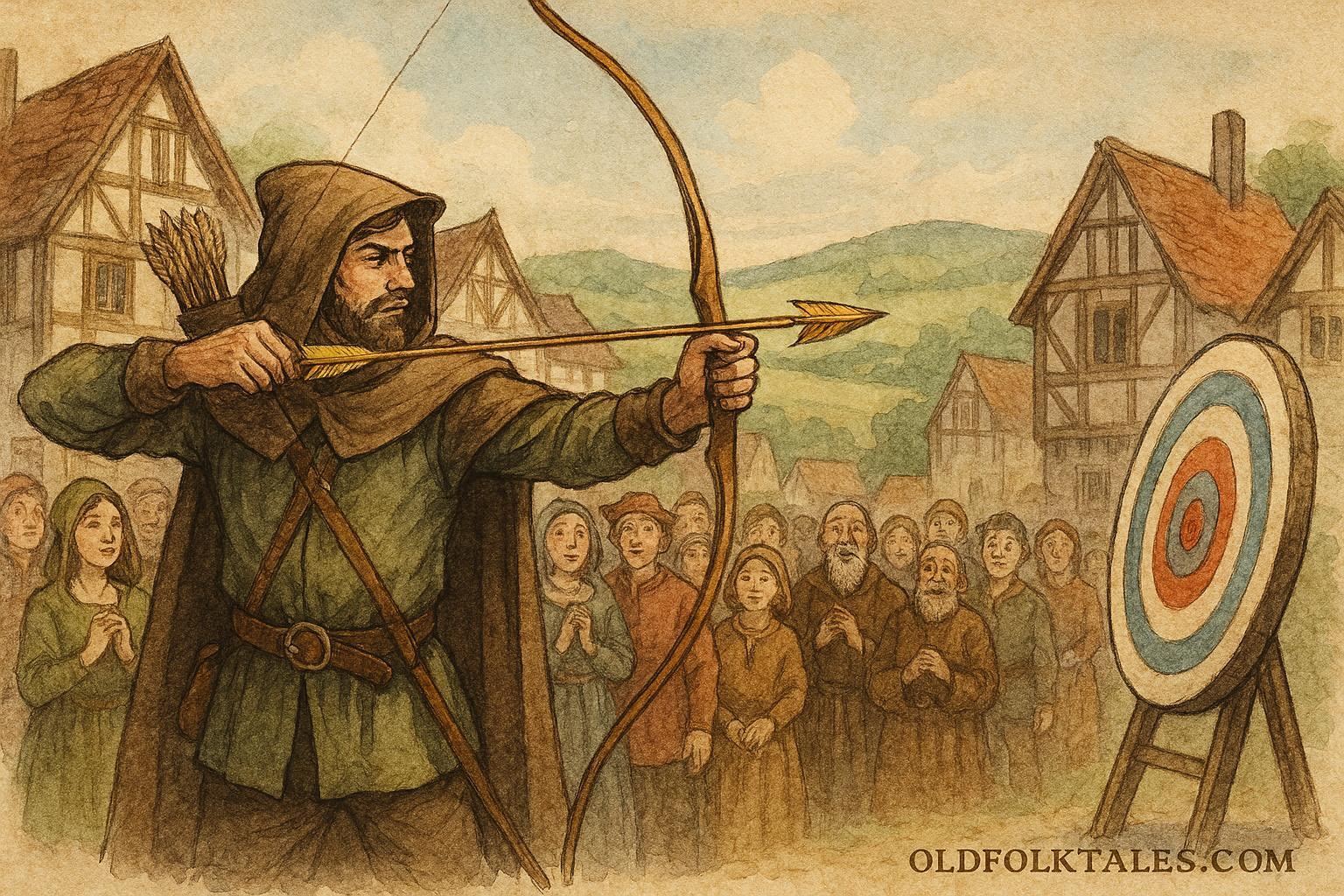
When Robin’s turn came, he stepped forward with quiet confidence. He drew the bow, feeling the familiar strain of the string against his hands, the grainy texture of the arrow beneath his fingers. The villagers held their breath as he aimed. With a smooth release, the arrow flew true, striking the center of the target with a resounding thud. The crowd gasped in awe. Whispers spread quickly: who was this mysterious archer? Even the wealthiest competitors, proud and self-assured, turned pale, recognizing that a master had just taken the field.
The contest was far from over, however. Several rounds were held, each more challenging than the last, with smaller targets placed at longer distances. Robin Hood, calm and clever, let others go first, observing the patterns of the contest and the crowd’s reactions. He noted the slightest breeze, the uneven ground, and the distractions caused by rival archers. Each time he released an arrow, it struck the bullseye with unerring precision, drawing gasps, cheers, and murmurs of envy from the spectators.
Finally, only Robin Hood remained to shoot. The golden arrow awaited him, perched on a pedestal gleaming in the sunlight. The villagers leaned forward, hearts pounding, as Robin took careful aim. He closed his eyes for a moment, imagining the faces of the poor families who had struggled to feed their children, who had labored endlessly in fields and workshops while the rich amassed their fortunes. “This arrow,” he whispered, “will fly not for glory, but for justice.”
He drew the bowstring with perfect tension and released. The arrow sailed through the spring air, spinning like a silver comet, and landed squarely upon the golden target. A cheer erupted, ringing across the village green. The crowd surged forward to witness the prize, only to see Robin Hood, still in disguise, bow respectfully and accept the golden arrow with humility.
Yet Robin’s triumph was more than just winning a contest. As he returned to Sherwood Forest with his band of merry men, he devised a clever scheme. That evening, the golden arrow was used as a token to claim a chest of coins and treasures, collected by the wealthy organizers of the contest. These riches were quietly distributed among the poor villagers, who found grain for their tables, warm blankets for their children, and tools to improve their workshops. Robin’s cunning ensured that justice prevailed, and that those most in need received what had long been denied to them.
The legend of Robin Hood and the golden arrow spread rapidly. Bards composed songs in his honor, telling of the clever archer who outwitted the powerful and gave to the poor. Children practiced archery in the fields, imagining themselves as Robin, brave and fair, striking down injustice with skill and intelligence. Villagers shared stories of his generosity, teaching that courage and cunning could triumph over wealth and oppression.
Robin’s band of merry men, loyal and skilled, celebrated in the forest. Fires crackled under the canopy of ancient oaks, and laughter echoed through the trees. Little John recounted his own feats of strength, Friar Tuck sang songs of merriment, and Will Scarlet practiced tricks with arrows, all inspired by their leader’s cleverness and sense of justice. Robin, ever humble, reminded them that it was not glory they sought, but fairness, and that every arrow, every plan, was aimed toward helping the downtrodden and protecting the forest they called home.
Weeks turned to months, and Robin Hood continued his campaigns of cleverness, strategy, and justice. The golden arrow became a symbol in Sherwood Forest, not merely of skill in archery, but of hope, fairness, and the idea that intelligence and bravery could overcome wealth and power. Whenever a contest of skill or chance arose, villagers remembered the archer in disguise who had ensured that justice and fairness were served.
Even the wealthy, though begrudgingly, came to recognize Robin Hood’s unmatched skill and cunning. Some attempted to challenge him, but none could match his wit, precision, and strategic mind. Robin Hood remained a protector of the poor, a clever trickster of the rich, and a legend whose tales would endure for generations.
Through the story of Robin Hood and the golden arrow, children learned lessons of courage, cleverness, and the importance of aiding those less fortunate. The archery contest was no longer merely a test of strength, but a symbol of justice and hope. The arrow itself, shining bright and true, reminded all who saw it that fairness and ingenuity could triumph over oppression, and that one clever individual, acting with courage and integrity, could make a profound difference in the lives of many.
Moral Lesson
Robin Hood and the Golden Arrow teaches that cleverness, courage, and a commitment to justice can overcome inequality and greed. True heroism lies in using one’s skills not for personal gain alone, but to aid those who are oppressed and in need.
Knowledge Check
- Who is the protagonist of the story?
- Robin Hood, the legendary outlaw known for cleverness and archery skill.
- What challenge does Robin Hood participate in?
- A contest to shoot a golden arrow, designed to favor the wealthy.
- How does Robin Hood win the golden arrow?
- By disguising himself, observing carefully, and using his skill and cleverness to strike the target with perfect precision.
- What themes are central to this English folktale?
- Social justice, cleverness over wealth, heroism, and loyalty to the community.
- How does Robin Hood use his victory to help others?
- He redistributes treasures obtained through the golden arrow to the poor villagers.
- What cultural elements are highlighted in the tale?
- Medieval English forest life, archery, folklore of outlaws, and the idea of clever justice prevailing over power and wealth.
Source: J. W. Hales & F. J. Child, English Ballads, 1892, England.
Cultural Origin: English