In the shadow of the mist-covered Highlands, where rugged hills sloped down into dark, silent waters, lay the vast and mysterious Loch Ness. Its surface often appeared calm, reflecting the grey skies above, yet beneath its depths, stories whispered of ancient creatures and unseen forces. The villagers who lived along its shores respected the loch with quiet caution, for they knew it was not merely water that filled its depths, but something far older and far more dangerous.
Among these villagers lived a young boy named Ewan, known for his keen eyes and thoughtful nature. Unlike the other children, who played freely along the shoreline, Ewan often paused to observe the loch. He watched how the mist curled over its surface in the early morning, how the water darkened suddenly even on clear days, and how the elders spoke in hushed tones whenever its name was mentioned.
Explore the wit and wisdom of Western Europe, where humor and virtue often go hand in hand
From a young age, Ewan had heard tales of the Kelpie, a shape-shifting water spirit said to haunt the loch. It was known to appear as a magnificent horse, sleek and strong, its coat glistening like wet stone, standing quietly near the water’s edge. To the unsuspecting traveler, it seemed like a gift, a horse waiting to be ridden. But those who mounted it found themselves unable to dismount, their hands stuck fast to its hide as it galloped into the depths, dragging them beneath the dark waters of the loch.
The villagers warned their children never to approach strange animals by the water, never to trust what seemed too inviting. Yet, as with many tales, curiosity often walked hand in hand with danger.
One cool autumn afternoon, as the sky hung low with clouds and the wind whispered through the reeds, Ewan wandered near the loch’s edge. The air felt unusually still, as though the land itself were holding its breath. It was then that he saw it.
A horse stood by the water, more beautiful than any he had ever seen. Its coat shimmered with an unnatural sheen, dark as midnight yet reflecting the faintest hints of silver. Its mane flowed like water itself, and its eyes held a strange, knowing glint. It stood perfectly still, watching him.
Ewan’s heart quickened. He remembered the stories, the warnings, the whispered fears, but the creature’s beauty was mesmerizing. It lowered its head slightly, as though inviting him closer.
For a moment, Ewan hesitated. The pull of curiosity urged him forward, yet something deep within him stirred, a quiet voice of caution, shaped by the tales he had heard since childhood.
Instead of rushing toward the horse, Ewan circled it carefully, keeping his distance. He noticed that its hooves did not quite touch the ground as ordinary horses’ would, and that the water near its feet rippled without cause. The boy’s eyes narrowed. This was no ordinary creature.
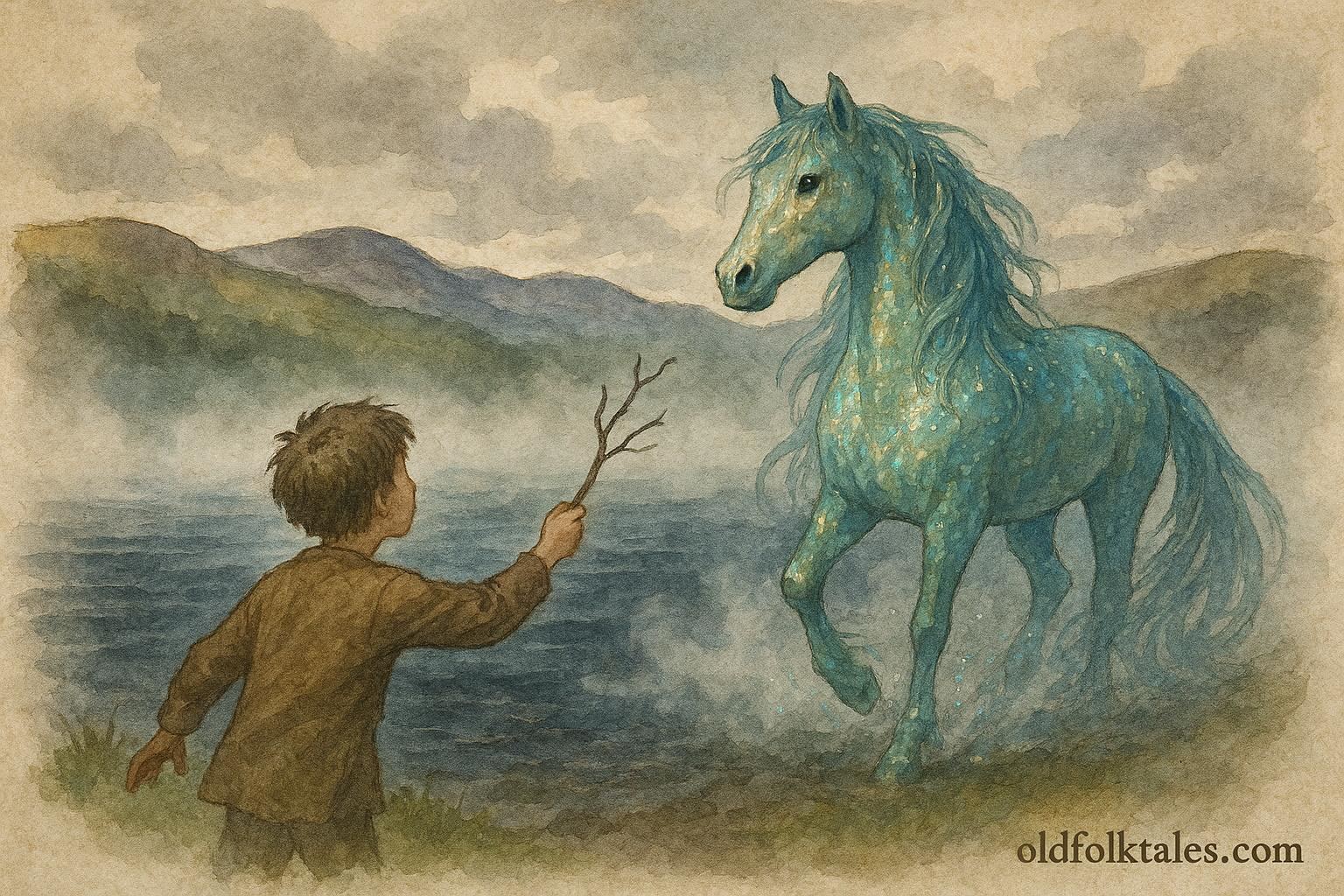
Summoning his courage, Ewan picked up a long branch lying nearby. Slowly, cautiously, he extended it toward the horse, touching its flank instead of using his hand. The moment the branch made contact, it stuck fast, as though glued to the creature’s hide.
Ewan’s breath caught. The truth of the stories stood before him. This was the Kelpie.
The creature’s calm demeanor shifted instantly. Its eyes flashed with a fierce, unnatural light, and its body tensed as though ready to spring. Realizing its deception had been uncovered, the Kelpie let out a low, chilling sound, something between a neigh and a growl, that echoed across the water.
Ewan did not wait. Dropping the branch, he turned and ran, his feet pounding against the earth as the wind seemed to carry the Kelpie’s furious cries behind him. He did not look back, though every instinct told him the creature might pursue him. The reeds rustled violently, and the loch’s surface churned as though something massive had plunged beneath it.
At last, breathless and shaken, Ewan reached the safety of the village. The elders gathered quickly, their faces grave as he recounted what he had seen. They listened intently, exchanging knowing glances.
“You have done well, lad,” one elder said, his voice steady but serious. “You trusted your wits over your curiosity. The Kelpie has claimed many who were not so wise.”
That evening, the villagers gathered near the hearth, the firelight flickering against the stone walls. Ewan’s story spread quickly, reinforcing the warnings that had long been part of their lives. The elders spoke of respect for the loch, of the unseen dangers that lurked beneath its surface, and of the importance of caution in a world where not all things were as they seemed.
In the days that followed, the villagers took extra care near the water. Children were reminded never to approach alone, and travelers were warned of the Kelpie’s deceptive form. Though the loch remained as beautiful as ever, it carried with it a renewed sense of caution, a reminder that nature held both wonder and peril.
Ewan, once merely a quiet observer, became a figure of respect among his people. His cleverness had saved his life, and his courage in sharing his story had protected others. He continued to watch the loch, but now with a deeper understanding.
He knew that the Kelpie might still linger beneath the surface, waiting for another unsuspecting traveler. But he also knew that knowledge and awareness were powerful defenses against such hidden threats.
Years later, Ewan would tell his own children the tale of the Kelpie, not as a story meant to frighten, but as a lesson. He would describe the shimmering horse, the silent loch, and the moment when curiosity could have led him to danger. And he would remind them that the world, though full of beauty, required wisdom to navigate.
The tale of the Kelpie of Loch Ness endured through generations, carried in whispers across the Highlands, told beside fires and along winding paths. It served as both a warning and a guide, teaching all who heard it to respect the unseen, to question what appears too perfect, and to rely on wit and caution in the face of danger.
For the loch still lay there, vast and silent, its depths holding secrets beyond imagination. And though the Kelpie might never be seen again, its legend lived on, woven into the fabric of the land, a reminder that not all that glimmers is safe, and not all that calls is meant to be followed.
Moral Lesson
The Kelpie of Loch Ness teaches that cleverness and caution can protect against hidden dangers. It reminds us to respect nature, question appearances, and trust wisdom over impulse when faced with the unknown.
Knowledge Check
- What is the Kelpie in Scottish folklore?
- A shape-shifting water spirit that lures victims into lakes or rivers by appearing as a horse.
- How does the Kelpie trap its victims?
- By causing them to stick to its body once they touch or mount it, then dragging them underwater.
- How does Ewan avoid the Kelpie’s trap?
- He uses a branch to test the creature instead of touching it, revealing its true nature.
- What themes are central to this Scottish folktale?
- Cunning over danger, respect for nature, and awareness of hidden threats.
- Why is Loch Ness significant in the story?
- It serves as the mysterious setting where the Kelpie resides, reflecting Scottish Highland folklore.
- What lesson does the village learn from Ewan’s experience?
- To remain cautious, respect the loch, and heed traditional warnings about unseen dangers.
Source: Scottish Fairy and Folk Tales, Sir George Douglas, 1893, Scotland.
Cultural Origin: Scottish Highlands (Loch-side communities)