Between the rugged western coast of Scotland and the scattered isles of the Hebrides lies a stretch of sea both beautiful and feared. Known as the Minch, these waters are restless even on calm days, their depths dark and their moods unpredictable. Sailors who crossed them spoke of shifting winds, sudden storms, and currents that seemed guided by unseen hands. Yet among all the dangers whispered in harbors and taverns, none stirred more unease than the tales of the Blue Men.
The Blue Men of the Minch were said to be spirits of the sea, creatures with blue skin, gleaming like the depths they inhabited, and eyes as cold as the northern waves. They were neither fully human nor wholly monstrous, but something in between, bound to the sea and its tempests. They were known to rise from the waters before storms, surrounding ships and calling out to captains with eerie voices.
Experience legends where mountains breathe magic and heroes face moral choices that shape destiny
But they did not attack without warning. Instead, they issued a challenge.
Any captain who crossed their waters would be tested in a duel of wit. The Blue Men would call out a line of verse, demanding a response in rhyme. If the captain failed, if he hesitated, faltered, or could not answer in time, the spirits would unleash their fury, summoning winds and waves to swallow the ship whole.
For generations, sailors told stories of vessels lost in sudden storms, their wreckage scattered along distant shores. Many believed those ships had failed the Blue Men’s test. And so, captains who dared to cross the Minch prepared not only their sails and rigging, but their minds, for words could be as vital as any rope or mast.
One such captain was Alasdair MacRae, a man known not only for his steady hand at sea but for his sharp wit and calm demeanor. He had sailed the Minch many times, yet he never treated it lightly. Before each voyage, he listened carefully to the stories of other sailors, committing their warnings to memory.
On a grey morning, with clouds hanging low and the sea stretching dark and endless before him, Captain MacRae set sail with his crew. The wind was steady, the sails full, and the ship cut cleanly through the water. Yet as they ventured deeper into the Minch, a silence fell over the sea.
The wind slowed. The waves softened. Even the cries of seabirds faded into nothing.
The crew exchanged uneasy glances. They knew this calm was no blessing, it was a sign.
Then, from the water ahead, came a movement.
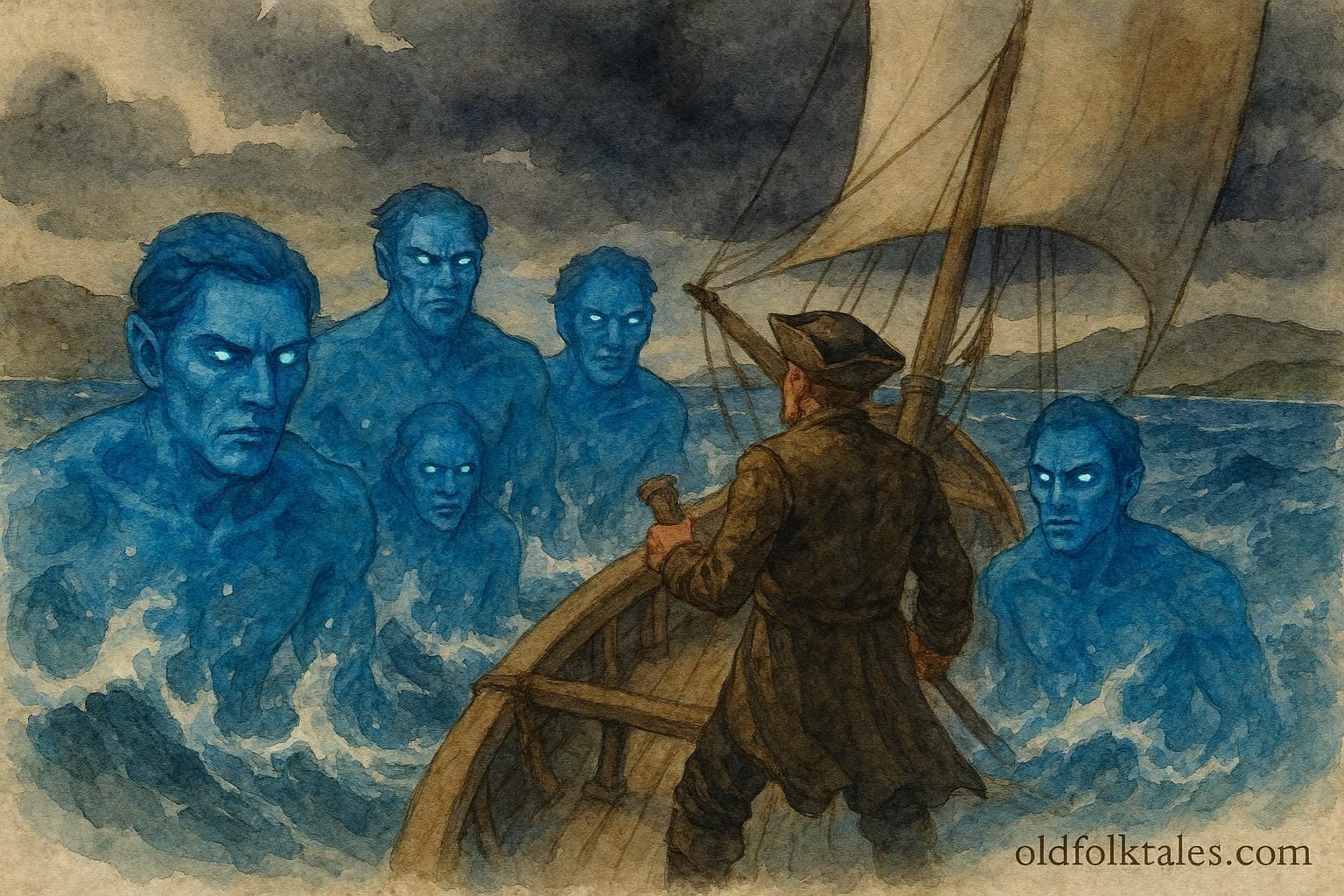
At first, it was only a ripple. Then another. And another. Soon, the surface of the sea stirred as shapes began to rise from its depths. One by one, they emerged, the Blue Men.
Their forms glistened as though carved from the sea itself, their skin a deep, shifting blue. Their hair clung like wet strands of kelp, and their eyes shone with an eerie, knowing light. They circled the ship slowly, their presence both mesmerizing and terrifying.
The crew froze, gripping ropes and rails, their breath held tight in their chests.
Captain MacRae stepped forward. He had heard the stories, and now he faced their truth.
One of the Blue Men rose higher than the others, his voice echoing across the still water. It was not a shout, but it carried with unnatural clarity, each word sharp and deliberate.
He spoke a line of verse.
The words flowed like the tide, rhythmic and haunting, carrying both challenge and threat. The meaning was clear: respond in kind, or face the storm.
The crew looked to their captain, fear etched in their faces. This was no battle of swords or strength. It was a test of mind and composure.
MacRae did not rush. He listened carefully, absorbing the rhythm, the cadence, the rhyme. For a brief moment, silence hung heavy in the air.
Then, with steady voice, he answered.
His reply matched the spirit’s verse in rhythm and rhyme, his words flowing smoothly, confidently, as though he had prepared for this very moment. The Blue Men paused, their expressions unreadable.
Another stepped forward. Again, a line of verse rang out, more complex this time, its rhythm shifting, its rhyme less obvious.
The tension aboard the ship tightened. A single misstep could mean disaster.
But MacRae remained calm. He allowed the words to settle in his mind before answering, shaping his reply with care. Once again, his voice carried across the water, meeting the challenge with precision.
The Blue Men circled closer. The sea beneath them began to stir, small waves forming where none had been before.
A third challenge came, faster, sharper, its rhyme twisted and difficult. It was as though the spirits sought to break the captain’s focus, to push him into error.
A murmur passed through the crew. Some whispered prayers, others clenched their fists, bracing for the storm they feared would come.
MacRae felt the weight of their lives upon him. He knew there would be no second chance.
Closing his eyes briefly, he drew upon every story, every rhyme, every fragment of verse he had ever known. Then he spoke.
His answer came clear and strong, perfectly matched, his words weaving effortlessly into the challenge set before him.
For a moment, nothing happened.
The sea held its breath.
Then the Blue Men stilled. The tension in the air seemed to dissolve, and the restless stir of the water quieted. One by one, the spirits began to sink back beneath the surface, their forms fading into the dark depths from which they had risen.
Before the last of them disappeared, the leader cast one final look toward the ship. There was no anger in his gaze, only a quiet acknowledgment. The challenge had been met. The duel had been won.
The sea returned to its natural rhythm. The wind picked up once more, filling the sails, and the ship moved forward as though released from an unseen grip.
For a long while, no one spoke. The crew stood in stunned silence, scarcely believing what they had witnessed.
At last, one sailor let out a breath he seemed to have been holding for an eternity. “We are spared,” he said, his voice trembling.
MacRae nodded, though his expression remained thoughtful. “Aye,” he replied, “but not by strength. By wit, and by respect.”
The journey continued, and the ship reached its destination safely. Yet the tale of that encounter spread quickly, carried by sailors from port to port. The story of the captain who had faced the Blue Men and answered their challenge became a lesson for all who ventured into the Minch.
It was said thereafter that any captain who sailed those waters would do well to sharpen not only his skill with rope and sail, but also his mind and tongue. For the sea, as the tale reminded them, was not only a force of nature but a realm of mystery, where unseen beings might test those who dared to cross it.
Captain MacRae himself never spoke boastfully of the event. When asked, he would simply say that the sea demands respect, and that survival often depends on more than strength alone.
The Minch remained as it always had, beautiful, unpredictable, and full of hidden depths. And though the Blue Men were seldom seen, their legend endured, a reminder to all who sailed those waters that wit, composure, and respect for the unknown were as essential as any tool aboard a ship.
For in the end, it was not the strongest who survived the Minch, but the most mindful.
Journey into the charm of British wit and Irish wonder through centuries of folk tradition
Moral Lesson
The Blue Men of the Minch teaches that intelligence, composure, and respect for the unknown are often more powerful than brute strength. In moments of danger, quick thinking and presence of mind can determine survival.
Knowledge Check
- Who are the Blue Men of the Minch?
- Supernatural sea spirits who challenge sailors with poetic riddles before storms.
- What happens if a captain fails their challenge?
- The Blue Men summon violent storms to sink the ship.
- How does Captain MacRae survive the encounter?
- By responding to their verses with clever rhymes, matching their poetic challenges.
- What themes are central to this folktale?
- Intelligence over strength, respect for the sea, and survival through wit.
- What is the Minch in Scottish geography?
- A stretch of sea between mainland Scotland and the Hebrides, known for treacherous waters.
- What lesson does the story teach sailors?
- That preparation, wit, and respect for the unknown are essential for survival at sea.
Source: John Gregorson Campbell, Superstitions of the Highlands and Islands of Scotland, 1900, Scotland.
Cultural Origin: The Minch (between the Hebrides and mainland Scotland)