In the old city of Warsaw, long before its streets rang with the sounds of modern life, there lived a poor soldier who had returned from war with little more than the clothes on his back and the weight of his memories. Though he had served bravely, fate had not rewarded him with riches or recognition. Instead, he wandered the cobbled streets in search of honest work, often going to bed with an empty stomach and waking with the same quiet determination to endure.
Warsaw itself was a city of contrasts, grand buildings stood beside humble homes, and whispers of old legends seemed to echo through its narrow alleys. Among these legends, one in particular captured the imagination of the poor and the curious alike: the tale of a golden duck hidden deep beneath the city, guarding unimaginable treasure.
The soldier first heard of this strange creature from an old man in a dimly lit tavern. The man spoke in hushed tones, as though the very walls might listen.
“Beneath Warsaw,” he said, leaning close, “there lies a hidden chamber, and in that chamber lives a golden duck. She sits upon a fortune beyond measure. But beware, her treasure comes with a condition that few can satisfy.”
The soldier, though weary and skeptical, could not ignore the spark of hope that flickered within him. What if the legend were true? What if, after all his hardship, fortune had finally turned its gaze upon him?
The next morning, driven by equal parts desperation and curiosity, he set out to find the hidden place the old man had described. He wandered through winding streets, passed ancient buildings, and eventually reached a quiet part of the city where few people ventured. There, hidden behind crumbling stone and half-forgotten pathways, he found what appeared to be an entrance, a narrow descent leading into darkness.
Without hesitation, he stepped inside.
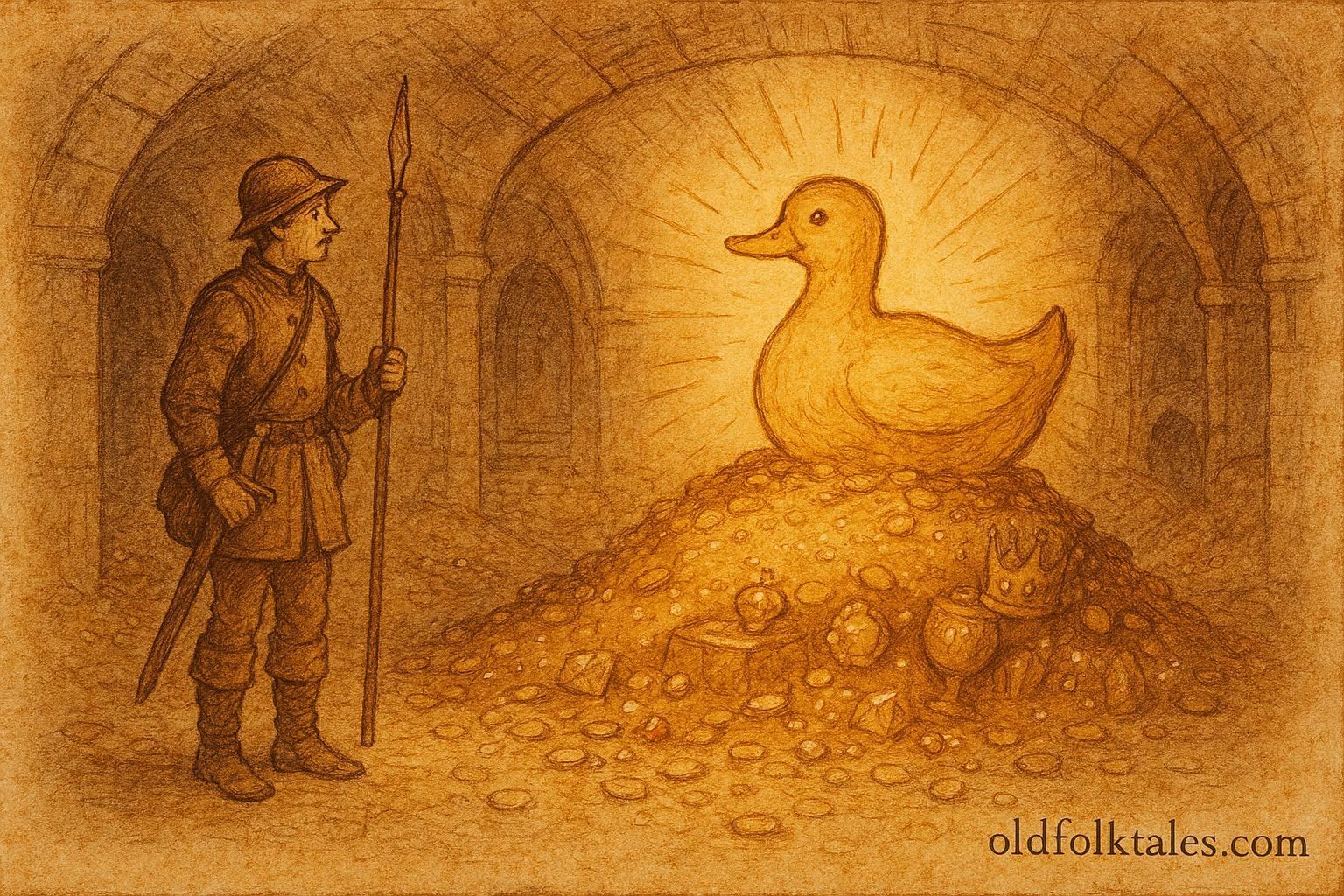
The air grew cooler as he descended, and the sounds of the city above faded into silence. The path twisted and turned, lit only by faint glimmers of light that seemed to come from nowhere and everywhere at once. At last, he reached a vast underground chamber.
In the center of the chamber, upon a mound of glittering treasure, sat the golden duck.
Her feathers shone like polished gold, reflecting the soft light in a way that made the entire chamber glow. Jewels, coins, and ornaments surrounded her, piled high in dazzling abundance. The soldier stood in awe, scarcely believing his eyes.
“You have come,” said the duck, her voice calm and knowing.
The soldier fell to his knees, both out of respect and disbelief.
“I have heard of your treasure,” he said. “I am a poor man, with nothing to my name. If your legend is true, I beg you, grant me a share of your wealth.”
The golden duck regarded him for a long moment before speaking again.
“I can grant you more wealth than you have ever imagined,” she said. “Gold enough to change your life forever. But there is a condition.”
The soldier listened intently.
“You must spend all the gold I give you in a single day,” she continued. “And you must spend it only on yourself. Not a single coin may be given to another, not out of kindness, not out of pity, not for any reason at all. If you break this condition, everything will be lost.”
The soldier hesitated.
It seemed a strange and harsh requirement. Yet, as he looked around at the endless treasure, his doubts began to fade. Surely, he thought, it would not be so difficult. For one day, he could think only of himself. After all, had he not suffered enough? Had he not earned at least one day of comfort?
“I accept,” he said at last.
The golden duck nodded. With a soft rustling of her shimmering feathers, she revealed a sack filled with gold coins.
“Take this,” she said. “Return tomorrow if you succeed.”
The soldier took the sack, its weight heavy in his hands, and made his way back to the surface.
That day, he began to spend.
At first, it was easy. He bought himself fine clothes, rich food, and a comfortable place to rest. He dined at the best establishments, tasted dishes he had only dreamed of, and felt, for the first time in years, the warmth of abundance.
But as the day wore on, the test grew harder.
He passed a beggar on the street, a man whose condition reminded him painfully of his own recent past. The beggar reached out a trembling hand, his eyes filled with quiet desperation.
“Please,” the man said softly. “Just a coin.”
The soldier froze.
The golden duck’s condition echoed in his mind. Not a single coin may be given to another.
He clenched his jaw and walked on.
A little further down the street, he encountered a woman trying to calm a hungry child. The child cried, clutching at her mother’s worn clothing.
“Food,” the child whispered.
Again, the soldier felt the weight of his choice. He had more than enough to help them, far more than enough. Yet the condition held him back.
He turned away, his steps growing heavier with each passing moment.
All day, the same scenes repeated themselves. Faces of need, voices of quiet suffering, each one testing his resolve. With every refusal, the gold in his sack seemed to grow heavier, not lighter.
By evening, he had spent much, but not all, of the gold. And though he had surrounded himself with comfort, he felt no joy. Instead, a deep unease settled within him.
As night approached, he found himself walking once more through the dim streets of Warsaw. The city, which had once felt full of promise, now seemed filled with silent accusations.
Then, in a shadowed corner, he saw a figure unlike the others.
It was an old man, frail and shivering, his clothes thin against the cold. He did not call out or beg. He simply sat there, his head bowed, as though he had already accepted his fate.
The soldier stopped.
For a long moment, he stood there, caught between the promise of wealth and the pull of his own conscience.
He thought of the golden duck, of the treasure waiting below, of the life he could have if he simply obeyed.
Then he thought of the man before him.
Without another word, the soldier reached into his sack and placed a coin into the old man’s hand.
In that instant, everything changed.
The weight of the gold vanished. The sack grew light, empty. The fine clothes he wore seemed to lose their luster, and the comfort he had purchased faded like a dream.
The soldier stood there, no longer rich, no longer bound by the golden duck’s condition.
But something within him felt different.
Lighter.
Stronger.
At peace.
The old man looked up, surprise and gratitude shining in his eyes.
“Thank you,” he said quietly.
The soldier nodded, offering a small, genuine smile.
The next day, he returned to the hidden chamber beneath Warsaw.
The golden duck was waiting.
“You have failed,” she said.
The soldier did not deny it.
“I have,” he replied. “I could not keep the gold if it meant turning away from those in need.”
The duck regarded him silently, her golden feathers shimmering softly in the dim light.
“And do you regret your choice?” she asked.
The soldier shook his head.
“No,” he said. “For the first time, I feel as though I have gained something, not lost it.”
At this, the golden duck gave a slow, approving nod.
“Then you have learned what many never do,” she said. “The value of wealth is not in its possession, but in its use. You leave here with no gold, but with something far greater.”
The chamber seemed to glow brighter for a moment, as though the treasure itself acknowledged the truth of her words.
The soldier bowed his head, understanding at last.
When he returned to the city above, his life was not suddenly transformed by riches. He still had to work, to struggle, and to endure. But he carried with him a quiet strength, a certainty that no treasure could equal the worth of compassion.
And though he never again saw the golden duck, the lesson she had taught him remained, guiding his steps through the rest of his days.
Step into the enchanted forests and mystical realms of the Slavic imagination
Moral Lesson
True wealth lies not in gold or possessions, but in the kindness we show to others. Compassion and generosity give a deeper, lasting fulfillment that material riches can never provide.
Knowledge Check
- What condition did the golden duck give the soldier?
The soldier had to spend all the gold in one day and could not give any of it to others. - Why was the condition difficult for the soldier?
Because he encountered many people in need, testing his compassion and moral values. - What caused the soldier to lose the treasure?
He chose to give a coin to a poor old man, breaking the rule of selfish spending. - What is the main moral of the Golden Duck of Warsaw?
Kindness and generosity are more valuable than wealth and material riches. - Where does the Golden Duck legend originate?
It originates from Warsaw, Poland, as part of Polish folklore. - What does the golden duck symbolize in the story?
She represents temptation, moral testing, and the illusion of wealth without compassion.
Source: Polish Legends and Folklore collected by Artur Oppman (early 20th century, published 1925)
Cultural Origin: Warsaw, Poland