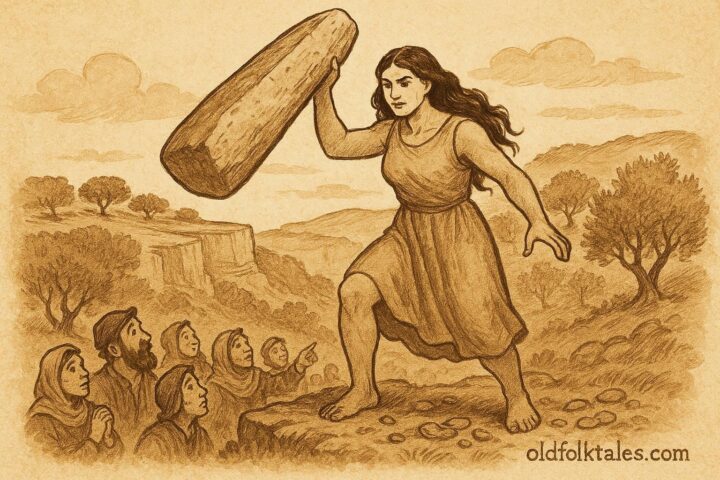
In the heart of Hungary’s Transdanubian hills, where the landscape rolled in gentle waves of emerald fields and thick forests, there once stood a small, quiet village. The houses were simple, with thatched roofs and stone chimneys, and smoke often spiraled lazily into the clear blue sky. Life here was humble and steady; the villagers farmed the land, tended their animals, and lived close to the rhythms of nature. Yet their peace was overshadowed by fear, for a giant of enormous size and terrible strength had made the surrounding hills his domain.
The giant was unlike any ordinary man. Towering above the treetops, his hands could crush wagons with a single sweep, and his deep, bellowing voice echoed through the valleys like distant thunder. From time to time, he would descend upon the village, demanding tribute, cattle, grain, gold, or anything else that glimmered or shone. Anyone who refused would face his wrath, and stories of smashed homes and frightened families circulated with each retelling.
Amid this climate of fear lived a poor tailor. Small, wiry, and humble, he spent his days repairing torn garments, stitching cloaks, and mending trousers for the villagers. Though he had little wealth, his mind was sharp, and his hands skillful. He watched the giant from a distance, noting how the creature’s greed and impatience could be predicted, and he began to devise a plan.
One morning, as the sun rose and painted the hills with golden light, the villagers gathered at the town square. Word had come that the giant would soon descend again, and panic stirred among the crowd.
“We cannot continue like this,” the mayor said, wringing his hands. “If we do not give him what he wants, he will destroy our homes and livelihoods.”
An elder spoke up. “But we are few and he is mighty. What can we do? Who has the courage, or the power, to resist him?”
The tailor, quietly listening from the corner, stepped forward. “Perhaps strength is not the only answer,” he said. “Cleverness, patience, and cunning may succeed where force cannot. Let me try to deal with him.”
The villagers exchanged worried glances. Could a small tailor possibly confront a giant? But desperation outweighed doubt, and they allowed him to proceed.
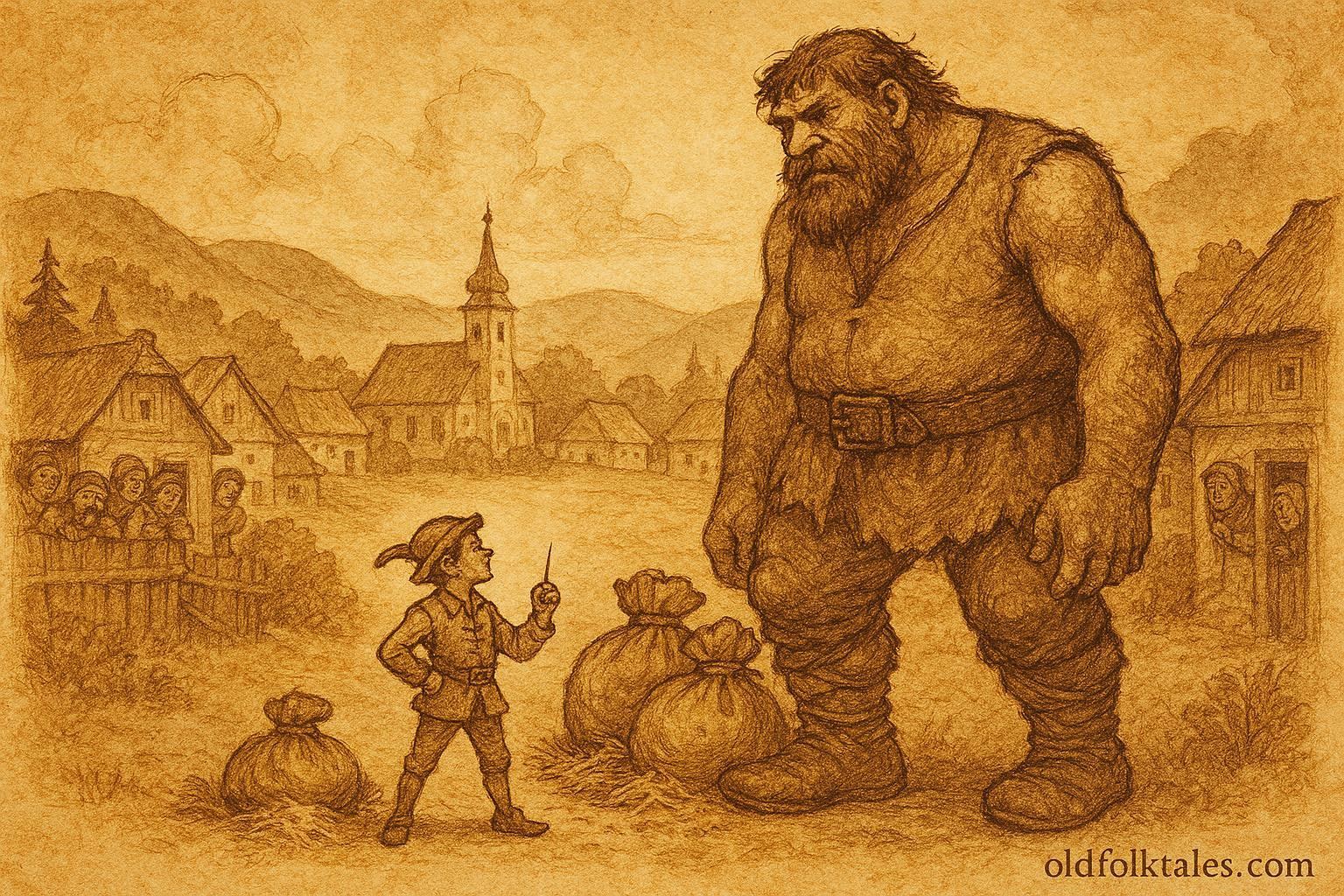
That night, the tailor worked tirelessly. He gathered scraps of cloth, sacks, ropes, and some pebbles from the river. He sewed them into bags that seemed heavy and valuable, tying each with a knot so secure that no one would suspect their emptiness. Some bags contained straw, some stones, and a few had old coins sprinkled inside to make them glitter convincingly. The tailor’s goal was simple: to fool the giant into believing the village possessed treasure beyond imagination.
The next morning, the giant appeared on the horizon. The earth seemed to quake with each of his steps, and the villagers scattered behind fences and under carts, peeking through cracks with wide eyes. The tailor, holding one of the gleaming bags, advanced boldly.
“Great Giant,” he called, his voice steady, “I have prepared a treasure worthy of your hands! But beware, these bags are protected by magic. A single misstep may bring misfortune.”
The giant’s laugh echoed like rolling boulders. “Magic?” he bellowed. “I fear nothing, little man! Bring forth your treasures!”
The tailor led the giant through the village, showing him the various bags. Some were so finely tied that even the largest of hands would have difficulty opening them. Others were marked with strange symbols the tailor had drawn, symbols that he claimed would unleash protective enchantments.
The giant, greedy and impatient, lunged at a bag. As he tore it open, straw spilled over him, and he stumbled, losing his balance. The villagers, peeking from behind fences and trees, stifled laughter and gasps. The giant roared, his anger rising, but the tailor continued, leading him from one bag to another, each filled with trickery.
Finally, the tailor reached the river, where a clever trap awaited. Using logs, vines, and planks, he had built a makeshift raft.
“Step carefully,” the tailor warned. “The treasure may sink if touched improperly.”
The giant, blinded by greed, ignored the warning and leapt onto the raft. Immediately, it sank beneath his enormous weight, plunging him into the cold, rushing waters. He thrashed and struggled, attempting to grasp the riverbank, but the swift current carried him away, far from the village. Exhausted and humbled, he disappeared over the bend, never to return.
The villagers cheered. They ran to embrace the tailor, marveling at how a man so small had defeated a being so powerful. The tailor smiled, but remained modest. “Brains often triumph where brawn fails,” he said, his voice calm. “Cleverness, courage, and careful planning can overcome even the mightiest foe.”
Grateful for his bravery, the villagers presented the tailor with gold, fine cloth, and jewels. But he accepted only enough to live comfortably and used the rest to repair homes, mend barns, and improve the village for everyone. His fame spread throughout Transdanubia, and travelers spoke of the clever tailor who had bested a giant. Children grew up hearing the tale, learning that intelligence, patience, and courage were virtues to cherish.
Years passed, and the village flourished. The hills and forests, once shadowed by fear, became places of laughter and celebration. People remembered the giant not with dread, but as a cautionary figure, a reminder that unchecked greed and pride could be undone by quick thinking and humility.
The tailor himself continued his craft, respected not only for his skill with needle and thread but for his wisdom, bravery, and ingenuity. Generations later, the story of the clever tailor who outwitted the giant remained a cherished legend, told around hearths, in marketplaces, and during village festivals, a testament to the power of wit over brute strength.
Moral Lesson
This Hungarian folktale teaches that intelligence, resourcefulness, and courage can triumph over brute strength. True heroism lies in using one’s wits to protect others, showing that careful thought and ingenuity often surpass sheer force.
Knowledge Check
- Who is the hero of the story?
A poor but clever tailor from a Hungarian village in Transdanubia. - What threat does the village face?
A greedy and powerful giant who terrorizes the villagers. - How does the tailor defeat the giant?
By using clever tricks, decoy treasures, and strategic traps. - What lessons does the tale teach?
Brains and wit can overcome brute strength; resourcefulness and courage are key. - How do the villagers reward the tailor?
They offer gold, fine cloth, and jewels, though he accepts only what he needs. - Where in Hungary does this folktale originate?
The Transdanubian region, known for its rolling hills and forests.
Source: Hungarian Folk Tales (1885)
Cultural Origin: Hungary, Transdanubian region