Long ago, in a quiet village at the edge of a vast and shadowy forest, there lived a young girl whose heart was as gentle as the morning light. Her life, however, was not easy. After the death of her mother, her father remarried, and the girl found herself under the care of a stepmother whose coldness was as biting as winter wind.
The stepmother had a daughter of her own, a girl who was indulged and protected from all hardship. While the stepdaughter was given the warmest clothes and the best food, the young girl was made to work from dawn until dusk. She fetched water from distant wells, gathered firewood in the cold, swept the house, and tended to every chore without complaint.
Explore the warmth and wit of Mediterranean storytelling, where love and wisdom intertwine
Yet, despite her suffering, she remained kind.
She did not speak harshly, nor did she let bitterness take root in her heart. Even when treated unfairly, she responded with patience and quiet strength. But her goodness only seemed to deepen her stepmother’s resentment.
One evening, as the wind howled beyond the wooden walls and the forest whispered in the darkness, the stepmother devised a cruel plan.
“You have grown lazy,” she said sharply, though the girl had not rested all day. “Tomorrow, you will go into the forest and seek out Baba Yaga. She will give you work, and perhaps teach you discipline.”
At the mention of Baba Yaga, the girl felt a chill run through her. Everyone in the village knew the stories. Baba Yaga was no ordinary woman, she was a fearsome witch who lived deep in the forest, in a hut that stood on chicken legs and turned at her command. Some said she devoured those who came to her. Others whispered that she tested those who crossed her path, rewarding the worthy and destroying the foolish.
The girl knew this was no simple errand. It was a sending away—a danger wrapped in command.
Still, she bowed her head and said softly, “Yes, Mother.”
That night, she prepared as best she could. With little to take and no one to guide her, she stepped into the forest at dawn.
The woods were thick and endless, their tall trees blocking out much of the light. The deeper she went, the quieter it became, until even the birds seemed to hold their breath. The path twisted and faded, and yet she continued, guided by nothing but resolve.
After many hours, she began to encounter strange things.
First, she came upon a small dog, thin and tangled, its fur matted and eyes weary. It looked at her with a quiet pleading.
The girl knelt beside it.
“You look hungry,” she said gently.
From the small bundle she carried, she took a piece of bread, one of the few provisions she had, and offered it to the dog. It ate gratefully, its tail wagging faintly.
“Thank you,” its eyes seemed to say, though no words were spoken.
She smiled and continued on her way.
Further along, she saw a wooden gate hanging crookedly between two posts, its hinges rusted and stiff. It creaked in the wind, struggling to remain upright.
The girl paused.
Carefully, she adjusted the gate, tightening what she could and setting it properly in place. The effort took time and strength, but she did not leave it broken.
As she moved on, the forest seemed to watch her more closely.
Soon after, she encountered a tall birch tree, its branches tangled and weighed down. A piece of cloth had become caught among its limbs, pulling them unnaturally.
The girl reached up, freeing the branches and gently removing the cloth. The tree stood straighter, its leaves rustling softly, as though in quiet thanks.
At last, as the sun began to lower, she came upon a clearing.
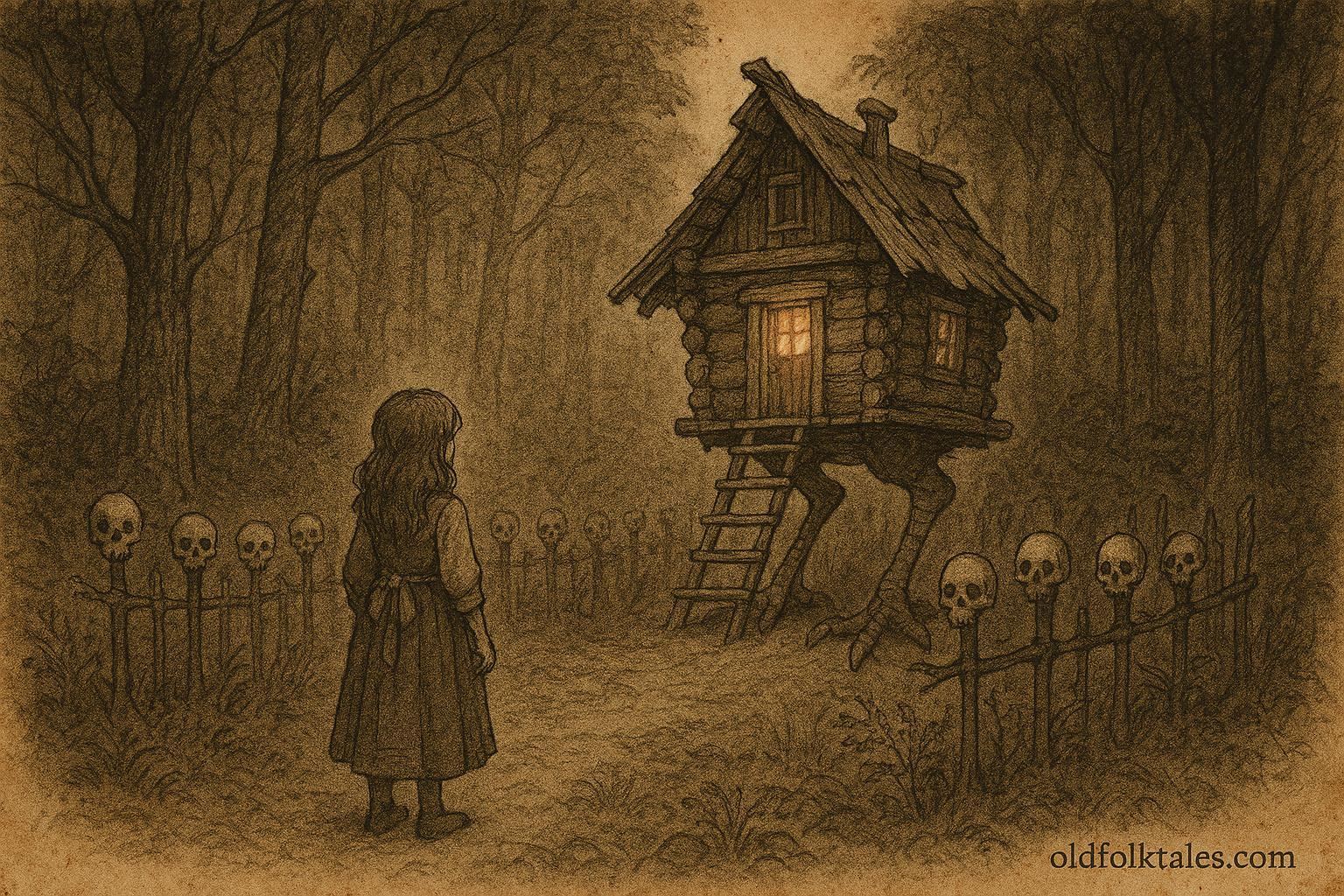
There, in the center, stood a hut unlike any she had ever seen.
It rested on long, crooked legs like those of a chicken, shifting slightly as though alive. Around it stood a fence made of bones, with skulls perched atop the posts, their hollow eyes staring into the distance.
The girl’s breath caught in her throat.
This was Baba Yaga’s dwelling.
Gathering her courage, she stepped forward.
“Little hut,” she said, remembering the old tales, “turn your back to the forest and your front to me.”
With a slow, creaking motion, the hut turned.
The door now faced her.
She stepped inside.
The air was thick and warm, filled with the scent of herbs and something darker she could not name. There, beside a great stove, stood Baba Yaga.
The witch was as fearsome as the stories claimed, her nose long and sharp, her eyes bright and piercing, her presence commanding.
“Ah,” Baba Yaga said, her voice low and knowing. “A visitor. And what brings you here, child?”
“My stepmother sent me,” the girl replied, her voice steady despite her fear. “She said you would give me work.”
Baba Yaga studied her for a long moment.
“Work, yes,” she said at last. “You may stay, if you can complete my tasks. Fail, and…” She did not finish the sentence, but her meaning was clear.
The girl nodded.
“I will try my best.”
And so began her trials.
Baba Yaga gave her tasks that seemed impossible, sorting grains from dust, preparing meals under watchful eyes, tending to strange and unsettling chores within the hut. All the while, the witch observed her closely.
Yet the girl did not complain.
She worked diligently, with care and patience, doing what she could even when the tasks seemed beyond her strength.
When night fell, she rested little, her thoughts filled with both fear and determination.
But she was not alone.
The kindness she had shown along her journey began to return to her.
The dog she had fed appeared quietly, helping her in ways small but meaningful. The gate she had fixed stood firm, protecting her from unseen dangers. The birch tree she had freed seemed to whisper guidance through the rustling of its leaves.
Each act of compassion she had given now became a source of support.
Baba Yaga noticed.
“You are not like the others,” she said one evening, her eyes narrowing slightly.
The girl said nothing, only continuing her work.
At last, when the tasks were done, Baba Yaga spoke again.
“You have completed what I asked,” she said. “And more importantly, you have shown respect, for the forest, for its creatures, and for the work itself.”
The witch stepped closer.
“Many who come here think only of themselves. They see the world as something to take from, not something to care for. But you…” She paused. “You understand balance.”
The girl lowered her gaze.
“I only did what felt right.”
Baba Yaga gave a small, approving nod.
“Then you may go,” she said. “And you will not leave empty-handed.”
She handed the girl a small bundle.
“Take this, and remember what you have learned.”
The girl accepted it with gratitude.
“Thank you.”
She left the hut, her steps lighter than when she had arrived.
The forest, once dark and uncertain, now seemed to guide her safely home.
When she returned, her stepmother and stepsister were waiting.
They had not expected her to come back.
“Well?” the stepmother demanded. “What did you bring?”
The girl opened the bundle.
Inside was a reward, not only of material value, but of something deeper, something earned through her actions.
Though the stepmother’s reaction was not kind, and though her jealousy grew, the girl herself had changed.
She was no longer just a quiet child under harsh command.
She had faced fear, shown kindness in the face of hardship, and returned stronger for it.
And as for Baba Yaga, she remained in the forest, watching, waiting, and testing those who dared to enter her domain.
Discover Polish, Russian, Ukrainian, and Belarusian folktales where magic and morality meet
Moral Lesson
Kindness, patience, and respect for others, even in difficult circumstances, are powerful strengths. True wisdom lies not in force, but in compassion and thoughtful action.
Knowledge Check
- Why was the girl sent to Baba Yaga?
Her cruel stepmother sent her into the forest as a dangerous task, hoping she would not return. - How did the girl survive Baba Yaga’s trials?
Through kindness, patience, and help from the creatures and nature she respected. - What role did the forest elements play in the story?
They helped the girl in return for her earlier acts of kindness. - What does Baba Yaga represent in the folktale?
She represents both danger and wisdom, testing the character of those who meet her. - What is the main lesson of the story?
Kindness and respect for nature lead to protection and reward. - What is the origin of this folktale?
It comes from Russian (Slavic) oral tradition, recorded by Alexander Afanasyev.
Source: Russian Fairy Tales by Alexander Afanasyev (published 1855–1863)
Cultural Origin: Slavic (Russian oral tradition)