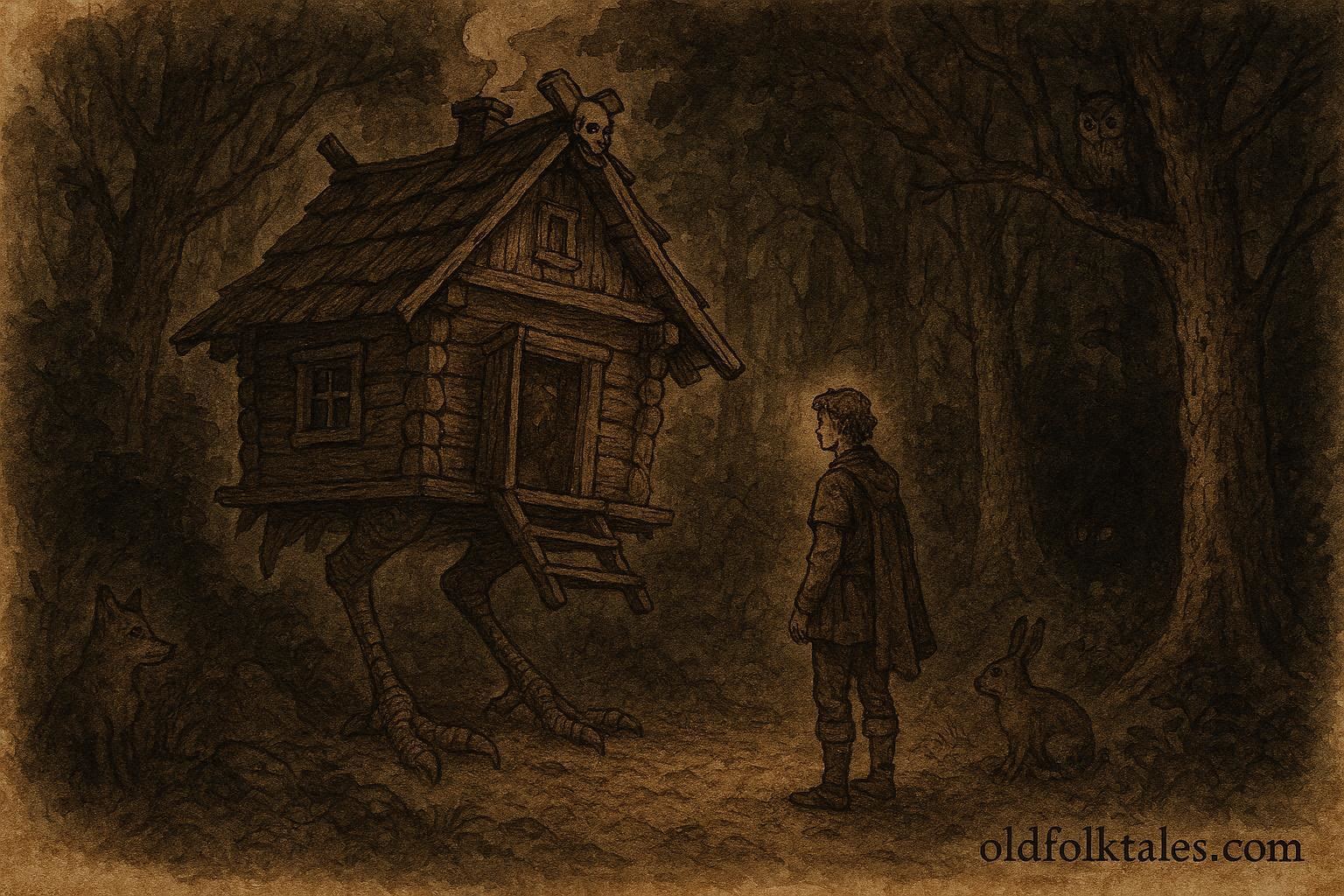
Beyond the last plowed fields of the village, where fences ended and paths dissolved into shadow, stretched the great forest. The villagers spoke of it in lowered voices, for it was no ordinary woodland. The trees grew too tall, their roots twisting like coiled serpents beneath the earth, and the air beneath their branches carried the scent of damp moss and old secrets. It was said that the forest belonged not to people, but to spirits, and to Baba Yaga.
In a small village at the forest’s edge lived a young man whose name has been lost to time, as often happens in old stories. He was neither prince nor warrior, but he possessed something rarer: a steady heart and a mind willing to learn. When misfortune fell upon his household and a task arose that no ordinary effort could solve, the elders spoke a single name in grim agreement. Baba Yaga.
The Task That Could Not Be Refused
The young man was sent from home with little more than a loaf of bread, a bundle of clothes, and a warning repeated by every voice he passed: “Show respect, listen more than you speak, and do not trust appearances.”
What he was sent to retrieve, or what task he was sent to complete, varied in the telling, but the meaning never changed. Only Baba Yaga possessed the knowledge or object required, and only one who passed her trials could earn it.
The young man stepped beneath the trees, and the forest closed behind him.
Lessons of the Road
The deeper he walked, the quieter the world became. Birds ceased their songs. Even the wind seemed cautious. Along the path, he encountered creatures others would ignore or mistreat, a limping wolf, a bird with a broken wing, a tired cat shivering beneath a fallen log.
Each time, the young man paused.
He shared his bread, straightened branches, or spoke gentle words. He did not know why he did these things. He only felt that the forest was watching, and that every action carried weight.
Each animal thanked him in its own way, their eyes glinting with an intelligence that suggested more than fur and feathers.
The Hut on Chicken Legs
At last, as twilight bled into darkness, he reached a clearing where the trees bent inward like a circle of witnesses. There stood a hut unlike any other, perched upon great chicken legs, turning slowly as if sniffing the air.
The young man remembered the warning and spoke respectfully.
“Hut, hut, turn your back to the forest and your front to me.”
The hut creaked, groaned, and obeyed.
The door opened on its own.
Meeting Baba Yaga
Inside, the air was thick with smoke and the scent of herbs. Skulls glimmered faintly from the walls, their empty eyes catching the firelight. At the center of the hut sat Baba Yaga, her back bent, her nose long, her hair tangled like dry roots.
Her voice scraped like bark against stone.
“Why do you come, young man? Do you seek death, or wisdom?”
The young man bowed low and answered truthfully. He did not boast. He did not beg. He stated his task plainly and waited.
Baba Yaga’s eyes narrowed.
The Trials Begin
Baba Yaga agreed to help him, but not freely.
“If you are clever, you will live,” she said. “If not, my oven waits.”
She set him to tasks meant to exhaust, confuse, and frighten, sorting grains too fine for mortal fingers, cleaning her yard before dawn, guarding her possessions without falling asleep.
The witch watched closely, testing not his strength, but his judgment.
Help from the Forest
When despair crept close, help arrived, not by magic words, but by earned loyalty.
The animals he had aided returned. The bird sorted grains with its beak. The cat kept watch. The wolf guarded the gate.
The young man did not command them. He thanked them.
Baba Yaga noticed.
Wisdom Over Trickery
At dawn, Baba Yaga questioned him. She twisted her words, seeking arrogance or fear. The young man answered carefully, neither flattering nor defying her.
Finally, she laughed, a sound like cracking ice.
“You are not strong,” she said. “But you are not foolish.”
She granted him what he sought and warned him:
“Remember what you learned. The forest remembers.”
The Return
The path home felt shorter, though no less strange. The forest released him slowly, as if satisfied. When he emerged into daylight, he carried more than a prize, he carried understanding.
He returned changed. Not louder. Not prouder. But wiser.
Discover Polish, Russian, Ukrainian, and Belarusian folktales where magic and morality meet
Moral Lesson
This folktale teaches that survival and success come not from force or arrogance, but from respect, patience, and wisdom. Those who honor nature and listen to its lessons gain allies unseen by the proud.
Knowledge Check
-
Who is Baba Yaga in Slavic folklore?
A powerful forest witch who tests travelers through dangerous trials. -
Why is the young man sent to her hut?
To obtain knowledge or complete a task impossible by ordinary means. -
What helps the hero succeed?
Kindness to animals, humility, and careful judgment. -
What does the forest symbolize?
The unseen world of spirits, nature, and moral testing. -
Why does Baba Yaga spare him?
Because he proves wise rather than arrogant. -
What lesson does the story emphasize?
Respect for nature and wisdom over brute strength.
Source: Russian oral folktale tradition. Collected in 19th-century Slavic folktale compilations, ca. 1800s
Cultural Origin: Slavic & Russian folklore