Long before Venice became a name whispered with awe across Europe, before marble palaces leaned over the canals and bells echoed across the lagoon, the city already lived and breathed like a thinking being. The Venetians of old believed this deeply. They said Venice was not merely stone and water, but a spirit clothed in beauty, watching those who passed through her narrow veins of water.
In those days, sailors, traders, and merchants arrived daily from distant shores. Their boats slid softly between wooden poles slick with algae, their oars dipping into green water that reflected sky and palace alike. Venice welcomed many, but not all equally.
Discover the moral heart and wild spirit of the north through timeless Nordic storytelling
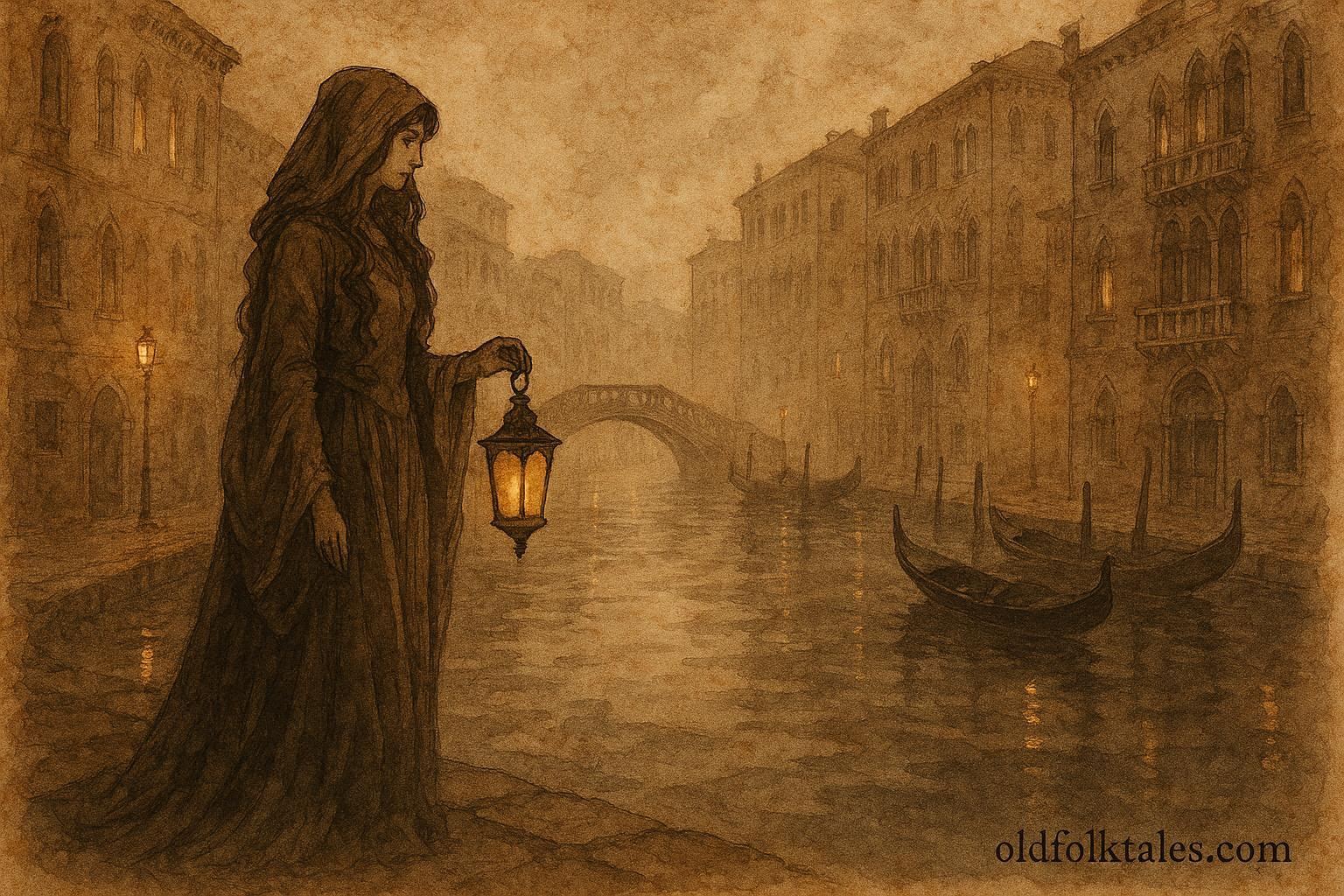
It was during these early centuries that stories began to circulate of a woman seen at dusk and dawn. She appeared where the canals twisted most sharply, where fog rolled thick and bells rang faintly across the water. Some said she saved lives. Others swore she led men to ruin.
They called her Bella Venezia.
The Woman on the Water
The first to speak openly of her were sailors, rough men hardened by storms yet unsettled by what they saw in Venice. More than one claimed that on mist-heavy nights, a woman stood at the edge of the canal or upon a narrow bridge, her figure pale against the dark water.
She was always dressed simply, though her clothing seemed to belong to no single era. Sometimes she wore a long gown like those painted in old churches; at other times, a shawl like those worn by fisherwomen of the lagoon. Her hair was dark and loose, stirred gently by the damp night air, and her eyes reflected lantern light like rippling water.
She never shouted. She never chased. She only guided.
To honest sailors lost in the maze of canals, she would raise her hand and point silently. Those who followed her gesture found themselves led to open water, to familiar quays, or safely back to their lodgings. Many swore that after obeying her, the fog lifted as if pushed aside by unseen hands.
Yet others told a darker story.
The Greedy Merchant
One such tale concerned a wealthy merchant from the mainland, a man known for clever deals and sharp practice. He arrived in Venice with chests of silver and silk, intent on exploiting the city’s markets while giving little in return. He bribed officials, cheated dockworkers of fair wages, and mocked the city’s traditions.
Late one night, after drinking heavily, he set out by boat alone, eager to hide his profits before morning. The canals were unusually quiet, the air thick with mist. As he hesitated at a crossing of waterways, a woman appeared on a nearby step.
She gestured left.
The merchant laughed. He knew Venice well enough, or so he believed. Ignoring her, he ordered his oar toward the darker channel to the right. But as the boat moved, the water grew sluggish, then restless. The fog thickened until even the lantern light seemed swallowed.
Moments later, the boat struck unseen debris and capsized.
By dawn, the merchant was found clinging to a rotten piling, his silver lost to the depths. Some versions say he survived, ruined and humbled. Others say the lagoon kept him forever. What all agreed upon was this: the woman had warned him.
The Spirit Revealed
As stories multiplied, patterns emerged. Those who respected Venice, its people, its waters, its fragile balance, were aided. Those who sought only profit, who treated the city as a thing to be used, found themselves misled, delayed, or undone.
Gradually, the people understood.
The woman was not a ghost, nor a saint, nor a demon. She was Venice itself.
They began to call her Bella Venezia, Beautiful Venice, not as flattery, but as recognition. She embodied the city’s grace and danger, its generosity and wrath. Like the tide, she gave and took away without apology.
Fishermen left offerings of bread or flowers at certain bridges. Gondoliers whispered greetings when fog thickened suddenly. Mothers warned their children never to insult the city, for Venice heard all.
The Sailor Who Listened
One of the most beloved stories tells of a young sailor newly arrived from the Adriatic coast. He was poor but careful, respectful of local customs, and quick to help others. One evening, after assisting an old dockworker without payment, he lost his way returning to his lodging.
As fear crept in, he noticed a woman standing at a narrow crossing. She did not speak but met his gaze. The sailor bowed his head—a gesture of respect learned from his mother and waited.
Only then did she point.
He followed, and the canals seemed to open before him. Lamps glowed brighter. The smell of bread reached his nose. Soon he stood before his door.
When he turned to thank her, she was gone. But the next morning, he found steady work, fair pay, and favor among his fellows. Venice had accepted him.
The Lesson of the City
Over generations, Bella Venezia became less a figure of fear and more a moral presence. She reminded the people that Venice was alive, delicate, and demanding of care. Built on water, balanced by human effort, the city could not survive greed without consequence.
Those who listened prospered quietly. Those who mocked her warnings learned, often too late, that beauty is not weakness, and that even stone and water have memory.
To this day, Venetians say that when the fog moves strangely, or a canal seems to lead somewhere unexpected, Bella Venezia is watching.
Explore the warmth and wit of Mediterranean storytelling, where love and wisdom intertwine
Moral Lesson
Bella Venezia teaches that places, like people, deserve respect. Those who honor their surroundings and act with integrity are guided safely, while greed and arrogance invite their own downfall.
Knowledge Check
1. Who is Bella Venezia in Venetian folklore?
Bella Venezia is the living spirit of the city of Venice, guiding and judging those who travel its canals.
2. How does Bella Venezia help honest travelers?
She silently guides respectful sailors and merchants safely through fog and confusing waterways.
3. What happens to greedy or corrupt individuals?
They are misled, delayed, or punished by the city itself, often losing wealth or safety.
4. Why is Bella Venezia associated with canals and fog?
These elements reflect Venice’s mysterious nature and its dependence on water and balance.
5. What cultural value does the story emphasize?
Respect for place, moral accountability, and harmony between humans and their environment.
6. Where does this folktale originate?
From Venetian oral folklore, Northern Italy, recorded in regional collections.
Source: Venetian oral folklore, recorded in regional collections, Late 18th–early 19th century (oral tradition)
Cultural Origin: Venice, Northern Italy