Long ago, in the sun-drenched lands of Lycia, where rugged mountains rose from plains dotted with olive groves and the sea glimmered in the distance, there lived a young hero named Bellerophon. Brave, strong, and noble of heart, he was known across the hills and valleys as a man of courage unmatched among mortals. Yet he was also ambitious, and ambition, the elders whispered, can be a dangerous companion.
Bellerophon had heard tales of a dreadful creature, the Chimera, a monstrous hybrid that breathed fire, had the head of a lion, the body of a goat, and the tail of a serpent. This terror roamed the hills, burning villages, devouring livestock, and striking fear into every heart. To rid his people of this menace was no ordinary task, it was a quest that would demand not only strength but cunning and the favor of the gods.
Discover the moral heart and wild spirit of the north through timeless Nordic storytelling
Before he could challenge such a creature, Bellerophon needed a steed capable of matching its swiftness and soaring above impossible heights. This steed was no ordinary horse. It was Pegasus, the winged horse, born of Poseidon’s power and nurtured in secret by the gods. Yet Pegasus, proud and untamed, would not bow to any mortal without divine aid.
Bellerophon prayed to Athena, the goddess of wisdom and war. Her presence was subtle but commanding, and in dreams she appeared to him, radiant and calm. She advised him: “Sleep upon this, son of Glaucus. When morning comes, a golden bridle shall appear. With it, you may capture Pegasus without harm. Your courage and respect will guide you, but pride alone will not command the winged horse.”
Following her guidance, Bellerophon rose at dawn and journeyed to a quiet spring where Pegasus drank. There, gleaming in the sunlight, lay a golden bridle, suspended as if by invisible hands. With gentle hands and steady heart, Bellerophon approached. The winged horse reared and snorted, fire dancing in his eyes, but Athena’s gift glimmered like the first light of day. With patience, Bellerophon slipped the bridle over Pegasus’ head. Instantly, the horse calmed, kneeling at the hero’s command.
Mounted upon Pegasus, Bellerophon felt a thrill beyond earthly joy. With a single leap, the horse’s wings unfurled, and together they soared into the skies, above mountains, rivers, and forests. The world beneath seemed fragile and distant, yet the task ahead weighed heavily on Bellerophon’s heart. The Chimera awaited.
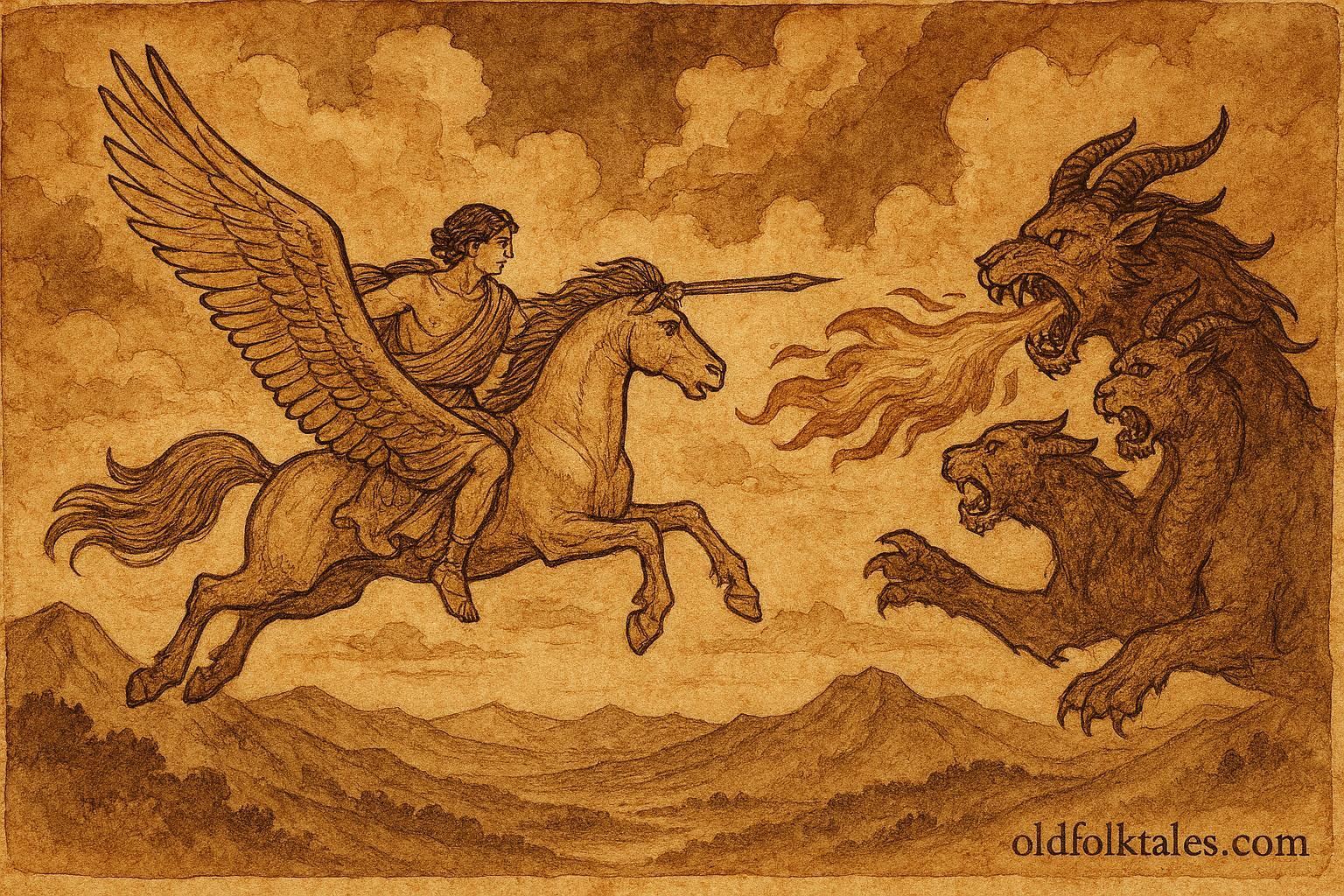
The beast lurked in a valley shadowed by cliffs, its roar shaking the earth and its flames licking the heavens. Bellerophon, undaunted, approached with both caution and determination. From above, Pegasus swooped, gliding silently with the wind beneath his wings. The Chimera saw them and roared, flames bursting from its triple heads. Villagers below fled in terror, and the earth trembled with the clash of beast and hero.
Bellerophon guided Pegasus skillfully. He avoided the fiery breath of the lion, the snapping jaws of the goat, and the venomous strike of the serpent tail. Then, with a lance tipped in lead, a gift from the god Hephaestus, who forged it to withstand the Chimera’s fire, he attacked. The lead melted in the Chimera’s flames and poured into its throat, choking the creature. A final cry echoed across the hills, and the Chimera fell, defeated, leaving the valleys safe once more.
Victory brought Bellerophon great renown. Mortals praised him; kings offered gifts. Pegasus carried him across the land, and for a time, the hero seemed unstoppable. Yet with triumph came temptation. Pride crept into Bellerophon’s heart like a shadow in the bright sun. The gods had aided him, yet now he imagined that no heights were beyond his reach.
One day, intoxicated by success and confidence, Bellerophon looked toward the ultimate goal: Olympus, the home of the gods. “Why should I, a mortal, remain earthbound?” he thought. “With Pegasus beneath me, I may rise to the very halls of the divine.”
He mounted Pegasus and urged him higher, beyond familiar skies, beyond clouds that brushed mountain peaks, toward the glittering palaces of Zeus and the immortal company of Olympus. The wind roared and the sun shimmered, but the gods observed silently, their eyes unyielding.
Zeus, king of the gods, saw the mortal’s hubris. Anger stirred within him, tempered by justice and divine law. Mortals were not meant to trespass among immortals, nor to claim the heights reserved for gods alone. From Olympus, Zeus summoned a gadfly, small, swift, and relentless. The creature stung Pegasus as they rose, biting with fire and piercing the horse’s flank.
Pegasus leapt and veered wildly, wings beating furiously. Bellerophon clung desperately, yet the noble horse could not be restrained. Higher and higher they spiraled, then suddenly Pegasus pitched, wings folding in panic, and the hero fell from the sky. He tumbled across rocks and hills, crashing to the earth, the wind ripped from his lungs. When he finally came to rest, he was broken, limbs crippled, pride shattered, and humbled.
Though he survived, Bellerophon was no longer the man who had dared the impossible. The lessons of ambition, divine favor, and humility weighed upon him. He lived afterward in solitude, respected and remembered, yet never again did he attempt to rise beyond mortal bounds. Pegasus returned to the heavens, free and untamed, a reminder that even the mightiest gifts must be tempered by wisdom.
And thus, the story of Bellerophon endured, a cautionary tale whispered across generations: greatness can be granted by gods, but the limits of mortals are set by the same hands that give blessings. Pride unchecked invites ruin, while humility preserves life and honor.
Discover the spiritual depth and wisdom hidden in the ancient folklore of Eastern and Balkan Europe
Moral Lesson
This myth teaches that mortal ambition must be tempered with humility. Even divine gifts can become a source of downfall if pride overcomes prudence. True heroism lies in courage and respect for limits, not in daring to claim the realm of the gods.
Knowledge Check
-
Who aids Bellerophon in capturing Pegasus?
Athena, goddess of wisdom and war. -
What monster does Bellerophon defeat with Pegasus?
The Chimera, a fire-breathing beast with lion, goat, and serpent features. -
Why does Bellerophon attempt to fly to Olympus?
Pride and ambition lead him to desire the heights of the gods. -
How does Zeus punish Bellerophon?
He sends a gadfly to sting Pegasus, causing the hero to fall. -
What is the key moral of the story?
Mortal ambition has limits; pride before the gods brings downfall. -
What does Pegasus symbolize in this myth?
Divine assistance and the freedom that must be respected.
Source: Homer, Iliad, Book VI, c. 8th century BCE
Cultural Origin: Ancient Greece (Lycian tradition)