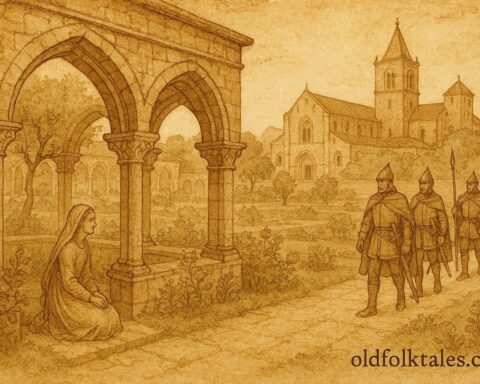
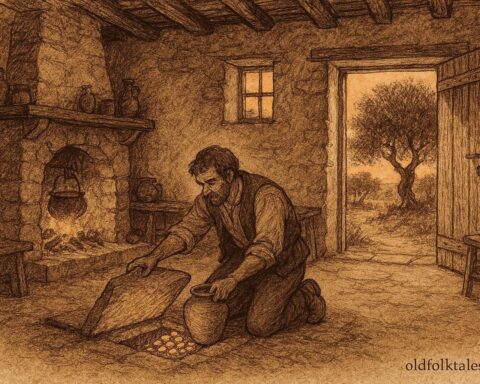
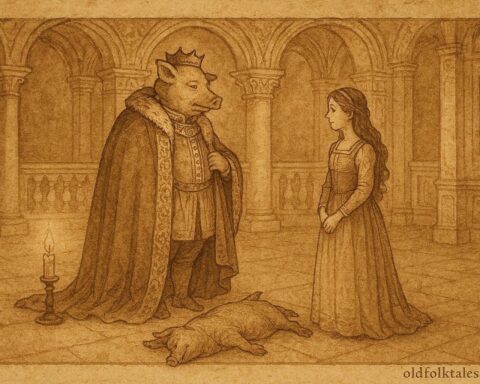
In the heart of Montale, a quiet town nestled among the rolling hills of central Italy, there once lived a merchant with three daughters. The youngest, Bellindia, was as kind as she was beautiful. Her eyes shone with gentleness, and her voice carried warmth that could calm even the most restless heart. Her father loved her dearly, but as fate would have it, her innocence would soon lead her into a strange and fateful destiny.
One day, the merchant prepared to travel for business to a distant city. Before leaving, he asked his daughters what gifts they would like him to bring back. The eldest wished for fine silk to make a gown; the second desired a golden necklace. But Bellindia asked only for a single golden carnation, a flower said to bloom once every hundred years in the depths of the forest.
The merchant smiled at her simple request, but when he reached the city, he found silks and jewels aplenty, yet no trace of a golden carnation. On his way home, weary and disappointed, he lost his path and wandered deep into a dense wood. There, hidden among ivy and old oak roots, he saw a glowing light. Following it, he came upon a magnificent garden blooming with flowers in impossible colors, and in the center stood the golden carnation, gleaming as if made of sunlight itself.
Awed by its beauty, the merchant reached out and plucked the flower. But before he could leave, the ground trembled beneath him. From behind the trees emerged a fearsome monster, half-beast, half-man, with eyes burning like embers and a voice that echoed through the forest.
“Who dares steal my golden carnation?” roared the creature.
The merchant fell to his knees, trembling. “Forgive me, lord of the forest. I meant no harm. I only wished to bring it to my daughter, Bellindia.”
The monster’s gaze softened slightly. “You have taken what was dearest to me,” he said. “But if your daughter loves you truly, she must come to dwell with me in your place. Only then shall you live.”
Terrified, the merchant agreed. When he returned home, he wept as he told his daughters what had happened. The two eldest recoiled in fear, but Bellindia, moved by her father’s grief and bound by her own sense of duty, spoke softly: “Do not weep, Father. You gave your word, and I will go.”
The next morning, she set out for the forest, clutching the golden carnation close to her heart. The path led her through mist and shadow until she reached the gates of a grand castle. Though its walls were overgrown with vines, inside it shimmered with light, music, and the scent of roses.
The Monster awaited her. His appearance was dreadful, but his voice, when he spoke, was gentle. “Welcome, Bellindia. You are mistress here. No harm shall come to you.”
Days turned into weeks, and Bellindia began to see that beneath his monstrous form lay a heart full of sorrow and kindness. He spoke to her softly, brought her gifts, and ensured she never lacked comfort. Yet each night, before sleep, he asked her the same question:
“Bellindia, will you be my wife?”
And each night, she answered with hesitation, “No, my lord. I cannot.”
Though the Monster always sighed in sadness, he never grew angry.
One day, Bellindia was allowed to visit her father. The Monster warned her gently, “You may go, but promise to return within three days, or I shall die of grief.” She agreed, and he gave her a magical ring that would carry her home in an instant.
At home, her sisters mocked her when they learned she lived with a beast. “You, a bride to a monster? How could you bear it?” they sneered. But Bellindia spoke little, her heart uneasy. On the third day, when she failed to return, she dreamed of the Monster lying pale and dying among the flowers of his garden. Startled awake, she slipped the ring on her finger and wished to return.
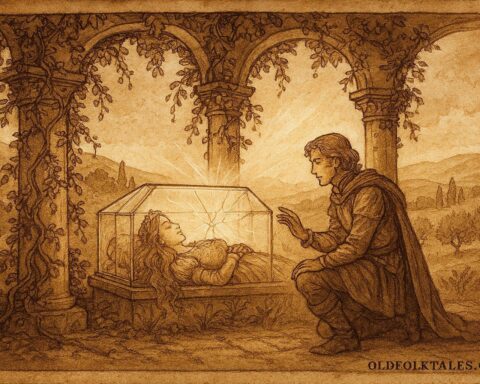
In a blink, she was back in the castle. The once-bright halls were dim, and in the garden lay the Monster, motionless beside the golden carnation. Tears streamed down her cheeks as she cried, “Oh, my poor Monster! Forgive me! I was foolish and cruel to delay.”
She kissed his forehead, and in that instant, a brilliant light surrounded them. When it faded, the beast was gone, and in his place stood a handsome prince, freed from an ancient curse.
He smiled and said, “Your love and loyalty have broken the spell, Bellindia. You have given me life again.”
The castle came alive with music and laughter as the servants, once enchanted, rejoiced. Bellindia and the prince were wed, and their joy spread through Montale as a tale told for generations, a story of love that saw beyond appearances and courage that conquered fear.
Moral of the Story
True beauty lies not in outward form but in the heart’s purity and compassion. Love, when born of kindness and trust, has the power to break even the darkest enchantment.
Knowledge Check
-
1. Who collected the story “Bellindia and the Monster”?
This Italian folktale was collected by Gherardo Nerucci in Sessanta novelle popolari montalesi and also by Domenico Comparetti.2. What does the golden carnation symbolize in the story?
It represents Bellindia’s innocence and the rare, unselfish nature of true love.3. Why does the Monster demand Bellindia’s presence?
Because her father stole the golden carnation, and the Monster demands a life in exchange, but ultimately, it leads to Bellindia’s redemptive love.4. How does Bellindia break the curse?
Her sincere love and act of compassion, kissing the dying Monster, lift the enchantment and restore his true form.5. What region of Italy does this folktale originate from?
The tale originates from Montale, a region in central Italy.6. What is the main lesson of “Bellindia and the Monster”?
That love born of goodness and sacrifice can reveal true beauty and restore what has been lost.
Source: Italian folktale, Montale region.
Adapted from “Bellindia e il Mostro” collected by Gherardo Nerucci in Sessanta novelle popolari montalesi and by Domenico Comparetti.