Long ago, when the fields and forests of Leicestershire, England, stretched darker and wilder than they do today, there rose a lonely place known as Dane Hills. The hills were thick with ancient oaks, tangled roots, and shadowed paths that twisted away from the safety of villages. By daylight, shepherds passed quietly and children played at the forest’s edge. But as dusk crept in and the sun sank low, the air grew heavy with warning.
For in those hills lived Black Annis.
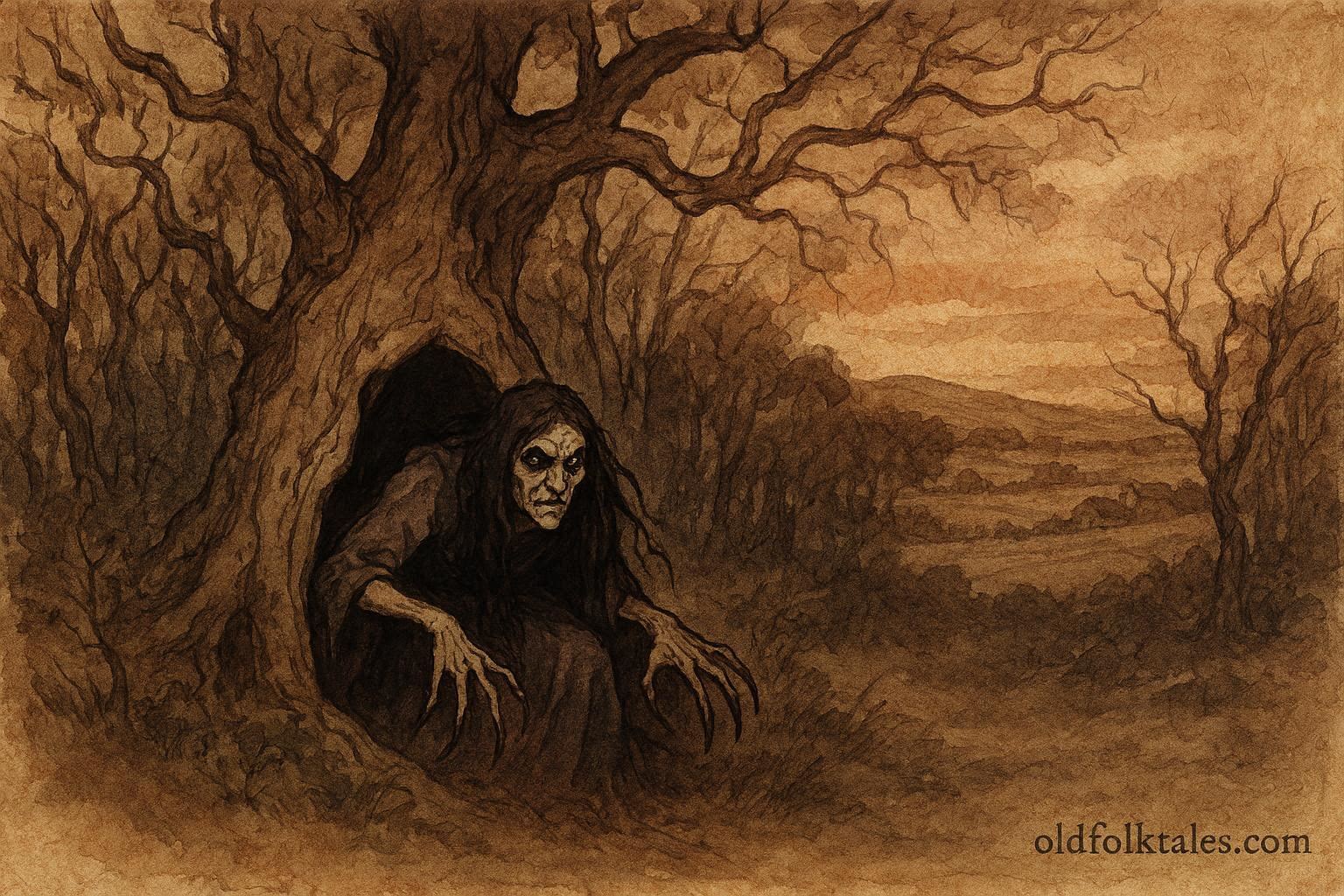
Black Annis was said to be an old woman, ancient beyond memory, with skin as dark as storm clouds and a face carved by time and hunger. Her eyes glinted like dying embers, and her long iron claws curved like sickles, sharp enough to tear bark from trees or stone from earth. Some said she lived inside a great hollow oak, its trunk split by age and lightning. Others whispered that she hid in a deep cave, carved into the hillside like a wound in the land itself. Wherever her dwelling lay, it was agreed upon by all: it was a place no child should ever approach.
Parents spoke of her in hushed voices, especially when evening shadows stretched across the fields. As the sky dimmed and the birds fell silent, mothers would call their children home, and fathers would bar the doors.
“Come inside before nightfall,” they warned.
“Do not stray toward the woods.”
“Black Annis walks when the sun is gone.”
It was said that Black Annis watched from the darkness, waiting patiently for those who disobeyed. She preyed upon children who wandered too far from home, especially those who ignored their parents’ calls or lingered after dusk. The forest, once friendly and green, became dangerous in her presence. Leaves whispered secrets, branches clawed at sleeves, and every hollow seemed to breathe.
Those who believed the old tales claimed that Black Annis would snatch careless children and drag them back to her lair. There, beneath the twisted roots of the oak or within the cold stone cave, she would keep them from ever returning. Some said she wore their skins like cloaks to protect herself from the cold. Others claimed she devoured them entirely. The truth was never fully spoken, only hinted at, just enough to let fear do its work.
Children did not need to see Black Annis to fear her. Her power lived in warnings, in the sharp call of a parent’s voice, in the sudden chill that followed sunset. A child lingering too long at play would imagine her crooked shape moving between the trees. A snap of a twig might become the scrape of her claws. In this way, Black Annis was everywhere, even when unseen.
The elders of Leicestershire understood this well. In an age without streetlamps or safe roads, the wilderness posed real danger. Wolves roamed in earlier times, and thieves and unseen hazards lay beyond village boundaries. Fear, shaped into story, became a tool of protection. Black Annis was not merely a monster; she was a guardian of boundaries, standing between children and the perils of the night.
As generations passed, the tale endured. Grandparents repeated it as they had once heard it themselves. Though fewer children now wandered the Dane Hills, the name Black Annis remained heavy with meaning. She became part of the land’s memory, a reminder of when nature was untamed and survival depended on obedience and caution.
Even as the world changed, the legend lingered. The oak trees still stood, ancient and watchful. The hills still darkened at dusk. And though Black Annis may no longer stalk the shadows, her lesson remained firmly rooted in English folklore: some rules exist not to frighten, but to protect.
Moral Lesson
The story of Black Annis of Dane Hills teaches that obedience and attentiveness to guidance are essential for safety, especially in unfamiliar or dangerous places. Fear, when wisely used, can serve as protection, reminding children, and adults, that boundaries exist for a reason.
Knowledge Check
1. Who is Black Annis in English folklore?
Black Annis is a fearsome folkloric figure depicted as an old woman who preys on disobedient children.
2. Where is the legend of Black Annis set?
The legend originates from Dane Hills in Leicestershire, England.
3. What purpose did the story of Black Annis serve?
It was used as a cautionary tale to keep children obedient and safe, especially after dark.
4. Where was Black Annis said to live?
She was believed to dwell in a hollow oak tree or a cave in the hills.
5. What themes are central to the Black Annis folktale?
Obedience, fear as moral instruction, and the dangers of the wilderness.
6. Why was fear important in this folktale’s cultural context?
Fear acted as a protective tool in a time when the wilderness posed real threats.
Source & Cultural Origin
Source: Recorded by John Brand in Observations on Popular Antiquities (1777)
Cultural Origin: Leicestershire, England
Tradition: English folklore (earlier oral tradition)