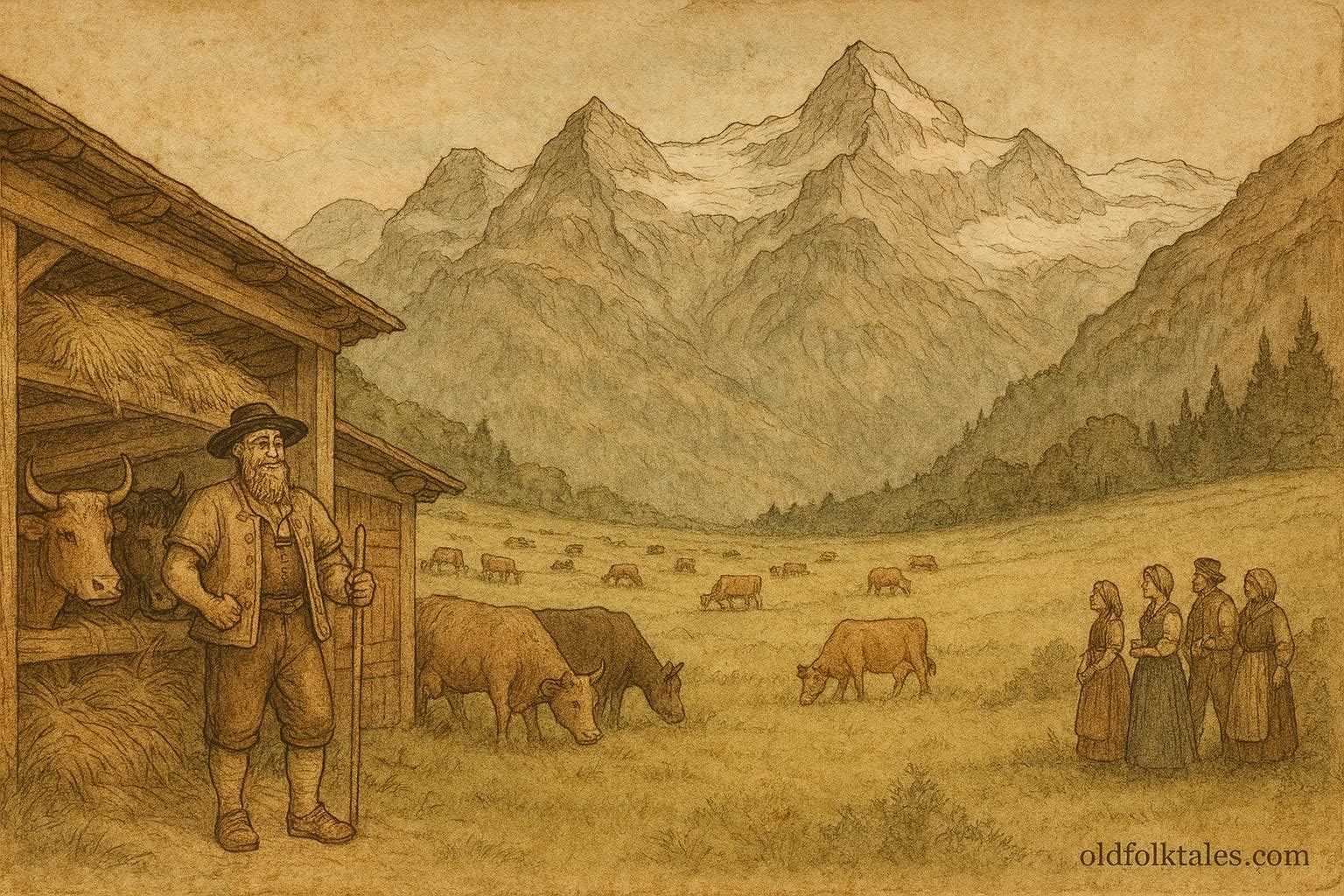
High in the heart of the Bernese Alps, where jagged peaks pierced the sky and alpine winds whispered through valleys, there once lay a pasture of unimaginable fertility. This was Blüemlisalp, a place where the grass grew thick and sweet, and the alpine flowers bloomed in riotous colors across gentle slopes. Streams ran clear and cold, their waters teeming with fish, and the sun touched every meadow with warmth and abundance. For generations, the villagers from nearby settlements had looked to this land as a shared treasure, a place where their livestock could graze and their families could gather the gifts of nature.
At the heart of this tale was a herdsman, a man whose wealth was unmatched in the region. He owned more cattle than any other in the valley, and his barns were perpetually filled with cheese, butter, and the richest cream the Alps could yield. Yet, for all his wealth, his heart was narrow. He guarded the lands of Blüemlisalp with a possessiveness that was known to every villager. When shepherds from neighboring hamlets came asking for help, some seeking just a handful of hay, others hoping for temporary grazing—he refused. He would watch them with sharp eyes, his lips thin and unmoving, and turn them away without a word of pity.
Discover the timeless charm of French, Dutch, and Belgian stories filled with cleverness and heart
This herdsman’s greed grew in proportion to his wealth. He began building high fences across meadows, cutting off even the gentlest slopes from the reach of those who had once shared the land freely. The villagers whispered among themselves, saddened by the transformation of a place that had once been a haven for all. Children who once played among the flowers now stared from a distance at the fences, their laughter silenced by the unyielding walls. Even the shepherd dogs seemed to sense the coldness of the land, and would howl mournfully when their masters tried to cross into forbidden meadows.
It was said that the mountains themselves watched these events. The peaks of Blüemlisalp, majestic and eternal, were not blind to human deeds. They had long been regarded as silent judges, guardians of balance between men and nature. On one particular summer’s day, as the herdsman counted his overflowing stores of cheese and milk, a strange stillness fell over the valley. Birds ceased their song; the wind paused mid-flight; even the streams seemed to hesitate in their flow. The villagers looked up from their work and whispered anxiously, sensing that the mountain had noticed the herdsman’s cruelty.
That evening, as twilight draped the slopes in violet and gold, the herdsman returned to his solitary hut atop the highest meadow. The sky had begun to darken with clouds that gathered without wind, and a strange chill swept through the air. He ignored it, counting coins and tasting the richness of his butter, blind to the omens that nature had sent. But when night fell, a deep rumble shook the valley. The herdsman rushed outside, heart pounding, only to see a transformation unfolding before his very eyes. The grass he had prized so dearly began to wither, and flowers that had painted the meadows in crimson and blue shriveled to dust. Streams once full of life slowed, then froze, leaving the land barren and harsh.
The villagers, watching from afar, could hardly believe their eyes. The meadows of Blüemlisalp, which had provided their sustenance for generations, were disappearing as though the mountains themselves had drawn a curtain over their abundance. The herdsman’s barns, full the previous day, were now emptied by unseen hands; his cattle huddled in confusion, unable to graze, their strength fading with each passing hour. The once-lush pastures were replaced with rocks jagged and cold, glaciers creeping slowly down the slopes. Where wildflowers had grown, only frost and stone remained, and the air carried a biting chill that had never been known before.
In despair, the herdsman fell to his knees and pleaded with the mountains. “Forgive me,” he cried, “for I did not share my bounty! I did not see the needs of others!” But the mountains, immutable and eternal, offered no comfort. They had witnessed the selfishness that had poisoned the harmony of the land. The transformation continued, relentless and thorough. By dawn, Blüemlisalp had been stripped of its generosity; what remained was a stark, unforgiving landscape, where only the strongest could survive, and where the memory of its former abundance seemed to linger like a ghost in the wind.
The villagers ventured carefully toward the slopes, seeing the full extent of the change. They mourned not only for the herdsman, who had lost everything, but for the land itself, which had been punished as much as its keeper. From that day forth, the story of Blüemlisalp became a cautionary tale told around hearths and in village squares: the mountains reward generosity and punish selfishness, and no amount of wealth can protect a heart that refuses to give.
Over time, even the herdsman learned a bitter lesson. He wandered the remaining pastures, tending to what little livestock had survived, offering help where he could, and speaking to villagers with humility he had never known before. Though the land never returned to its former fertility, his actions softened the harshness of life in the valley, and the villagers gradually forgave his earlier transgressions. Yet, the tale of Blüemlisalp’s vanished abundance endured, a stark reminder that greed can transform not only communities but the very world we live in.
And so the Alps themselves, in their quiet majesty, remind every traveler who gazes upon the jagged peaks and frozen glaciers of Blüemlisalp: abundance is fleeting without generosity, and the land remembers every act of selfishness. The story is still told, not just as a legend, but as a moral compass for those who live among the mountains, guiding the hearts of young and old alike.
Moral Lesson
Greed and selfishness can corrupt both community and nature, while generosity fosters harmony and enduring abundance. True wealth lies not in hoarded riches, but in shared prosperity and care for the world around us.
Knowledge Check
-
Q: Who was the main character in the Blüemlisalp folktale?
A: The main character was a wealthy, selfish herdsman who refused to share the fertile alpine pastures with villagers. -
Q: What caused the transformation of the Blüemlisalp meadows?
A: The herdsman’s greed angered nature, causing the land to turn into harsh rocks and glaciers as punishment. -
Q: What moral does the Blüemlisalp legend teach?
A: It teaches that selfishness leads to loss and suffering, while generosity fosters community and harmony with nature. -
Q: Which geographical region is the story of Blüemlisalp linked to?
A: It is linked to the Bernese Alps region of German-speaking Switzerland. -
Q: How did the villagers respond to the herdsman’s initial selfishness?
A: They were saddened and whispered among themselves, noting the loss of shared abundance. -
Q: What symbolic role do the mountains play in the folktale?
A: The mountains act as moral agents, punishing greed and rewarding generosity.
Source: Adapted from Alpine lore, documented in written forms by scholars such as Johann Jakob Scheuchzer, 1707, Switzerland.
Cultural Origin: Bernese Alps region, German-speaking Switzerland