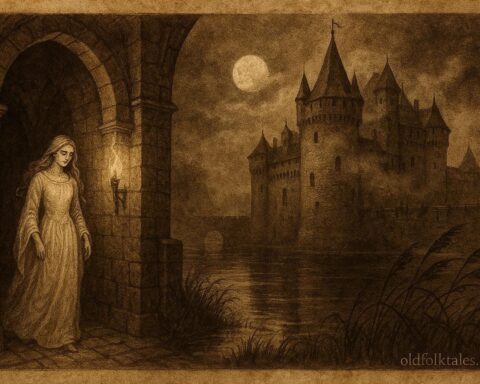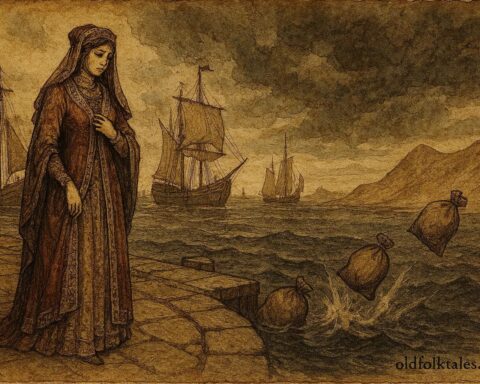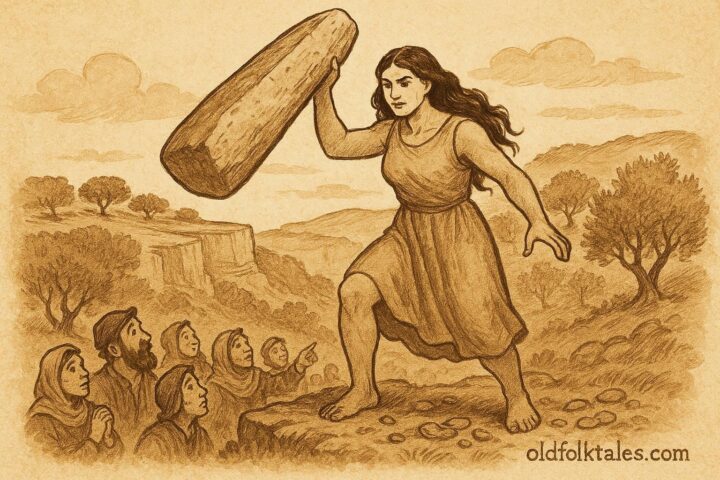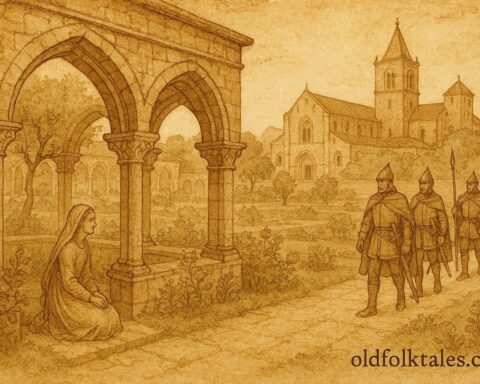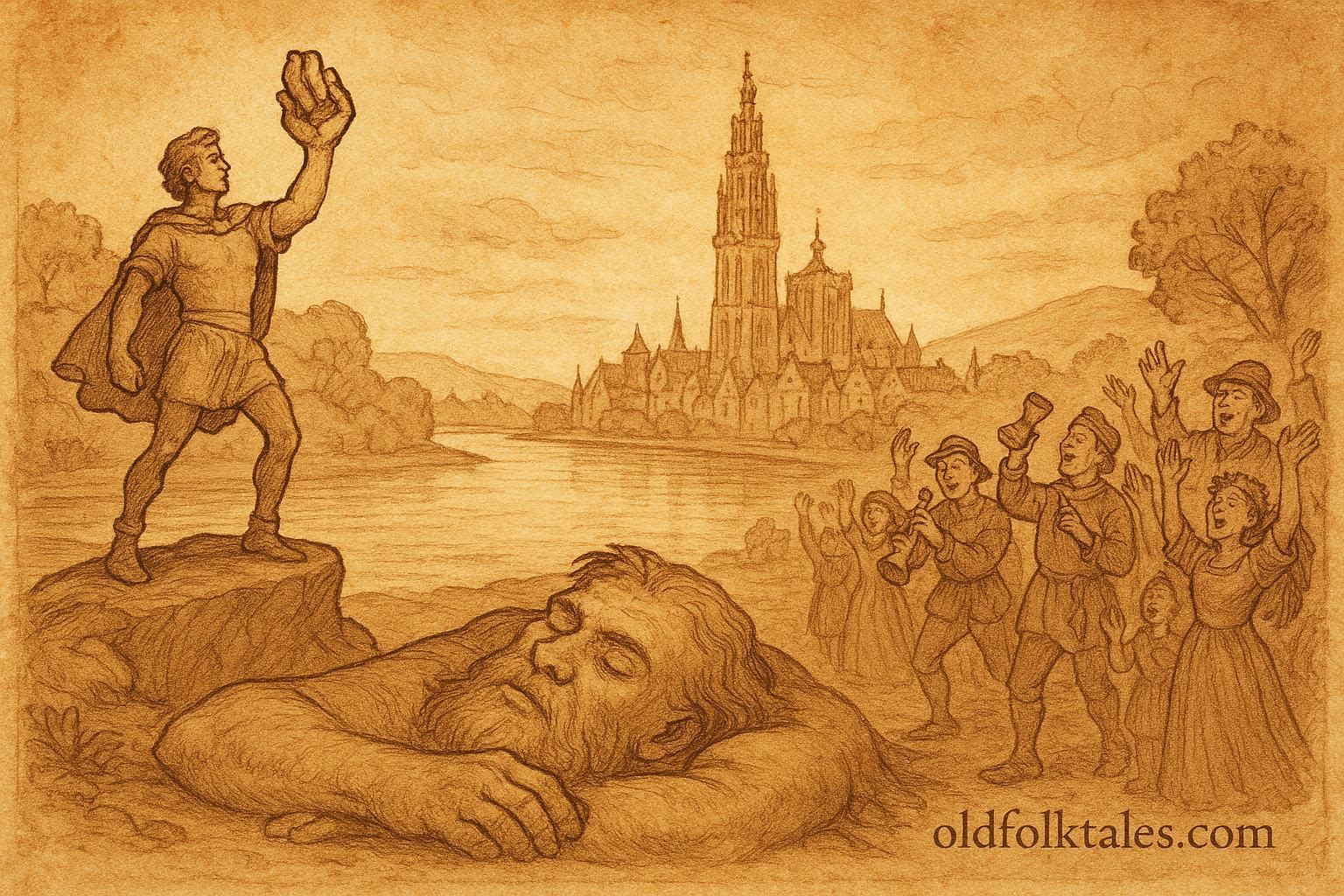
Long ago, in the misty lands that would one day be called the Netherlands, where the name of the brave soldier Brabo would be remembered for generations, the River Scheldt wound its way through fertile meadows and bustling villages. Along its banks lay a prosperous port, where merchants brought goods from faraway places, spices, silks, and amber from the seas beyond. But peace and trade did not last, for a giant came to rule the river, and his cruelty cast a shadow over all who lived nearby.
Discover the timeless charm of French, Dutch, and Belgian stories filled with cleverness and heart
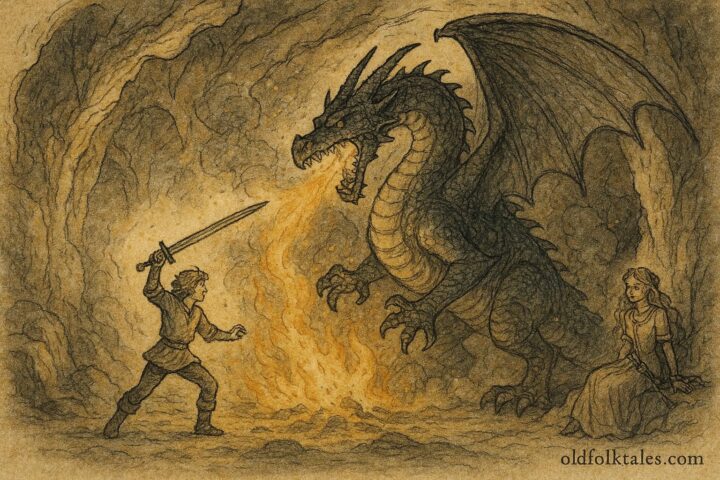
This giant’s name was Druon Antigoon. He was taller than a church steeple, with skin like stone and eyes that glowed like burning coals. From his fortress on the Scheldt, he controlled every ship that passed. “No one crosses my river,” he thundered, “without paying my toll!”
The toll he demanded was cruel beyond measure: each sailor or merchant had to pay half of all they carried, or lose his right hand to the giant’s axe. And so it was that fear gripped the land. Ships turned back to sea rather than face him, and the once-busy port fell silent.
Years passed under the giant’s tyranny. The people grew weary, but none dared challenge him, until a brave young soldier named Brabo arrived in the land. He was said to be of noble birth, a captain in the army of the Roman commander Julius. When Brabo heard of the giant’s evil, he was filled with indignation. “No man,” he declared, “should rule others by fear. I will face him and end this cruelty.”
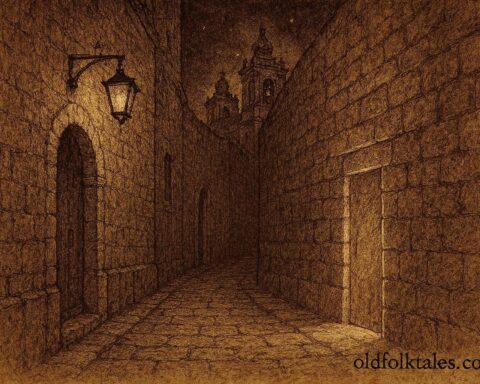
One evening, as the sun dipped low over the marshes, Brabo set out toward the giant’s stronghold. The path was long and dark, winding through dikes and mist-shrouded fields. Farmers watched from afar as his lone figure disappeared into the shadows, carrying only his sword and shield.
When he reached the fortress, he found the giant sitting before a great fire, gnawing on the bones of a stolen ox. The giant’s laughter echoed across the riverbank.
“Who dares enter my hall?” roared Druon Antigoon, rising to his full, terrible height.
“I am Brabo,” the young man answered firmly. “I have come to end your reign of terror.”
The giant’s laughter turned to a growl. “Then pay my toll, little man, or give me your hand!”
But Brabo raised his sword and cried, “Here is your toll, tyrant, in full measure!”
With that, he leaped forward. The clash of battle shook the stones. The giant swung his axe, splitting the air with terrible force, but Brabo was quick and brave. Again and again, he struck until his blade found its mark. The giant staggered, bellowing in pain. With one final blow, Brabo severed the monster’s head and lifted it high for all to see.
At dawn, the villagers found him standing by the river, weary but victorious. The giant’s lifeless body lay beside the water, his massive hand still gripping his axe.
To mark the end of his tyranny, Brabo took the giant’s severed hand and cast it into the River Scheldt, shouting, “So may every man’s hand be free!” The crowd cheered, for they knew their bondage had ended. From that day forward, ships once again sailed freely, and the river flowed without fear.
In honor of Brabo’s courage, the people built a great city on that very spot. They named it Antwerpen, which means “hand thrown”, in memory of the hero who cast off oppression.
As years passed, stories of Brabo’s victory spread across the Low Countries. He became a symbol of justice and freedom, a reminder that courage can break the mightiest chains. Even today, in the city of Antwerp, a statue of Brabo stands proudly in the marketplace, holding the giant’s severed hand high above his head, the river glinting in the distance as if still remembering his deed.
Moral of the Story
True bravery lies not in strength of arm, but in strength of heart. Those who stand against injustice, no matter their size or station, can free a nation from fear.
Discover the timeless charm of French, Dutch, and Belgian stories filled with cleverness and heart
Knowledge Check
- Who is the main hero in “Brabo and the Giant”?
The hero is Brabo, a brave young soldier who confronts and defeats the cruel giant Druon Antigoon. - What cruel act did the giant commit?
Druon Antigoon forced sailors to pay heavy tolls or lose their right hands, controlling passage on the River Scheldt through fear. - How did Brabo defeat the giant?
After a fierce battle, Brabo killed Druon Antigoon and threw the giant’s severed hand into the river as a symbol of freedom. - What is the origin of the city name “Antwerp”?
It comes from the Dutch words hand werpen, meaning “hand thrown,” referring to Brabo casting the giant’s hand into the river. - What lesson does the story teach?
That courage and justice can overcome tyranny, and one person’s bravery can free an entire people. - Where can Brabo’s statue be found today?
In the city of Antwerp, Belgium, where he stands as a lasting symbol of freedom and heroism.
Source: Adapted from Dutch Fairy Tales for Young Folks by William Elliot Griffis (1918), and traditional Low Countries folklore.
Cultural Origin: Netherlands (Low Countries folklore)