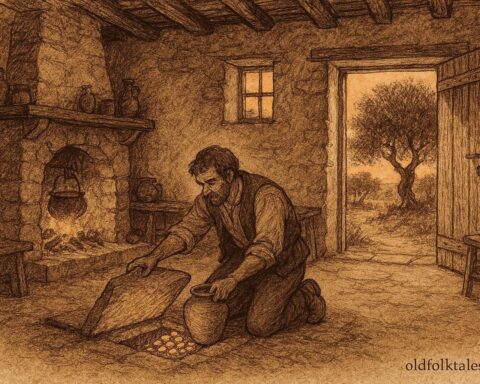
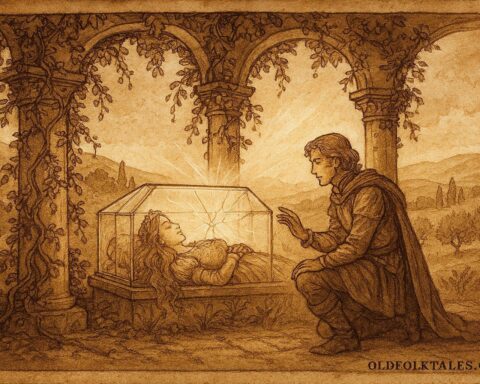
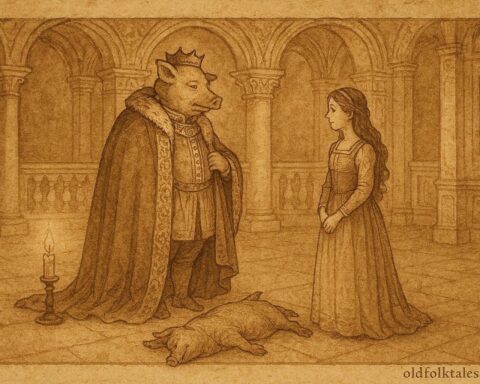
In a humble farmstead nestled at the fringes of the Venetian plain lived a young maiden named Cecchina, known among all for her radiant fair brow and golden hair that caught the sun like strands of spun light. Though born of humble peasant stock, Cecchina carried herself with the gentle dignity and warmth of one who knows kindness in her heart.
She had two older sisters, both proud and envious of her beauty and the favour she won in the eyes of the villagers. Their hearts were dark with jealousy, and they resolved one day to set Ceccina impossible tasks, that they might push her into failure and disgrace.
“Go,” they said, “and bring us the first bowl of rich, thick cream from the cow that bears a golden patch on her flank.” Cecchina was bewildered, but she did not resist. She rose before the dawn and tended the herd. As she milked, a small white dove alighted by the barn door and cooed softly to her. The bird whispered in her ear, “Call the cow by the name ‘Luna’ and speak gently; she will yield the cream without fuss.” Taking heart from the dove’s counsel, Cecchina did exactly so. The cow, at the gentle voice and the bird’s guidance, gave forth the sweetest cream, which Cecchina carried back to her sisters. They frowned and said, “That was but a trifling task; now we require something greater.”
Next, they bade her: “Fetch from the forest the single rose that blooms only at midnight beneath the old walnut tree by the river’s bend.” Again Cecchina did not shrink. As dusk gathered and the moon rose pale over the water, she slipped into the forest. There, a silver frog sat by the walnut tree and spoke: “When the moon reaches the crown of the tree, pluck the rose with both hands, speak your desire, and it will surrender its petals to you.” Obedient, she waited until the moon was high and plucked the rose. With that rose in her hand she returned to her sisters, who sneered and said, “We are not done with you yet.”
Their final demand: “Tomorrow morning, appear before the Count’s manor dressed in the slender grey gown of the widow’s daughter who sleeps at dawn with only a broom beside her bed.” They meant to humiliate Cecchina, for the widow’s daughter was known to labour in rags and sleep in a room where the broom stood as her only companion. But Cecchina accepted and at dawn, with trembling fingers seizing the task, entered the manor in the simple gown. There, she encountered the Count’s young son, who was immediately taken by her fairness of brow and the kind light in her eyes.
He spoke to her: “Who are you, that walk here at dawn in a gown of grey and carry yourself with such calm?” Cecchina answered honestly: “I am but a peasant’s daughter, sent by my sisters to this house at your side.” The young prince, struck by her gentle manner and purity of heart, bade her stay. And so she remained, tending the hearth and the garden of the manor, while her sisters plotted still to bring her low.
One day, as Cecchina worked in the garden, a stately stag, its coat glimmering in the light, stepped forth from the trees. He spoke in a voice soft as wind in the reeds: “Cecchina, you have endured. Come with me under the walnut tree and there the fairies dwell who will aid you.” Hesitant, but trusting, she followed the creature. Beneath the tree she found a ring of mushrooms and delicate fae lights dancing above the ground. From the circle emerged a fairy queen, whose robes were spun of moonlight and shadow.
“I have watched your trials,” the fairy said. “Because your heart is true and you did not turn aside, I shall give you a token: this silver comb, which when you rest your hair and speak your wish will call a gentle breeze to carry you where you should go.” With that, the fairy touched Cecchina’s golden hair, and the comb gleamed.
The next morning, the two older sisters demanded yet another task: “Go into the great lake, find the swan that swims at the centre, and bring its single white feather to us by midday.” Cecchina prepared to accept this too. At the lakeside a small frog again appeared, and helped her dive beneath the water where the swan spoke: “Speak your wish into the feather, and it shall be yours.” Cecchina did so, and the swan surrendered a feather white as dawn’s first light. With that in hand she returned, and her sisters sneered at their good fortune yet again.
Then, something unexpected happened. The young prince, filled with admiration for Cecchina’s kindness and endurance, declared to his father, the Count: “I will marry this fair-browed girl, for her beauty lies not only in her visage, but in her soul.” The Count consented, seeing in Cecchina a rare grace. The sisters stood aghast, for their plan to humiliate her had failed.
On the wedding day, the house was draped in white lace and silver ribbons; the air rang with laughter and music, and the dove that had once guided Cecchina perched on the bough above the hall, cooing softly. The fairy queen appeared in secret and blessed the union, weaving sunlight and moonbeam in its wake. Cecchina entered the hall in a gown of soft grey, humble yet proud, her golden hair crowned simply yet elegantly. The prince took her hand and they danced beneath garlands of pale roses.
Her sisters, humbled and silent, stood aside as Cecchina took her proper place beside the prince. The villagers whispered of the gentle maid who had borne envy and trials and yet remained pure of heart, and now sat at the side of the young count. The fairy queen smiled, the stag vanished into the forest, and the small white dove flew from the bough into the open window, free and light as hope.
And so the humble peasant girl, Cecchina of the fair brow, proved that kindness, endurance, and truth can triumph over envy and injustice. She reigned in grace, loved by her husband and remembered by all the village folk for the beauty of her soul as much as the fairness of her brow.
Moral: True beauty comes not from outward splendour alone, but from enduring kindness, quiet courage, and compassion. Even when faced with impossible tasks and the envy of others, remaining true to your heart will lead to a reward far greater than mere praise.
Knowledge Check
- Who is Cecchina and why is she called “of the fair brow”?
Cecchina is the young peasant girl in the tale, and she is called “of the fair brow” because of her radiant forehead and golden hair which mark her beauty and gentle nature.
- What impossible tasks do her sisters set for her?
The first: bring the first bowl of thick cream from a cow with a golden patch. The second: fetch the midnight-rose beneath the old walnut tree by the river. The third: appear at the Count’s manor in the widow’s daughter’s simple grey gown at dawn.
- Which enchanted creatures and beings help Cecchina, and how?
A white dove guides her in the barn; a silver frog by the walnut tree shows her how to pluck the rose; a stag leads her to the fairy queen; the fairy queen gives her a silver comb as a token of aid and blessing.
- How does Cecchina’s relationship with the young prince develop in the story?
The prince encounters Cecchina at the manor when she arrives in the grey gown and is struck by her humble dignity and fairness of brow. He soon wishes to marry her, honouring her for her heart and endurance, not just her beauty.
- What elements tie this tale to its regional origin in the Venetian countryside?
The simple farmstead at the edge of the Venetian plain, the local forest with walnut trees by the river, the manor of the Count, and the peasant-village setting evoke a rural Venetian region.
- What is the central moral lesson of the story?
The moral is that true beauty and reward come from kindness, endurance under trials, and remaining true to one’s heart. Envy and malice may set harsh tasks, but sincerity and compassion will lead to triumph.
Cultural Origin: Italian folktale, Veneto (Venetian region), collected in Italian Popular Tales by Thomas Frederick Crane, 1885.