Once upon a time, in a quiet corner of France, there lived a nobleman who took for his second wife a proud and haughty woman. She had two daughters of her own, both as vain as their mother. The nobleman, too gentle and good to see through their hearts, believed he was securing a happy home for his only daughter by his first marriage, a girl of rare sweetness and beauty named Cinderella.
But no sooner had the wedding feast ended than the new wife’s true nature appeared. Jealous of Cinderella’s charm and grace, she could not bear to see her treated as an equal. The poor girl was stripped of her fine dresses and jewels, made to wear coarse clothes, and sent to the kitchen to work from dawn until dark. She scrubbed the floors, cooked the meals, and slept on a straw mattress beside the ashes of the hearth. It was from this that she earned her cruel nickname, Cinderella.
Her stepsisters, though clothed in silk and velvet, were as heartless as they were foolish. They mocked her rags and laughed whenever soot smudged her face. Yet Cinderella bore all their cruelty with patience and grace, never complaining, for her gentle heart remained pure.
One day, the king’s son announced a grand ball at the royal palace. Every young lady in the kingdom was invited, for the prince hoped to find his bride. The two stepsisters were beside themselves with excitement. They spent days choosing gowns and jewels, commanding Cinderella to lace their bodices and polish their shoes. As she worked, she watched them in silence, her eyes bright with quiet longing.
“You would like to go to the ball, wouldn’t you?” one of them sneered.
“Oh yes,” said Cinderella softly, “but it is not meant for such as I.”
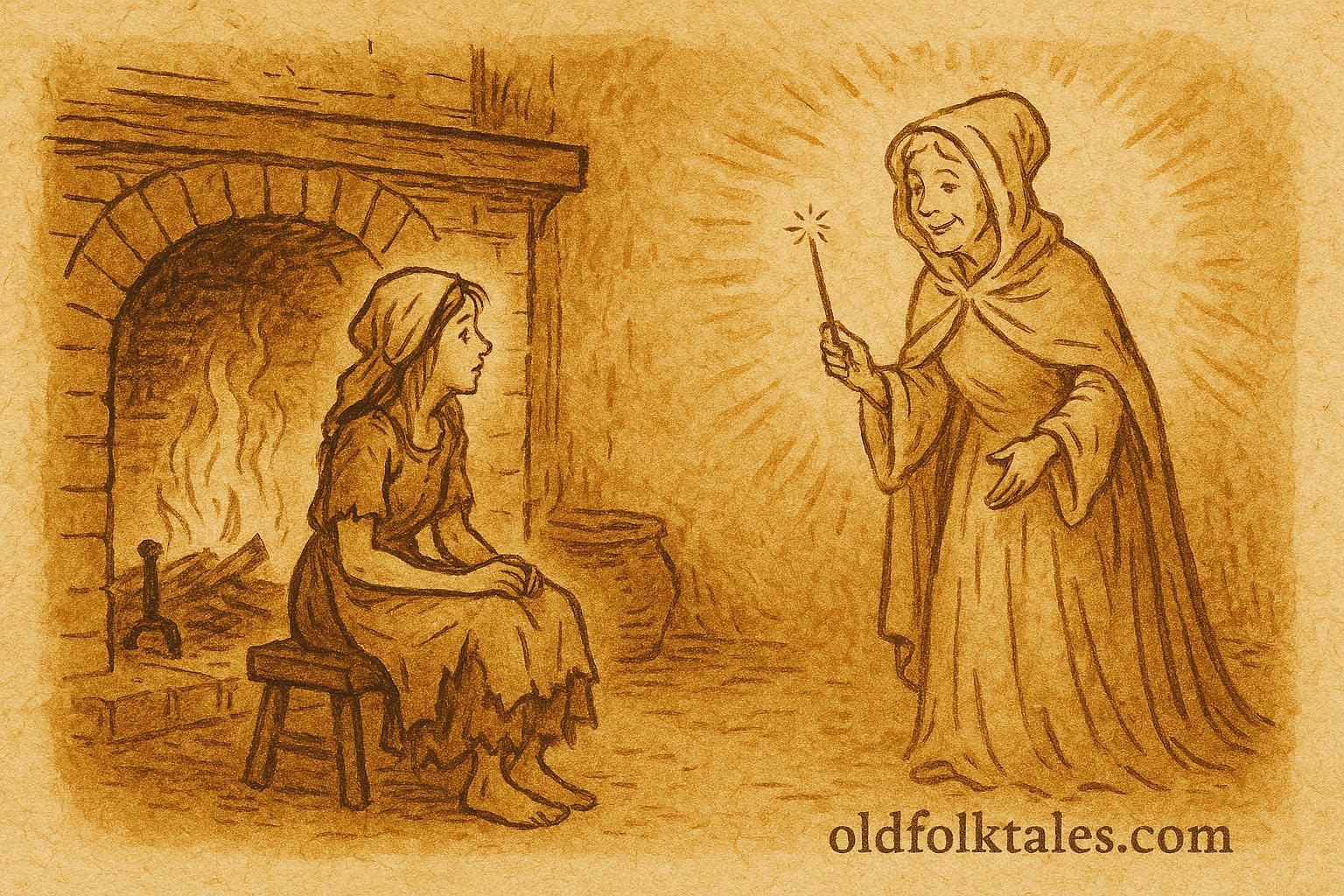
When the night came, her stepmother and sisters swept away in their glittering gowns, leaving Cinderella alone by the fire. Tears filled her eyes as she whispered, “If only I could see the ball, even from afar.”
At that moment, a gentle light filled the room, and an old woman appeared, her fairy godmother. “You wish to go to the ball, my child,” she said kindly. “And so you shall.”
With a wave of her wand, she transformed a pumpkin from the garden into a golden coach. Six mice became fine horses, a rat became a stately coachman, and six lizards turned into footmen in shining livery. Then, touching Cinderella’s rags, the fairy changed them into a gown of silver and gold, more splendid than any worn at court. On her feet, she placed a pair of glass slippers, so delicate and bright they glittered like stars.
“Go, my dear,” said the fairy, “but remember, you must leave before the clock strikes twelve. After midnight, all will return to what it was.”
Cinderella promised and was driven away in her shining coach. When she entered the palace, every eye turned toward her. The musicians paused, the courtiers whispered, and the prince himself came forward to meet her. Never had anyone seen such grace or beauty. He danced with her the entire night, speaking softly and forgetting every other lady in the room.
When the clock began to strike twelve, Cinderella remembered her promise. With a frightened gasp, she fled, the prince following close behind. In her haste, one of her glass slippers slipped from her foot and was left behind on the grand staircase. The prince picked it up, holding it as tenderly as if it were the lady’s own hand.
The next day, royal messengers were sent throughout the land with the slipper. The prince had sworn to marry only the woman whose foot it would fit. Every maiden tried it on, but none could wear it, not even the stepsisters, who pinched and squeezed their feet until they cried out in pain.
When the messengers came to Cinderella’s home, her stepmother laughed. “The little kitchen girl? It’s absurd! But let her try, if she insists.”
Cinderella knelt, and as she slipped her foot into the glass slipper, it fit as though made for her. Then, drawing the matching slipper from her pocket, she put it on, and in that instant, her fairy godmother appeared, transforming her rags into the radiant gown once more.
The stepmother and stepsisters fell to their knees, begging forgiveness. But Cinderella, whose heart was too gentle for vengeance, embraced them with kindness. Soon after, she was carried to the palace, where the prince received her with joy and made her his bride.
Her goodness was rewarded at last, and she lived happily ever after, showing her new family nothing but grace and mercy.
Moral Lesson
Cinderella teaches that true beauty lies in kindness and humility. No matter how harsh life may seem, patience and goodness will always lead to reward. Pride and cruelty, by contrast, bring only shame and regret.
Knowledge Check
- Who is the author who popularized “Cinderella, or The Little Glass Slipper”?
Charles Perrault popularized the story in Histoires ou contes du temps passé (1697). - What magical object identified Cinderella to the prince?
The delicate glass slipper that perfectly fit her foot. - What lesson does the story of Cinderella teach?
It teaches that kindness, patience, and virtue triumph over cruelty and pride. - Who helped Cinderella attend the royal ball?
Her fairy godmother, who used magic to transform ordinary things into royal splendor. - What happens to Cinderella’s attire after midnight?
It returns to her humble clothes and the carriage and servants return to their original forms. - What is the cultural origin of the Cinderella tale?
The version known today originated in France, written by Charles Perrault in the 17th century.
Source: Adapted from “Cendrillon, ou la Petite Pantoufle de Verre” in Histoires ou contes du temps passé (1697) by Charles Perrault.
Cultural Origin: France