In the sun-washed island of Sicily, where rocky cliffs fall into deep blue waters and the sea breathes with ancient power, there once lived a boy named Nicola. From his earliest days, the people of his coastal village noticed that he was unlike other children. While others played in dusty streets or helped their parents mend nets, Nicola was always drawn to the shore, standing barefoot where the waves kissed the land.
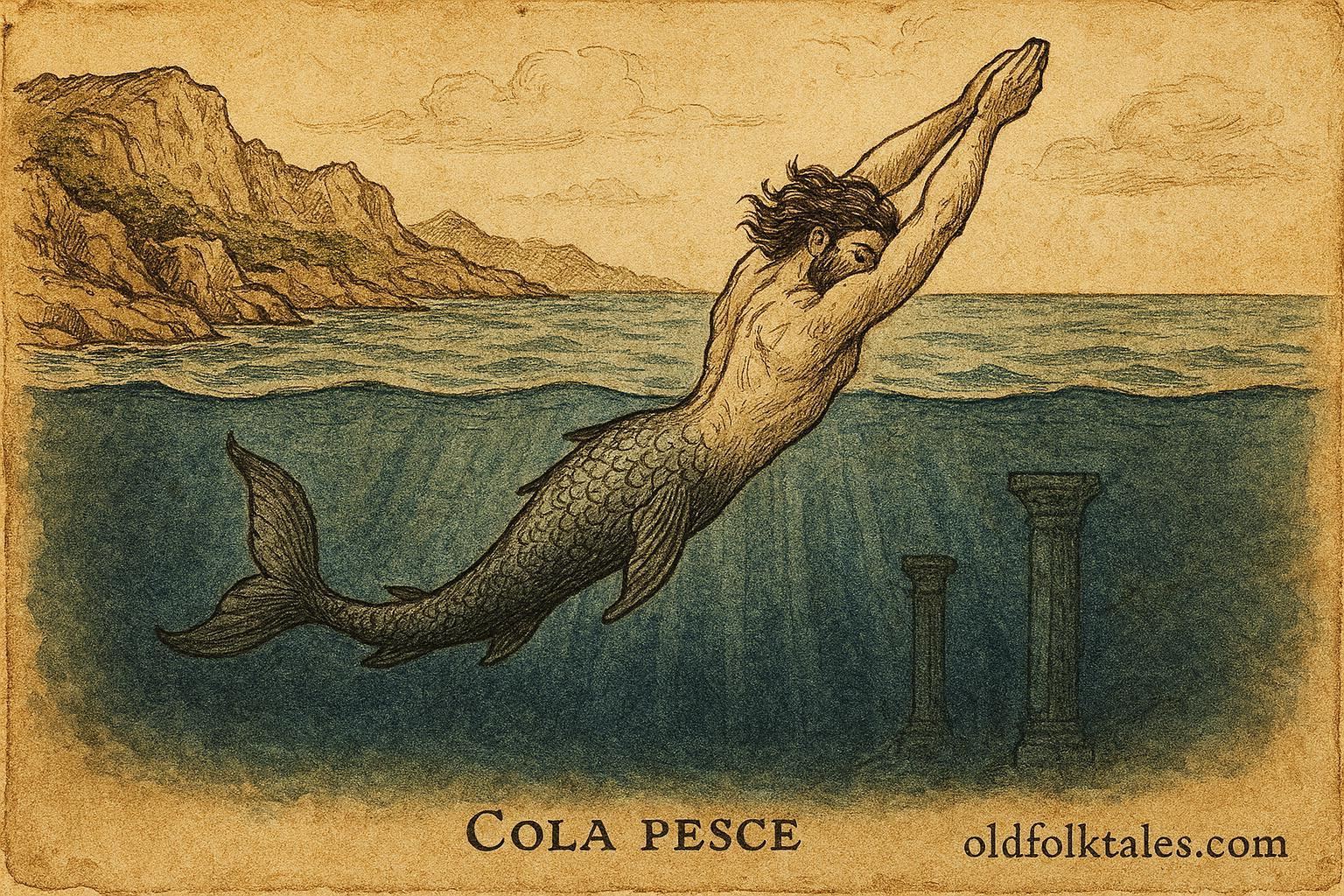
They called him Cola, a shortened form of his name, and soon another name followed him wherever he went, Pesce, the fish. For Cola swam as if born to the water. He could dive deeper and remain beneath the surface longer than any grown fisherman. The sea did not resist him; it welcomed him.
His mother watched him with a heart divided between pride and fear. She called him home at dusk, scolded him for disappearing for hours, and warned him of storms and unseen dangers. But Cola only smiled. The sea, he said, spoke to him. It showed him hidden caves, forests of coral, and creatures no man had ever described.
As years passed, Cola grew lean and strong, his skin darkened by sun and salt, his eyes sharp and restless. He began to change in ways that unsettled the village. His fingers grew slightly webbed, his breath deeper and slower. He ate little food from land and seemed most alive only when submerged.
Whispers spread. Some said the sea had claimed him. Others believed he was blessed, or cursed, by ancient spirits older than Sicily itself.
One day, anger and fear overcame his mother. In despair, she cried out that if Cola loved the sea more than his own home, then he should belong to it forever. The words, spoken in anguish, carried a weight beyond intention. From that moment on, Cola could no longer live fully on land. His bond with the sea was sealed.
News of Cola Pesce spread across Sicily, reaching even the court of the king. Curious and skeptical, the ruler summoned Cola to Palermo. He wished to test whether the tales were truth or exaggeration.
Before the assembled court, the king threw a golden cup into the harbor and commanded Cola to retrieve it. Without hesitation, Cola dove into the water and vanished. Time passed. Courtiers murmured. Then, at last, Cola emerged, holding the cup aloft, his breath calm, his eyes shining.
Amazed but not satisfied, the king ordered a heavier object cast into deeper waters. Again, Cola descended and returned, describing strange currents and stone pillars beneath the sea.
Finally, the king asked Cola to explore the very foundations of Sicily itself. Legends claimed the island rested upon three great columns hidden beneath the waves. If they weakened, the land would tremble and collapse into the sea.
Cola agreed, though his face grew solemn.
He dove deeper than ever before, into darkness where light could not reach. When he returned, he spoke of wonders and terrors, of underwater fires, crushing pressure, and the vast weight of the island above. He reported that two of the columns were strong, but the third was cracked and failing.
The king, alarmed, demanded proof. He threw his crown into the abyss and commanded Cola to retrieve it.
Cola hesitated.
He knew what awaited him below. He knew the truth the king did not wish to hear. At last, Cola spoke plainly: if he descended again, he might never return. The column could not endure without support. Someone, or something, must hold it in place.
The king, driven by fear for his realm, insisted.
Cola Pesce looked once more upon Sicily, the mountains, the harbors, the people who had shaped him yet never fully understood him. He then dove into the sea one final time.
He did not return.
From that day onward, Sicily stood firm. No earthquake shattered it, no sea swallowed its shores. Fishermen claimed that sometimes, in the deepest waters, they felt a presence, steady, enduring, alive. They said Cola Pesce still holds the land aloft, half man, half sea-spirit, bound forever to the island he loved more than his own life.
And so his story was passed down, not as a tale of punishment, but of sacrifice, of a boy who listened to the sea and gave everything so others could stand safely upon the land.
Moral Lesson
True devotion to one’s homeland and harmony with nature may demand great sacrifice. Cola Pesce teaches that selflessness and duty, though unseen and unpraised, can uphold the world itself.
Knowledge Check
-
Who is Cola Pesce in Sicilian folklore?
Cola Pesce is a legendary boy who becomes half-human, half-fish through his bond with the sea. -
Why is Cola called “the Fish”?
His extraordinary swimming ability and physical transformation reflect his deep connection to the ocean. -
What threat faces Sicily in the story?
The island risks collapse because one of its mythical underwater pillars is failing. -
What sacrifice does Cola Pesce make?
He remains beneath the sea forever to support Sicily and prevent its destruction. -
What themes define the Cola Pesce legend?
Self-sacrifice, duty to homeland, harmony with nature, and transformation. -
What is the cultural origin of Cola Pesce?
Sicilian folklore, documented by Giuseppe Pitrè in the 19th century.
Source: Sicilian Folk Traditions by Giuseppe Pitrè, Vol. I (1875)
Cultural Origin: Sicily