In the ancient and mist-covered lands of Wales, where rivers wound through shadowed valleys and forests whispered with the voices of old magic, there lived a young prince named Culhwch. Born of noble lineage, he was admired for his courage and sharp mind, yet his heart was captured by one thought alone: the desire to win the hand of Olwen, the daughter of the giant Ysbaddaden, whose beauty was said to rival the morning sun, and whose presence carried both majesty and the subtle magic of her lineage.
From the moment Culhwch first beheld Olwen, he knew that she was his destined bride. Yet to claim her hand would be no ordinary courtship. Ysbaddaden, her father, was a fearsome giant who commanded both fear and respect across the land. He despised mortals and jealously guarded his daughter. Any suitor who approached him was doomed to face an impossible challenge, for the giant’s mind was cunning and his wrath formidable.
Discover the moral heart and wild spirit of the north through timeless Nordic storytelling
Culhwch, determined and resolute, journeyed to Ysbaddaden’s fortress. Along the way, he faced natural obstacles, dense forests filled with twisting paths, rivers that refused to yield, and hills where the wind howled like spirits of the past. Yet his resolve never faltered. The prince understood that courage alone would not suffice; he would need allies who could match the scale of the challenges ahead.
He sought the counsel and aid of King Arthur, the legendary ruler whose wisdom, strength, and loyal warriors were renowned throughout Britain. Arthur, moved by the young prince’s devotion and recognizing the nobility of his cause, agreed to assist him. Together, they gathered a host of heroes, warriors, magicians, and skilled trackers, each bound by loyalty and purpose. They swore to aid Culhwch in fulfilling the tasks set by Ysbaddaden, knowing that many of these challenges would require not just strength but cleverness, courage, and unity.
When Culhwch and his companions arrived at Ysbaddaden’s stronghold, the giant listened to their request and laughed with a voice that shook the mountains. He laid before Culhwch a series of impossible tasks: to capture fierce boars and wild hounds, to secure magical cauldrons that could boil without fire, to retrieve swords from distant lands, and to confront monstrous beasts whose power had defeated many warriors before. Each task seemed designed to ensure that no mortal could succeed. Yet Culhwch, with Arthur and his company at his side, accepted the challenge with calm determination, understanding that perseverance and collective heroism would carry him through.
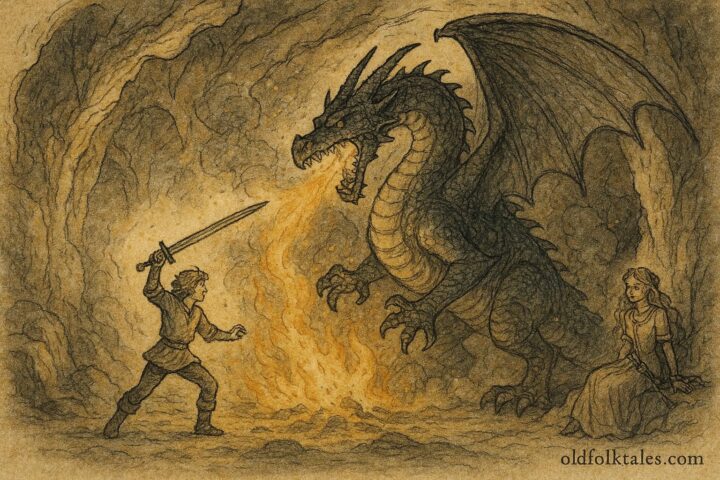
The first tasks led them to the forests of enchantment, where wolves with eyes like coals and boars with tusks sharper than iron roamed freely. Guided by Arthur’s warriors and aided by magic, Culhwch confronted these beasts. He showed skill not only in battle but in strategy, capturing the creatures without unnecessary bloodshed. These early victories built the confidence of his companions and demonstrated that the impossible could indeed be approached with courage, cunning, and teamwork.
Next, the quest demanded journeys across mountains and rivers to retrieve magical items and swords, each guarded by enchantments or ferocious monsters. Culhwch and his allies navigated treacherous terrain, relying on both physical strength and sharp minds. Wizards guided them with spells of protection, while warriors devised traps and clever ruses to outwit guardians who were far stronger than any ordinary man. Culhwch’s determination never wavered, and with each completed task, the path toward Olwen’s hand became clearer, though no less dangerous.
Throughout the trials, the heroes’ bonds strengthened. Arthur himself marveled at Culhwch’s steadfastness, noting that love combined with courage could inspire feats surpassing even the greatest legends. Magic and mortal effort worked together; enchanted swords, cauldrons, and beasts were overcome not by raw power alone but by ingenuity, collaboration, and unwavering resolve.
Finally, after facing every trial set by Ysbaddaden, Culhwch returned victorious. Each impossible task had been met, each monster subdued, and each enchanted object recovered. The giant, though initially resentful, recognized that the young prince’s perseverance and the loyalty of Arthur’s warriors had overcome what he had deemed insurmountable. Reluctantly, he consented to the marriage, understanding that some fates could not be denied, even by the mightiest giant.
Culhwch and Olwen were wed with great celebration. Their union represented more than the fulfillment of love; it was a triumph of courage, determination, and the bonds of kinship and friendship that made success possible. The tale of their quest spread across the lands, becoming legend: a story of heroism, collective effort, and the triumph of human resolve over impossible odds.
Yet the story of Culhwch is more than a romantic legend. It reminds all who hear it that love can inspire courage beyond measure, that no obstacle is too great for those who act with integrity and cooperation, and that destiny often requires not just desire but action, wisdom, and the support of loyal companions. Culhwch’s journey emphasizes that heroic quests are rarely solitary; even the greatest warriors rely on alliances, counsel, and magic to navigate challenges beyond ordinary human skill.
Moral Lesson
The story of Culhwch teaches that love and destiny can inspire extraordinary courage. Perseverance, loyalty, and cooperation can turn impossible challenges into achievable goals. True heroism is a blend of personal bravery, wisdom, and the support of allies.
Knowledge Check
1. Who is Culhwch in Welsh folklore?
Culhwch is a prince seeking to marry Olwen, undertaking a series of impossible tasks in the Mabinogion.
2. Why must Culhwch complete impossible tasks?
Olwen’s father, the giant Ysbaddaden, sets these tasks to prevent any mortal from marrying his daughter.
3. Who aids Culhwch in his quest?
King Arthur and his warriors, offering strength, magic, and wisdom to help him overcome the challenges.
4. What types of tasks does Culhwch face?
He must capture magical beasts, recover enchanted objects, and confront monsters and enchanted items across Wales.
5. What role does collective heroism play in the story?
Success is achieved through the combined efforts of Culhwch, Arthur, and their allies, highlighting teamwork over solitary bravery.
6. What lesson does Culhwch’s story teach about love and destiny?
That love and destiny demand courage, perseverance, cooperation, and the wise use of resources, mortal and magical.
Source & Cultural Origin
Source: The Mabinogion, translated by Lady Charlotte Guest (1849)
Cultural Origin: Wales (Brythonic Celtic tradition)