In the earliest age of the world, when gods still shaped the destiny of mortals with their hands and voices, there lived Persephone, only daughter of Demeter, goddess of grain, fertility, and the generous earth. Persephone was beloved not only by her mother but by the land itself. Wherever she walked, flowers lifted their heads, and wherever her laughter rang, the fields seemed brighter.
Demeter cherished her daughter above all else. As goddess of agriculture, she governed the growth of crops and the rhythm of the seasons, ensuring that humankind never lacked bread. Yet Persephone was her deepest joy, her living bond to the earth she nourished. Together they wandered across plains and hills, blessing furrows, teaching mortals the sacred laws of sowing and harvest, and keeping famine far from the world.
Under Demeter’s watchful care, the earth thrived. Wheat rose tall and golden, orchards bent beneath the weight of fruit, and rivers flowed steadily through fertile valleys. The world knew balance, and suffering was held at bay.
One day, as spring reached its height, Persephone walked through a meadow bursting with wildflowers. The air was heavy with scent, and the earth pulsed with life. She gathered blossoms, roses, crocuses, and lilies, laughing softly as her hands filled with color. At the far edge of the field bloomed a narcissus of dazzling beauty, brighter than any flower she had seen. Drawn to it, Persephone stepped away from her companions and reached out.
At that moment, the earth itself betrayed her.
The ground split open with a thunderous cry, and from the yawning chasm rose Hades, lord of the Underworld, unseen ruler of the dead. His chariot surged forward, pulled by immortal horses, and before Persephone could flee or call for her mother, he seized her and vanished back into the depths. Her screams echoed briefly across the meadow before the earth closed, smooth and silent, as if nothing had occurred.
Demeter heard her daughter’s cry.
It cut through her like a blade.
The goddess rushed across the land, calling Persephone’s name with growing desperation. For nine days and nights she wandered without rest, refusing nectar and ambrosia, her divine radiance dimmed by anguish. She searched mountains and valleys, forests and seas, questioning gods and mortals alike, but no one could tell her where her child had gone.
On the tenth day, Hecate, goddess of crossroads and shadows, approached her. She had heard Persephone’s cry but had not seen who took her. Together they sought Helios, the all-seeing sun, who witnesses all things beneath the sky. Though reluctant, Helios revealed the truth: Zeus, king of the gods, had allowed Hades to take Persephone as his wife.
Demeter’s grief turned to wrath.
She withdrew from Olympus, abandoning her divine duties. Disguised as an old woman, bent and weary, she wandered among mortals and came at last to Eleusis. There she sat in silence, refusing comfort, her sorrow heavy upon her. Though welcomed by the people, she would not smile, nor would she allow the earth to flourish.
As Demeter mourned, the world began to wither.
Seeds lay lifeless in the soil. Crops failed. Fields turned barren and cold. Hunger spread across the land, and mortals cried out to the gods. Without harvests, offerings ceased, and the gods themselves felt their power weaken.
Yet Demeter would not relent.
“Let the earth remain barren,” she declared, “until my daughter is returned to me.”
At last, Zeus could no longer ignore the suffering of gods and humans alike. He sent Hermes, swift messenger of Olympus, to the Underworld with a command: Persephone must be released.
Hades obeyed, but not without subtlety.
Before Persephone departed, he offered her a pomegranate, its seeds glowing red as blood. Hungry and unaware of the ancient law, Persephone ate a few seeds. By doing so, she bound herself to the realm of the dead.
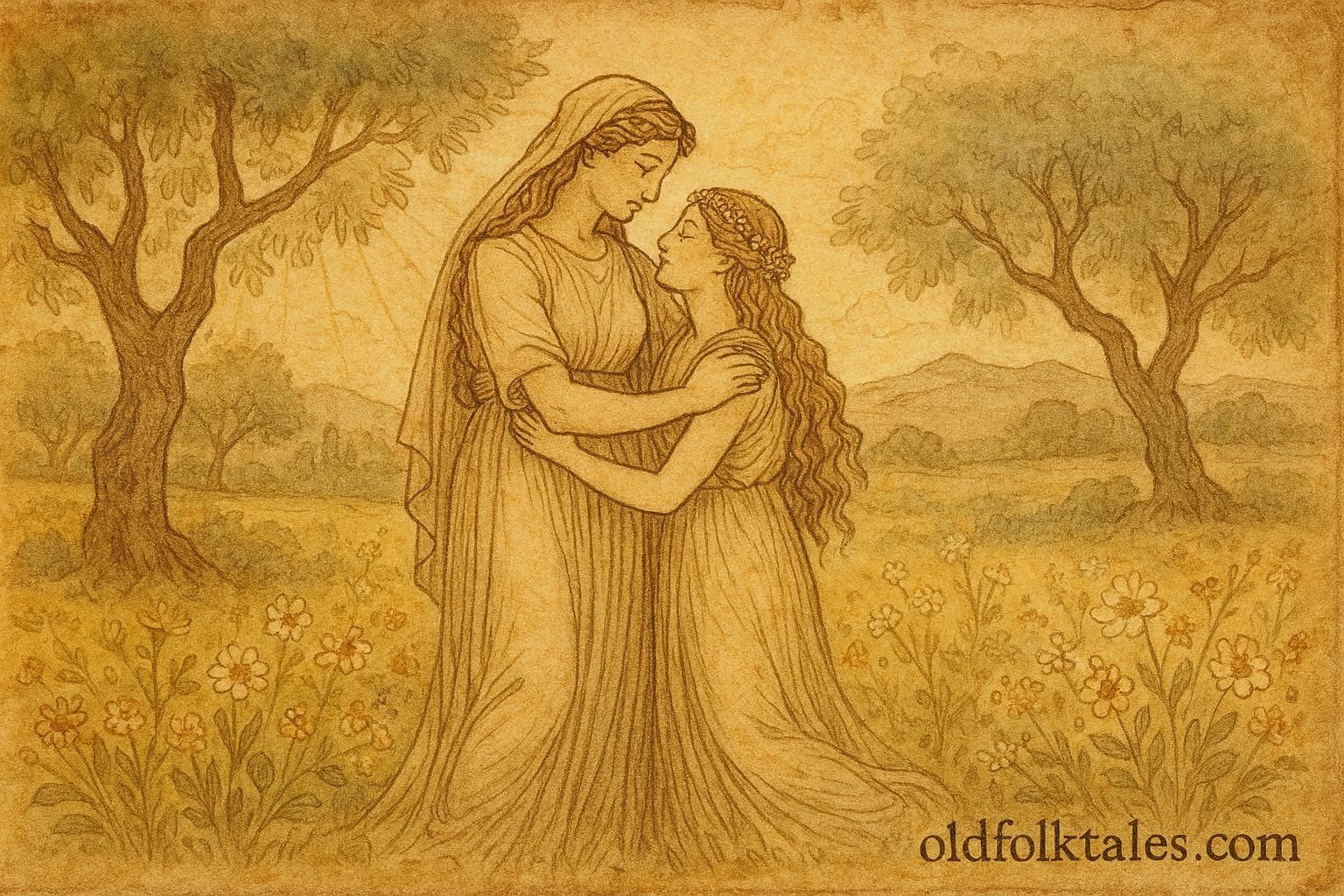
When Persephone returned to the surface, Demeter embraced her with a cry that shook the earth. In her joy, the goddess restored fertility to the land. Grass sprang from the soil, trees budded, and fields burst into bloom. Life returned in abundance.
Yet the joy was incomplete.
Zeus declared a compromise: because Persephone had tasted the food of the Underworld, she must return there for part of each year. For the remaining months, she would dwell with her mother among the living.
Thus, the seasons were born.
When Persephone rises from the Underworld and returns to Demeter, the earth awakens. Spring blooms, summer ripens, and life flourishes. When Persephone descends again to Hades, Demeter mourns, and the world enters autumn and winter, a time of decline, rest, and waiting.
So, the cycle continues, eternal and unbroken, shaped by love, loss, and renewal.
Moral Lesson
This ancient Greek myth teaches that life moves in cycles of separation and reunion, death and rebirth. Grief is not an end, but a passage, and hope always returns with time. Through acceptance of life’s rhythms, renewal is made possible.
Knowledge Check
-
Who is Persephone’s mother?
Demeter, goddess of agriculture and fertility. -
Who abducts Persephone?
Hades, ruler of the Underworld. -
Why does Demeter cause famine?
In grief and protest over her daughter’s disappearance. -
What binds Persephone to the Underworld?
Eating the pomegranate seeds. -
What natural cycle does the myth explain?
The changing seasons. -
What is the central theme of the story?
Life, death, and rebirth through cyclical renewal.
Source: Homeric Hymn to Demeter, c. 7th century BCE
Cultural Origin: Ancient Greece