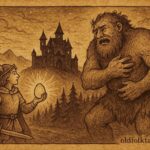
In the far east of Norway, where the sun rises over frost-covered mountains and the northern winds whisper through endless pine forests, there once lived a poor man with many children. His youngest daughter was so fair and kind that her beauty shone even in the dim light of their small cottage. Her hair gleamed like sunlight upon snow, and her gentle spirit brought warmth to the hearts of all who knew her.
Discover the moral heart and wild spirit of the north through timeless Nordic storytelling
One winter’s evening, as the family sat by the hearth, a great knock echoed through their wooden door. When the father opened it, a massive white bear stood before him, its fur gleaming in the moonlight like freshly fallen snow. The creature spoke in a deep, human voice:
“Good evening, good man. If you will give me your youngest daughter, I will make you as rich as you are now poor.”
The man was struck with fear and wonder. The offer was beyond imagining, but how could he give away his beloved child to a beast of the wild? He hesitated and refused. Yet the white bear returned the next night, and again the night after that, repeating the same offer. Seeing his family’s hunger and the depth of their poverty, the father finally asked his daughter what she would do.
The girl, though frightened, was brave. “Father,” she said softly, “if it will make you and Mother happy and take away our suffering, I will go with the white bear.”
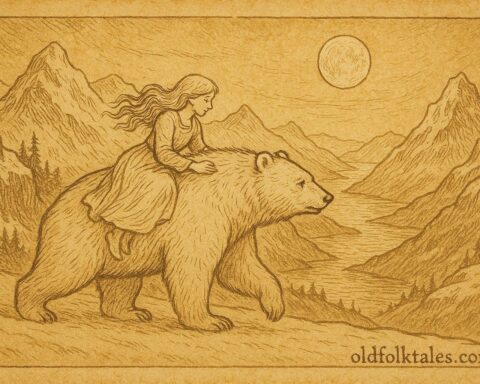
The next morning, the bear came once more. She climbed upon his broad back, and they set off together through forests and mountains, past icy lakes and whispering pines, until the world itself seemed to fade behind them.
At last, they reached a grand castle of stone and silver hidden in a land no human eyes had seen. Inside, every room glowed with golden light. Servants she could not see brought her food and tended to her comfort. Yet she was lonely, for each night, when she lay in bed, someone came to her in the darkness, a silent man whose face she could not see. Though his presence comforted her, curiosity and fear grew within her heart.
Time passed, and she began to long for her family. The white bear permitted her to visit them but warned her: “Do not let your mother speak to you alone, or she will bring misfortune upon us.”
When she returned home, her family rejoiced to see her dressed in silks and shining with health. But her mother, filled with love and worry, pulled her aside. “Child, who is this white bear you live with? Are you well? Are you safe?”
The girl tried to assure her mother, but under her questions, she grew uneasy. That night, her mother gave her a small candle. “When he sleeps beside you,” she whispered, “light this candle and see who he truly is.”
When the girl returned to the castle, she could not rest. That night, while the mysterious man slept beside her, she lit the candle and gazed upon his face. Before her lay not a beast but the most handsome prince she had ever seen, his golden hair shining in the soft light. But as she leaned closer, three drops of hot wax fell upon his shoulder, waking him.
“Ah, foolish one!” he cried. “If you had waited but one year, I would have been free. My stepmother, the troll-queen, cursed me to live as a white bear until I found a maiden who would love me without seeing me. Now I must leave you and go to her, east of the sun and west of the moon.”
And with that, he vanished.
The girl wept bitterly, but her sorrow soon hardened into resolve. She dressed herself for travel and set forth to find her prince. She journeyed over mountains, through dark forests, and across vast icy plains, asking every creature she met if they knew the way to the land “east of the sun and west of the moon.”
She came first to the house of the North Wind, who blew fiercely but kindly. “I have never been there,” he said, “but I will carry you to my brother, the East Wind.” From one wind to another she was passed, to the West Wind, then the South Wind, but none knew the place she sought. Finally, the mighty North Wind offered to take her himself.
“I have never been there,” he said, “but I will take you as far as I can, and perhaps beyond.”
He lifted her upon his back, and they flew across mountains and seas, until the earth was but a distant shadow below. When at last he could go no farther, he set her down before a grand, glittering castle of ice and gold.
Inside, she found her prince trapped by the troll-princess who sought to wed him. But the girl, clever and determined, used her courage and kindness to outwit the trolls. She exchanged gifts with the servants, won the prince’s trust again, and finally broke the enchantment that bound him. When dawn came, the trolls burst like stone in sunlight, and the spell was ended.
Together, the prince and the girl returned to his kingdom, where they were married amid great joy and feasting. And from that day forward, they lived happily, not in a castle of ice, but in a home filled with warmth and light.
Discover the moral heart and wild spirit of the north through timeless Nordic storytelling
Moral Lesson
Love that is faithful and courageous can overcome even the strongest enchantment. Trust, patience, and perseverance are the true keys to freedom and happiness.
Knowledge Check
- Who was the white bear in disguise?
The white bear was an enchanted prince cursed by a troll-queen. - What caused the prince to vanish?
The girl disobeyed his warning and lit a candle to see his face, breaking the condition of his curse. - What does “east of the sun and west of the moon” symbolize?
It represents a place beyond the known world, the realm of impossible quests and true devotion. - Which creatures helped the girl on her journey?
The four Winds, North, South, East, and West, guided her in her search. - What moral lesson does the tale teach?
True love demands faith and endurance, and even the greatest trials can be overcome with courage. - What is the cultural origin of the story?
This tale originates from Norwegian folklore, collected by Asbjørnsen and Moe.
Source: Adapted from the Norwegian folktale “East of the Sun and West of the Moon” in Norske folkeeventyr, collected by Peter Christen Asbjørnsen and Jørgen Moe (1840s).
Cultural Origin: Norway (Traditional Norwegian folklore)