Long ago, in the rugged and misty lands of Ireland, where cliffs meet the restless Atlantic and waves crash like drums upon the rocky shore, there lived a man known as Finn McCool, Fionn mac Cumhaill in the old tongue. Finn was no ordinary man. He was a giant among men in strength and courage, yet even more remarkable was his mind: sharp, clever, and quick to find a solution where others might rely only on brute force. Tales of his exploits spread far across the emerald hills and valleys, carried in song and story from one generation to the next.
It happened one day that Finn’s fame reached across the sea to Scotland, where another giant, Benandonner, dwelled. Benandonner was enormous and fierce, feared by all who lived near the northern coasts. Upon hearing of Finn’s renown, Benandonner grew proud and belligerent. He decided that he would challenge Finn, to prove which of the two giants was the stronger and the cleverer. The thought of such a challenge alarmed the people of Ireland, for they knew that a clash of giants could destroy entire villages and fields in a single day.
Explore the warmth and wit of Mediterranean storytelling, where love and wisdom intertwine
Finn, however, was not a man to cower. He welcomed the contest, confident that strength alone would not ensure victory; wit would be his greatest weapon. Standing upon the northern cliffs of Ireland, he gazed across the churning waters that separated him from Scotland, where Benandonner awaited. The sea was wide and wild, and no ordinary man could hope to cross it swiftly, yet Finn’s mind worked as surely as his legs and arms.
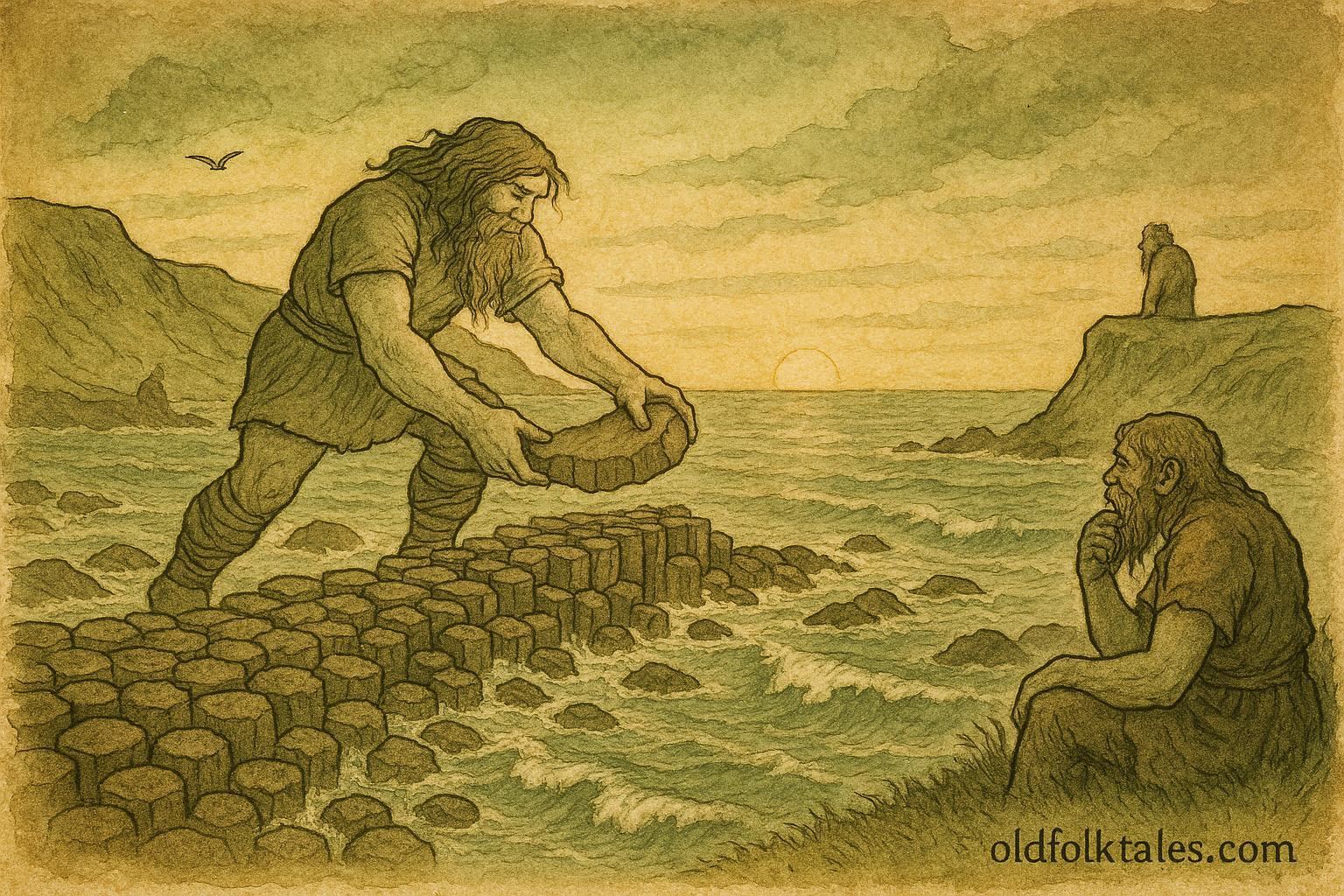
He conceived a plan: he would build a path across the sea itself, a causeway of massive stones that would stretch from the cliffs of Ireland to the Scottish shore. Each stone was set with care, forming a solid path over the surging waves. The stones were broad and flat, like enormous stepping stones, and they rose from the water in perfect rows. By the time he finished, a firm roadway connected the two lands, daring Benandonner to cross it and meet Finn face to face.
When Benandonner saw the causeway, he was astonished. No man or giant had ever built such a thing. Yet pride and fury filled him, and he strode onto the stones, crossing the sea with thunderous steps that made the waves roar even louder. Finn waited calmly on the Irish side, preparing for the encounter, knowing that his cleverness would soon be tested.
As the two giants came closer, Finn realized that Benandonner was far larger than he had imagined, so immense, in fact, that Finn feared a direct confrontation might be perilous. The Scottish giant’s bellow shook the cliffs, and his fists were as large as entire cottages. Finn’s wits raced. He remembered an old trick, one known among the clever men and women of Ireland: sometimes, fear could be used as skill, and a clever display of imagination could defeat even the strongest foe.
Finn quickly hatched a plan. Retreating to his home, he instructed his wife, Oonagh, to help him. She understood his clever mind and was loyal to his cause. Together, they set the stage for what would become a legendary ruse. Finn disguised himself as a tiny child and placed himself in the crib that Oonagh had prepared. She covered him with blankets, leaving only a small, vulnerable figure exposed.
When Benandonner arrived at Finn’s house, he was bewildered to see the “child.” Oonagh welcomed him kindly, explaining that this was her infant son, the child of Finn McCool. Benandonner, curious and somewhat wary, peered into the crib. The infant’s size was remarkable: it was large for a baby, yet still far smaller than Benandonner himself.
Oonagh, speaking with calm confidence, said, “If this is the child of Finn McCool, then the father must be a giant beyond imagining! He must be stronger than even the tallest cliffs of Ireland!”
Benandonner’s eyes widened in astonishment. The thought of facing a man so vast that he could father a child of such size filled him with fear. Though Benandonner was mighty, he was not foolish. He realized that if the child was this large, Finn himself must be a giant far greater than any he had encountered. Panic overtook pride. Without a word, Benandonner fled, retreating back across the causeway toward Scotland, leaving the pathway behind him.
Finn, still hidden, chuckled quietly. His cleverness had triumphed over strength. He had used wit and imagination to outsmart a foe who might have crushed him through brute force alone. The people of Ireland, who had watched from afar and waited anxiously for news, rejoiced. Finn’s fame grew even greater, not merely for his strength, but for his intelligence and resourcefulness.
The stones that Finn had laid across the sea did not vanish. Over time, the waves and winds shaped them into columns of basalt, hexagonal and upright, forming a natural bridge between Ireland and Scotland. The formation became known as the Giant’s Causeway, a lasting monument to Finn’s ingenuity. Travelers marveled at the stones, wondering how such a path could have been created, unaware that they were gazing upon the clever work of a hero who used his mind as surely as his strength.
The story of Finn McCool reminds those who hear it that heroism is not only measured in muscles or might. It is measured also in courage, intelligence, and the ability to think creatively in the face of danger. Humor, too, plays its part: for even the fearsome can be bested through cleverness and a light heart. In the hills and coasts of Ireland, children learned that daydreams and wit could carry them farther than mere brawn, and that sometimes the cleverest path to victory is the one that surprises the enemy most.
Through the centuries, the legend endured, carried on the wind and whispered along the cliffs. Every time waves crash against the Giant’s Causeway, they echo the laughter of Finn McCool, a reminder that the landscape itself holds the memory of cleverness and heroism. Those who visit the Causeway feel a sense of wonder, imagining the mighty Finn laying stones across the sea, plotting, laughing, and triumphing not by force, but by the power of his mind.
Thus, the tale of Finn McCool is more than a story of giants and battles. It is a celebration of Irish ingenuity, courage, and humor, tied forever to the natural wonder of the Causeway. It teaches that intelligence and quick thinking can overcome fearsome obstacles, that laughter may accompany wisdom, and that human imagination can explain even the most marvelous of landscapes.
Moral Lesson
The story of Finn McCool teaches that cleverness often surpasses brute strength. Intelligence, courage, and creative thinking allow even the seemingly small or weak to overcome greater foes. Humor and ingenuity are tools as powerful as arms, and respect for the natural world can be found in the stories we tell.
Knowledge Check
1. Who is Finn McCool (Fionn mac Cumhaill)?
A legendary Irish hero, known for strength, cleverness, and courage.
2. Why did Finn build the Giant’s Causeway?
To create a path across the sea to challenge the Scottish giant, Benandonner.
3. How did Finn defeat the Scottish giant?
By clever trickery, disguising himself as a child, causing Benandonner to flee.
4. What themes are highlighted in the story?
Intelligence over strength, courage, humor, and connection to the landscape.
5. What natural wonder is associated with this tale?
The Giant’s Causeway in northern Ireland.
6. What source preserves this legend in written form?
W.B. Yeats, Fairy and Folk Tales of the Irish Peasantry, 1888.
Source: W.B. Yeats, Fairy and Folk Tales of the Irish Peasantry, 1888
Cultural Origin: Ireland