Once upon a time, along the stony shores of the Adriatic coast, there lived a poor fisherman named Plunk and his wife, Mara. Their cottage was small and crooked, standing close enough to the sea that the waves often brushed its walls with salty spray. Though they had little more than the bare necessities, Plunk was content. He rose before dawn, cast his nets, and sang old seafarers’ songs to the rhythm of the tide. But Mara, his wife, was not content at all.
Every day, as she patched their worn clothes or stirred their thin soup, she would sigh and scowl. “Plunk,” she would say, “you toil all day, and what do we have? A leaky roof and an empty pot. Is this the life you want to live forever?”
Plunk only smiled gently. “The sea gives what it will, Mara. It’s not for us to ask for more than our share.”
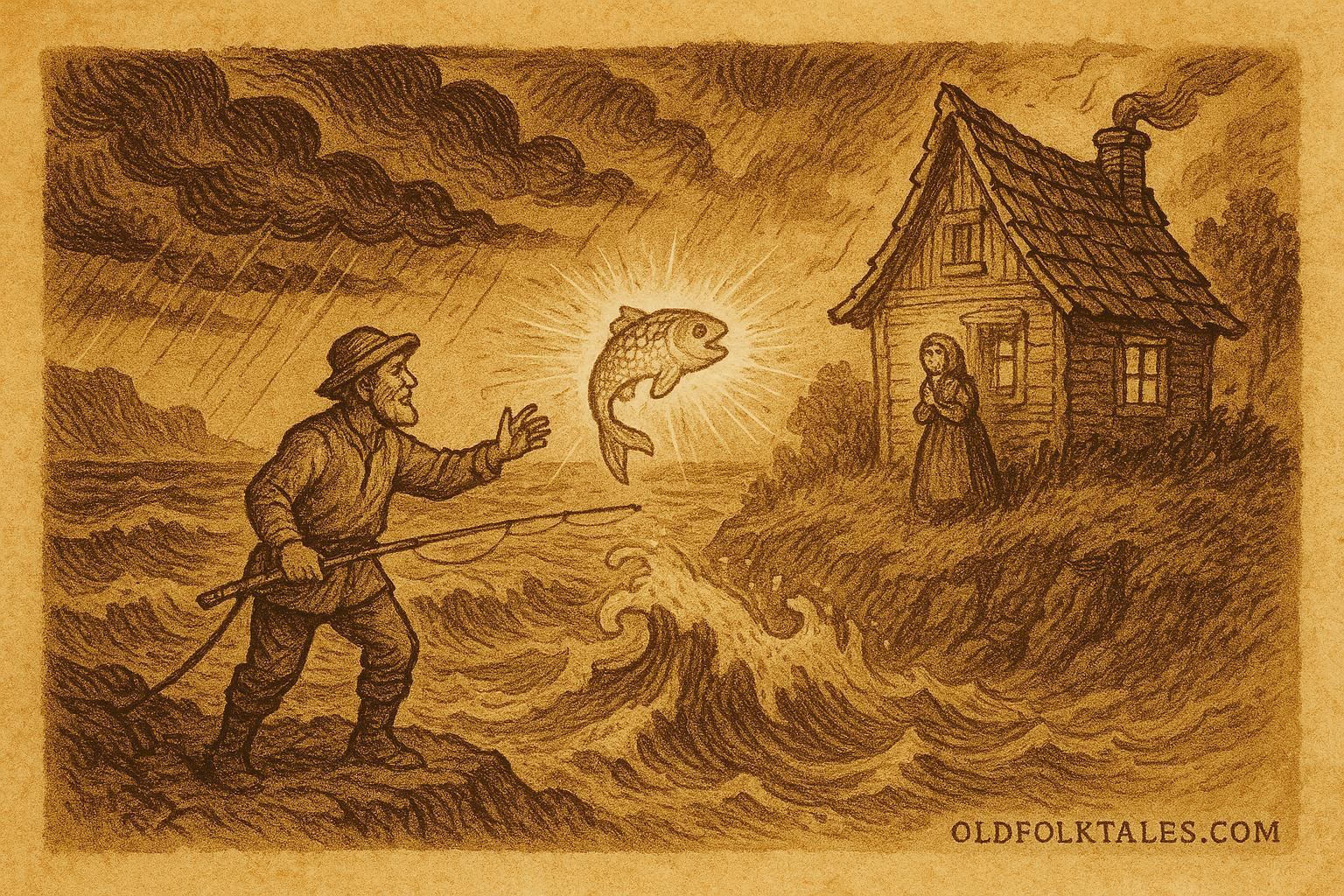
But one morning, as the dawn light turned the waves to gold, Plunk cast his net and felt a strange tug. He pulled and pulled until, to his astonishment, he hauled up a great shimmering fish, its scales glittered like silver coins, and its eyes glowed with deep intelligence.
“Good fisherman,” the fish spoke, its voice calm and clear as the tide, “spare my life, and I shall grant you whatever you wish.”
Plunk, who had never heard a fish speak before, was so startled he nearly dropped it back into the sea. But his heart was kind, and he said at once, “I wish nothing, good fish. Swim free and trouble yourself no more.”
And with that, he let the fish slip back into the water.
When Plunk told his wife what had happened, Mara’s eyes widened with greed. “You fool!” she cried. “A talking fish offered you a wish, and you let it go? Go back! Tell it I want a proper house, one with real walls and windows!”
Plunk hesitated. “Mara, we have what we need.”
But Mara would not rest until he returned. So Plunk trudged back to the shore, feeling foolish. He called out to the sea, “Oh, great fish, come if you please. My wife has sent me to speak with you.”
The water stirred, and the fish appeared once more. “What is it your wife desires?” it asked.
“She wishes for a fine house,” Plunk said quietly.
“Go home,” said the fish. “It is already so.”
Plunk hurried home and found that their old shack was gone. In its place stood a neat stone cottage with a red-tiled roof and a garden blooming with rosemary and fig trees. Mara clapped her hands in delight.
For a while, she was happy. But not for long.
“Plunk,” she said one morning, “this house is too small. I want a grand estate with servants and marble floors. Go to the fish again!”
Plunk sighed, his heart heavy. “Mara, must we not be thankful for what we have?”
But again, she drove him to the sea.
The fish appeared once more, and when Plunk asked on her behalf, the creature’s silver eyes dimmed slightly. Still, it said, “Go home. It is already so.”
Now a grand manor stood where the cottage had been. Mara swept through its halls in silk and jewels, giving orders to servants who bowed low.
Yet her heart was restless. “If I am to live like this,” she declared one evening, “I might as well be queen! Go, Plunk, tell the fish I wish to rule this land.”
Plunk trembled. “Mara, this cannot end well. Please, let us be content.”
But she would not listen. So once again, he went to the shore. The sea was darker now, the wind sharp. The fish rose slowly, its silver scales dulled by shadow.
“What does she ask this time?” it said.
“She wishes to be queen,” whispered Plunk.
The fish’s eyes flashed. “Go home.”
When Plunk returned, he found a castle standing on the cliffs, its towers shining over the restless sea. Guards stood at the gates, and Mara sat on a throne of gold, wearing a crown that sparkled like frost.
But still she was not satisfied. “Queen is not enough,” she said after some days. “I want to be the ruler of the seas themselves! The fish will obey me! Go, Plunk, tell it so.”
Plunk fell to his knees. “Mara, you go too far! The fish has been kind. We tempt its anger.”
But she pushed him away. “Go!”
With dread, Plunk walked to the shore. The sky was black, and waves crashed against the rocks. The fish rose amid the storm, its eyes glowing with sorrow.
“She wants to rule the seas?” it said quietly.
Plunk nodded, unable to speak.
The fish turned and vanished beneath the waves.
When Plunk returned home, there was no castle, no servants, no riches. The manor was gone. In its place stood the old, crooked cottage, half-buried in sand. His wife sat beside it, pale and silent, staring at the sea.
Plunk said nothing. He only took up his nets again and went to the water, as he had before.
Moral Lesson
The tale of Fisherman Plunk and His Wife teaches that greed and discontent can turn blessings into burdens. True happiness lies in gratitude for what one already has, not in endless desires for more.
Knowledge Check (Q&A)
1. Who are the main characters in “Fisherman Plunk and His Wife”?
Plunk, the humble fisherman, and his wife, Mara, who becomes increasingly greedy.
2. What magical element appears in the story?
A talking fish that grants wishes to Plunk.
3. What lesson does the folktale teach?
It warns against greed and the danger of never being content with what one has.
4. How does the setting reflect Croatian coastal life?
The story takes place by the Adriatic Sea, reflecting the fishing culture and seaside villages of Croatia.
5. What causes the final downfall of Plunk and his wife?
Mara’s final wish, to rule the seas, angers the magical fish, who takes away all their riches.
6. What emotion defines Plunk throughout the story?
Humility and patience, even as his wife grows more demanding.
Cultural Origin: Croatian folktale, Croatia.
Sources: Ivana Brlić-Mažuranić’s Priče iz davnine (Croatian Tales of Long Ago) and regional oral traditions.