In the rugged heart of Gwynedd, where steep mountains rose like ancient sentinels and narrow valleys echoed with the cries of wind and river, there stood the stronghold of Prince Llywelyn. His lands stretched across forests and hills, shaped by stone, rain, and time, and his people respected him as a just and capable ruler. Among all his possessions, his lands, his halls, his horses, there was none more treasured than his great hound, Gelert.
Gelert was no ordinary dog. He was large and strong, with a thick coat suited to the harsh Welsh climate, and eyes filled with intelligence and devotion. From the day he had been gifted to the prince, Gelert had never left his side. He guarded the halls at night, followed Llywelyn on hunts through forest and mountain, and watched faithfully over the prince’s household. His loyalty was absolute, unquestioned by any who knew him.
In time, Prince Llywelyn was blessed with a child, an infant son, small and fragile, yet precious beyond measure. The prince loved his child deeply, though the duties of leadership often called him away from the hall. Knowing Gelert’s devotion, Llywelyn entrusted the hound with the protection of the child whenever he was absent. Gelert accepted this duty as he did all others, with unwavering seriousness.
The Fateful Day
One morning, Prince Llywelyn prepared to go hunting in the nearby forests. The air was sharp and cool, and the hills were cloaked in drifting mist. Before departing, he looked upon his sleeping child and nodded with satisfaction as Gelert lay nearby, alert and watchful.
“Guard him well,” Llywelyn said, though he had no doubt the hound would do so.
The hunt took longer than expected. The prince pursued game deep into the woods, losing track of the sun as clouds gathered overhead. When he finally returned to his hall, evening shadows were already stretching across the valley.
As Llywelyn entered the great hall, a terrible sight met his eyes.
Gelert rushed forward to greet him, tail wagging, as he always did, but his muzzle and chest were stained with blood. The sight struck the prince like a blow. Panic seized his heart. Without speaking, he rushed past the hound and into the chamber where his child had been left.
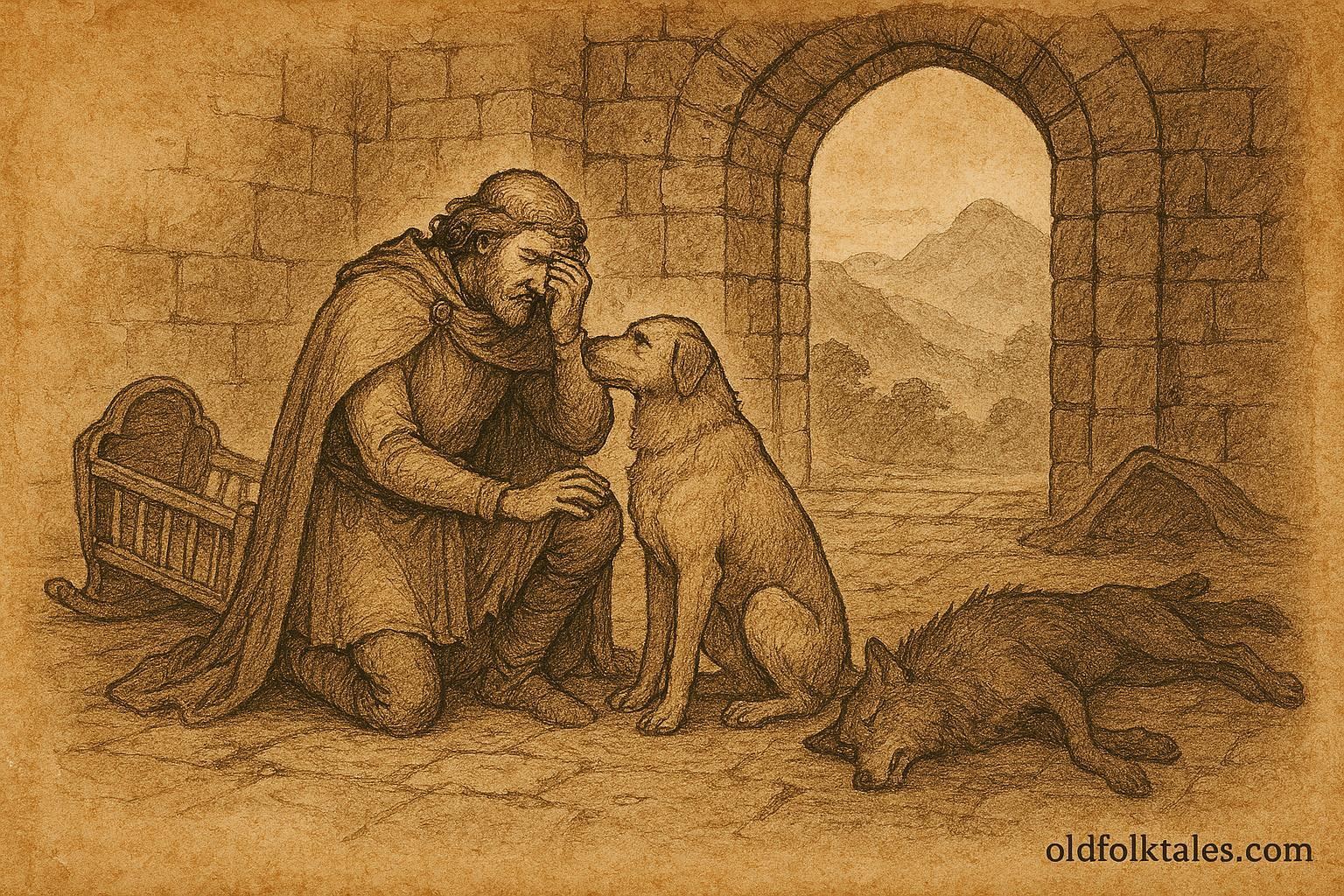
The cradle lay overturned. The blankets were torn and scattered. The child was nowhere to be seen.
In that moment, grief and rage consumed Prince Llywelyn. His thoughts raced, but his fear allowed no room for reason. Seeing the blood upon Gelert and the empty cradle, he leapt to the most terrible conclusion. He believed his loyal hound had turned savage and slain the child he had been sworn to protect.
Without waiting, without searching further, Llywelyn drew his sword.
A Tragic Mistake
Gelert, sensing his master’s distress but not understanding its cause, approached with trust and devotion. The hound did not growl or flee. He stood calmly before the prince, as he always had.
In a moment that would haunt him forever, Prince Llywelyn struck.
The blade fell, and Gelert collapsed without a sound. As life left the faithful hound, a single cry escaped his throat, not of anger or fear, but of pain and confusion. The hall fell silent.
Only then did the prince’s fury fade, replaced by a hollow dread.
Almost immediately, a faint sound reached his ears, a child’s cry, thin but unmistakable. It came from beyond the hall, near the far end of the chamber.
Llywelyn followed the sound with trembling steps.
Behind a fallen beam lay his child, alive and unharmed. Beside the child was the body of a great wolf, its throat torn and bloodied.
In that terrible instant, the truth revealed itself.
Gelert had not betrayed his trust. He had defended it.
The hound had fought the wolf to protect the child, killing the beast at the cost of his own life. The blood upon his coat was not a sign of guilt, but of courage.
Prince Llywelyn fell to his knees.
Grief Beyond Measure
The weight of what he had done crushed him. He gathered his child into his arms, sobbing, while his gaze fell again and again upon Gelert’s lifeless form. No enemy blade had slain the hound, only the hand of the master he had loved without question.
Llywelyn’s grief was profound and unending. No words could undo his act. No apology could reach the ears of the hound who had given everything in loyalty.
The prince ordered Gelert to be buried with honor near the place of the tragedy. He himself oversaw the burial, placing stones carefully and marking the grave so it would never be forgotten.
From that day forward, it is said that Prince Llywelyn never again smiled as he once had. The sound of hunting horns brought no joy to his heart, and laughter no longer echoed through his hall. He ruled justly still, but sorrow followed him like a shadow.
The place where Gelert was buried came to be known as Beddgelert, “Gelert’s Grave.”
A Story Remembered
Generations passed, but the story of Gelert endured. Parents told it to children, not to frighten them, but to teach them. Travelers heard it in the valleys of Gwynedd, spoken with quiet reverence. It became a lesson woven into the land itself, a reminder of the cost of rash judgment and the depth of true loyalty.
The people remembered Gelert not as a dog, but as a symbol: of faithfulness beyond reward, of courage without recognition, and of trust that deserved better than it received.
And so, in Wales, among mountains older than memory, the tale of Gelert the Faithful Hound lives on.
Moral Lesson
The story of Gelert teaches that rash judgment, made in anger or fear, can lead to irreversible loss. True loyalty may be silent and misunderstood, and trust, once broken, cannot always be restored. Wisdom lies in patience, reflection, and restraint.
Knowledge Check
-
Who was Gelert in Welsh folklore?
Gelert was Prince Llywelyn’s loyal hound, entrusted with guarding his child. -
Why did Prince Llywelyn kill Gelert?
He mistakenly believed Gelert had killed his child after seeing blood and an overturned cradle. -
What was the truth behind Gelert’s actions?
Gelert had slain a wolf to protect the child. -
What does the name “Beddgelert” mean?
It means “Gelert’s Grave” in Welsh. -
What is the central theme of the story?
The danger of rash judgment and the tragedy of misunderstood loyalty. -
Where does this legend originate?
Gwynedd, Wales, from Welsh oral tradition.
Source: John Rhys, The Legends and Traditions of North Wales (1901)
Cultural Origin: Wales (Gwynedd tradition)