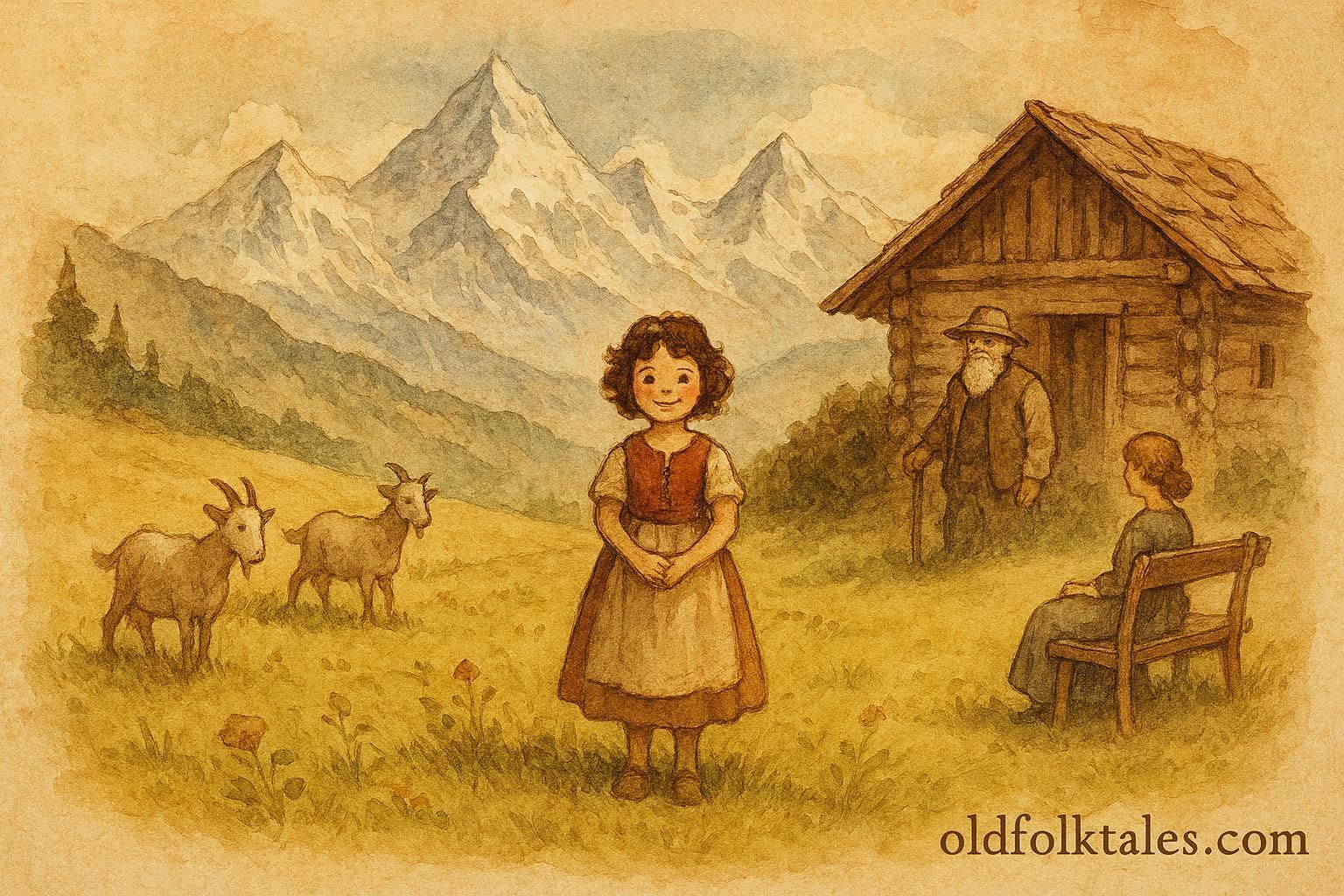
High above the valleys of German-speaking Switzerland, where the peaks of the Alps catch the first light of dawn and cowbells echo across green slopes, there lived a little girl whose name would become forever tied to the mountains themselves. Her name was Heidi.
She was a child of simple clothes, bright eyes, and unrestrained joy. When her story begins, she is sent away from the lowlands to live with her grandfather in the Canton of Graubünden, in a lonely hut perched above the village of Dörfli. Her aunt, unable to care for her, leaves her there, believing that the old man, though feared and avoided by the villagers, is still her closest kin.
The grandfather is a man apart.
He lives alone in the alpine heights, tending goats and carving wooden spoons by the hearth. The villagers speak of him in hushed tones. They call him stern, proud, hardened by sorrow and estranged from society. Years earlier, grief and disappointment had driven him away from human company. Since then, he has kept only the mountains for companions.
Into this silence bursts Heidi.
She arrives barefoot and curious, her hair sunlit, her heart unburdened. From the first moment, she looks upon the high pastures not with fear, but with wonder. The scent of hay, the whisper of fir trees, the open sky stretching endlessly above her, these are not hardships to her. They are gifts.
At first, her grandfather watches her with wary eyes. He is unused to chatter and laughter. Yet Heidi does not attempt to change him by force or persuasion. She simply lives as she is, joyfully, honestly, without guile.
She delights in sleeping in the hayloft, in watching the golden sunset spill across the peaks, in drinking fresh goat’s milk straight from the pail. Each morning, she accompanies the goatherd Peter and his flock up the mountainside. She runs across alpine meadows filled with wildflowers, listening to the wind hum through the grasses. To her, the mountains are alive, protective, and generous.
Her innocence begins to soften the old man’s guarded heart.
He builds her a sturdy bed of hay. He brings her fresh bread and cheese. Slowly, almost without noticing it himself, he begins to smile again.
The transformation is quiet but profound.
The villagers observe from below as the once-reclusive grandfather descends occasionally into Dörfli to purchase necessities. He no longer scowls at greetings. He no longer walks as one burdened by resentment. Heidi’s presence has rekindled something long dormant, his capacity for tenderness.
But Heidi’s life in the Alps does not remain undisturbed.
One day, her aunt returns. She insists that Heidi must go to Frankfurt, to serve as companion to a wealthy but sickly girl named Clara. Though the grandfather resists, circumstances press upon him. Heidi, confused but obedient, is taken from the mountains she loves.
The city overwhelms her.
Frankfurt is orderly and grand, yet enclosed. There are walls instead of peaks, paved streets instead of grassy slopes. Windows frame the sky in narrow strips. For a child whose soul has grown wide beneath open air, the confinement feels suffocating.
Clara is kind and intelligent but physically frail, unable to walk. She sits indoors surrounded by tutors, governesses, and expectations. Heidi befriends her sincerely. She tells Clara of the Alps, the blue gentians, the soaring eagles, the warmth of the sun at high altitude. Clara listens as if hearing tales of another world.
Yet while Heidi brings joy to Clara, she herself begins to wither.
She grows pale. She forgets to eat. At night, she sleepwalks, drawn by dreams of mountain winds and star-filled skies. The doctor, observing her condition, recognizes what others do not: Heidi is suffering from homesickness, not a trivial longing, but a deep spiritual ache.
She must return to the Alps.
When Heidi finally goes back to her grandfather’s hut, the reunion is radiant. The mountains seem to welcome her as one of their own. She runs across familiar meadows; the wind tangles her hair; the goats bleat in greeting. Health returns to her cheeks almost at once.
Clara, too, will soon travel to visit Heidi in the mountains. Her arrival brings a new chapter. At first, she is carried up the slopes, her delicate body unaccustomed to the terrain. But the Alpine air works quietly upon her. The sunlight strengthens her. The vastness of the landscape awakens courage within her heart.
Encouraged gently, never forced, Clara begins to attempt standing. Then stepping. Then walking.
The same mountains that healed Heidi now help restore Clara’s strength.
Meanwhile, Heidi’s grandfather completes his own redemption. Once estranged from faith and community, he gradually reconciles with the village pastor. He returns to church. He allows himself to belong again. Through the steadfast affection of a child, he re-enters human society, not diminished but renewed.
The story of Heidi is not one of grand battles or enchanted spells. There are no witches or curses. Yet its power lies in something equally enduring: the quiet magic of nature, innocence, and compassion.
The Swiss Alps are not mere backdrop. They are participants, living symbols of simplicity, clarity, and restoration. In contrast to the artificial constraints of urban life, the mountains represent freedom and authenticity. Heidi thrives not because of wealth or status, but because she is rooted in an environment that honors natural rhythms.
In the end, Heidi remains what she has always been: open-hearted, joyful, deeply connected to the land and to the people around her. She does not seek greatness, yet she transforms lives. Her presence heals divisions, rekindles hope, and reminds those around her that belonging cannot be bought, it must be lived.
Thus, the tale of Heidi, though literary in origin, has become woven into Swiss cultural identity. It reflects alpine values of resilience, humility, closeness to nature, and the belief that even hardened hearts can soften under the warmth of genuine love.
Moral Lesson
True healing comes from simplicity, kindness, and connection, to nature, to community, and to one another. Innocence and sincerity can mend even the most wounded hearts.
Knowledge Check
1. Who created the story of Heidi?
Heidi was written by Johanna Spyri in 1881 and reflects authentic Swiss alpine life and values.
2. What role do the Swiss Alps play in Heidi?
The Alps symbolize freedom, healing, simplicity, and moral clarity, shaping the growth of every character.
3. How does Heidi change her grandfather?
Through unconditional love and joyful innocence, she softens his isolation and restores his connection to the community.
4. Why does Heidi become ill in Frankfurt?
She suffers from severe homesickness, demonstrating the emotional and spiritual importance of belonging.
5. How is Clara transformed in the Alps?
The mountain air, encouragement, and renewed courage help Clara regain physical strength and independence.
6. What cultural values does Heidi reflect?
The story reflects Swiss alpine ideals of humility, pastoral life, resilience, redemption, and harmony with nature.
Source: Heidi by Johanna Spyri (1881).
Cultural Origin: German-speaking Switzerland (Canton of Graubünden / Swiss Alps).