In the fortified city of Valletta, where honey-colored bastions rise above the Mediterranean and narrow streets still carry the footsteps of centuries, there once stood a grand residence known among locals as the Red Palace. Its façade caught the sunset in deep crimson hues, and its long corridors were lined with portraits of stern-faced nobles whose lives had unfolded during the era of the Knights of St. John. Within those walls, a story was born, one not recorded in marble plaques, but whispered from generation to generation. It is the tale of Il-Fatat tal-Palazz l-Aħmar, the Ghost of the Red Palace.
Long ago, during the final flourishing years of the Knights, a noblewoman resided in that palace. She was known for her elegance and quiet intelligence. Dressed often in fine fabrics dyed in shades of deep red, she moved through the grand halls with grace, her presence commanding respect.
She had given her heart to a man of rank and promise. Their union was to strengthen family ties and secure influence in the intricate web of alliances that defined Maltese noble society under the Knights’ rule. In those days, loyalty was not only a personal virtue, it was political currency.
But trust, when misplaced, becomes the sharpest blade.
Whispers began before the wedding day. Servants carried fragments of overheard conversations. Letters passed discreetly between rival houses. The noblewoman discovered, not through confession but through betrayal laid bare, that the man she trusted had pledged himself elsewhere in secret. His vows to her were convenient. His loyalty divided. His ambition greater than his honor.
To be betrayed in love is painful. To be betrayed in a world governed by reputation and oath was devastating.
The wedding never came.
Some say she confronted him in the very corridor where her portrait now hangs. Others claim she simply withdrew, her dignity intact but her spirit wounded beyond repair. What is certain is that she died not long after, her grief etched into memory as sharply as any inscription in stone.
And then, the sightings began.
Servants working late would report soft footsteps echoing at midnight, though the palace doors were locked. A faint rustle of silk where no one stood. The distant scent of rosewater lingering in the air.
Then came the first clear account.
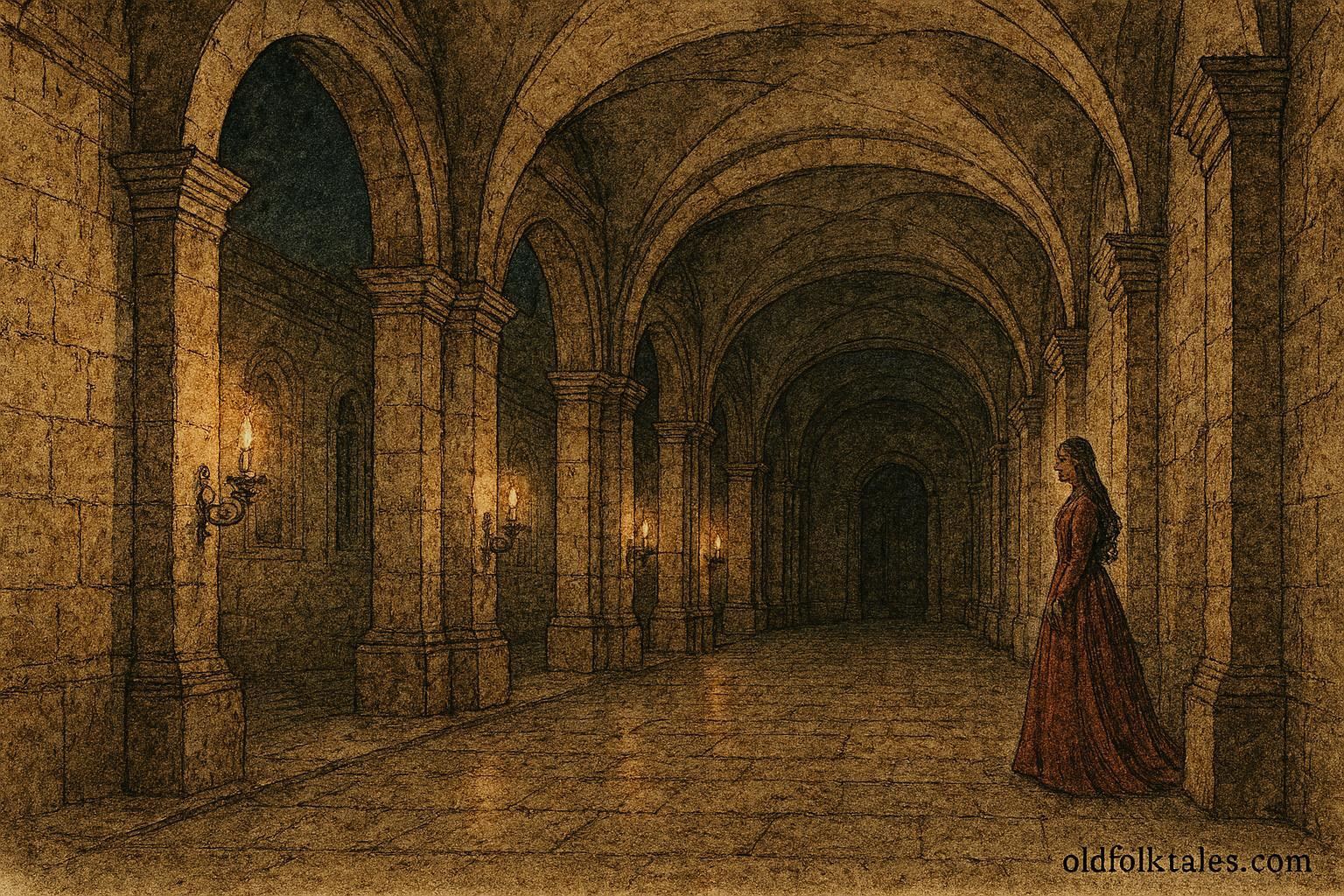
A descendant of the family, walking alone through the palace corridor at the stroke of twelve, saw a figure at the far end of the hall. She was dressed in red, deep crimson that seemed almost luminous against the dim candlelight. Her face was pale but composed, her expression neither angry nor sorrowful.
She did not speak.
She simply stood, her gaze steady, her presence unmistakable.
When he blinked, she was gone.
Word spread quietly through Valletta. The ghost was not violent. She did not rattle doors or scream in anguish. Instead, she appeared only at midnight, gliding along the corridor where betrayal had unfolded, as though reliving the moment suspended between trust and treachery.
Those who saw her described a strange feeling, not fear, but warning.
One story tells of a young heir generations later who contemplated breaking a solemn promise for personal gain. On the very night he resolved to act dishonorably, he walked the corridor and found her waiting.
She stood in red at the end of the hall.
The candle flame in his hand trembled though there was no draft. He felt, unmistakably, the weight of her gaze.
No words passed between them.
Yet he understood.
The next morning, he reversed his decision.
Thus, the legend of Il-Fatat tal-Palazz l-Aħmar took on deeper meaning. She was no restless spirit seeking revenge. She was memory made visible, a reminder that broken vows echo beyond a single lifetime.
The palace itself became part of the tale. Visitors remarked on its long, symmetrical corridors and heavy wooden doors. Portraits of ancestors watched from gilded frames. Red draperies caught the evening light in ways that seemed almost animate.
At midnight, some claimed, the silence deepened unnaturally.
In Maltese tradition, especially in stories shaped by the era following the Knights, hauntings often serve as moral instruction. They preserve historical memory, reminding the living that honor and loyalty are not relics of the past but obligations carried forward.
The Ghost of the Red Palace embodies that belief.
She appears not to terrify strangers but to caution descendants. Her presence binds generations together in shared accountability. The palace walls, witnesses to ambition and betrayal, hold her image like a living conscience.
Even as Valletta modernized and centuries turned, the story endured. Guides spoke of it in hushed tones. Families referenced it half-seriously when reminding children of the value of keeping promises.
And always, the detail remained the same:
At midnight, in the quiet corridor of the Red Palace, a noblewoman dressed in crimson may be seen, silent, dignified, unwavering.
Not seeking sympathy.
Not demanding justice.
Simply reminding.
For history in Malta is never entirely past. It lingers in limestone streets, in cathedral domes, in bastions facing the sea. And sometimes, it walks in red silk through a silent hall.
Moral Lesson
This Maltese folktale teaches that betrayal carries consequences beyond the immediate moment. Loyalty and honor shape not only personal fate but family legacy. History remembers broken vows, and conscience may return to remind us.
Knowledge Check
-
Who is the Ghost of the Red Palace?
A betrayed noblewoman from the era of the Knights who haunts a palace corridor in Valletta. -
When does the ghost appear?
At midnight, walking silently through the palace hall. -
What does her red dress symbolize?
Love, betrayal, dignity, and the emotional weight of broken vows. -
What is the purpose of her haunting?
To warn descendants against treachery and dishonor. -
Which historical period shapes this legend?
The era of the Knights of St. John in Malta. -
Where was this folklore documented?
In Folklore of the Maltese Islands (1996).
Source: Ġorġ Mifsud Chircop, Folklore of the Maltese Islands (1996).
Cultural Origin: Valletta and central Malta (post-Knights period).