In the tightly woven villages of Malta, where limestone houses leaned close together and church bells ordered the rhythm of every day, baptism was no small matter. It was not merely a rite of welcome, but a shield, one placed upon the soul of a newborn to guard it against sickness, misfortune, and forces unseen. To delay it was dangerous. To corrupt it was unthinkable.
And yet, the elders warned, there were nights when even holy customs could be twisted.
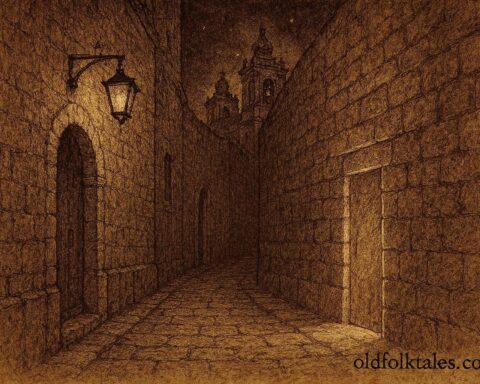
It was on such a night that the midwife Maria, known across the village for her steady hands and sharper mind, received a knock at her door long after the evening prayers had ended. The streets outside lay silent, moonlight washing pale over the stone. Dogs did not bark. Lamps had gone dark.
The knock came again. Polite. Patient.
When Maria opened the door, she found a man standing with the bearing of a noble. His clothes were fine but strangely old-fashioned, his boots spotless despite the dust of the road. His face was handsome, calm, and unreadable, and yet something about his eyes unsettled her, not cruel, but calculating, as though they measured more than they revealed.
He bowed deeply.
“Madonna,” he said smoothly, “I seek your skill. A child has been born under my roof this very night. The family wishes the baptism performed at once.”
Maria frowned. Baptisms were the work of priests, but midwives were often called to prepare the child, to speak the prayers, to guide the family until dawn could bring the bells and the blessing.
“Where is the child?” she asked.
“In my home,” the man replied. “Not far.”
She noticed then what he had not said. No name. No family. No priest summoned.
“And why come alone?” Maria asked. “Why not send word to the parish?”
The nobleman smiled, a slow, practiced thing. “This baptism must be… special.”
At that word, Maria felt the weight of old teachings stir in her chest. She had learned her trade from women who crossed themselves before every birth and whispered prayers into the ears of newborns. She knew the stories, of spirits drawn to unguarded souls, of rites performed wrongly, of words said backward to undo what God had ordered forward.
Still, she did not refuse.
She wrapped her shawl tightly and followed the man through narrow lanes that twisted away from the village center. The church tower faded behind them. The houses thinned. At last, they reached a large, silent dwelling set apart from the rest, its windows dark despite the hour.
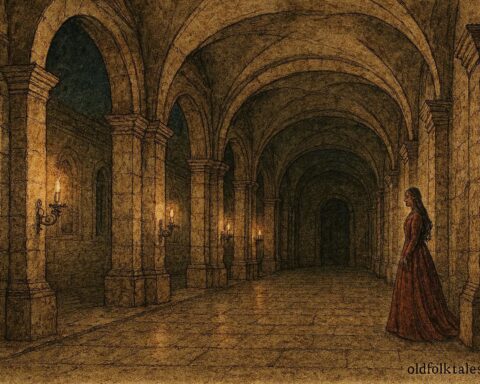
Inside, the air felt heavy, as if the walls themselves were holding their breath.
The child lay in a cradle near the hearth, swaddled and still. No mother hovered nearby. No grandmother murmured prayers. The room was unnaturally quiet.
The nobleman gestured toward the infant.
“Begin,” he said.
Maria approached slowly. The child slept, its chest rising and falling. She placed her fingers gently against its brow and felt warmth—life, fragile and new.
Then the man spoke again.
“The baptism,” he said, “must be performed backward.”
Maria’s hand stilled.
“Backward?” she repeated carefully.
“Yes,” he replied. “The words reversed. The gestures undone. That is the custom in my family.”
At that moment, all doubt vanished.
Maria did not cry out. She did not recoil. Instead, she straightened her back and looked directly at the nobleman.
“There is no Christian baptism performed backward,” she said firmly. “Only mockery. Only blasphemy.”
The man’s smile did not fade, but something in his eyes sharpened.
“You are wiser than you appear,” he said. “But wisdom does not protect the soul of a child. Only obedience does.”
Maria felt fear then, but she felt faith more strongly.
She crossed herself, deliberately and slowly, her fingers firm against her brow and chest. She began the baptismal prayers aloud, speaking them correctly, clearly, invoking the Father, the Son, and the Holy Spirit.
The nobleman stepped forward sharply.
“Stop,” he hissed. “You were instructed otherwise.”
Maria did not stop.
Instead, she did something she had been taught long ago: she spoke the prayers forward, but she addressed them against deception. She named the evil she sensed without naming him directly. She asked for protection, for light, for truth.
The air in the room shifted. The hearth flared suddenly, though no wood was added. Shadows twisted along the walls.
The nobleman recoiled.
“You dare?” he snarled, his voice no longer smooth. “You dare defy me in my own house?”
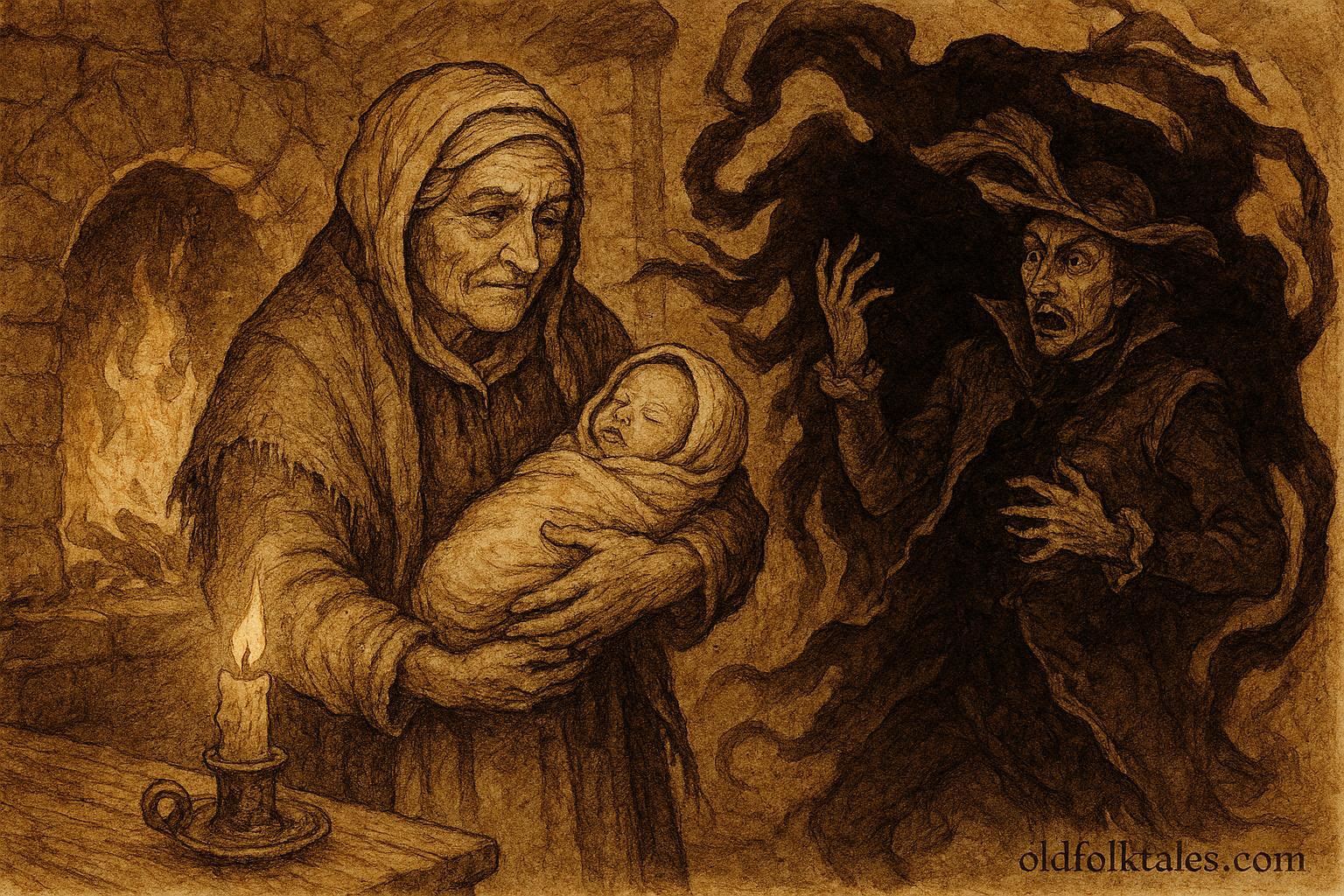
Maria lifted the child gently from the cradle and held it close, pressing her shawl around it like a barrier.
“This is not your house,” she said. “And this soul is not yours.”
At that, the man’s disguise faltered. His fine clothes seemed to darken. His shadow stretched unnaturally long across the floor. His eyes burned—not with fire, but with fury.
“You midwives,” he spat. “Always meddling. Always watching.”
With a sound like wind rushing through a cracked door, he vanished. The hearth went cold. The silence broke.
Outside, church bells began to ring, not for dawn, but as if stirred by unseen hands.
Maria stood trembling, clutching the child. When villagers arrived, drawn by the bells and the sudden light in the sky, they found her alone in the empty house, the nobleman gone as though he had never existed.
The child was baptized properly the next morning, surrounded by candles, prayers, and a church filled to the doors.
Maria never spoke of the man again. But from that day on, she never entered a birth without whispering the Sign of the Cross first.
And in Maltese villages still, elders say: watch the rites, mind the words, and never trust a stranger who asks you to turn faith backward.
Explore the warmth and wit of Mediterranean storytelling, where love and wisdom intertwine
Moral Lesson
Il-Magħmudija tax-Xitan teaches that evil often arrives disguised as authority or tradition. Faith must be paired with vigilance, and cleverness guided by belief can protect even the most vulnerable. Sacred rituals lose their power when performed without truth, but when upheld with courage, they drive deception away.
Knowledge Check
1. Who disguises himself as a nobleman in the story?
The Devil disguises himself to deceive the midwife and corrupt the baptism.
2. Why is the backward baptism significant?
It represents a perversion of sacred ritual intended to endanger the child’s soul.
3. What saves the child from harm?
The midwife’s faith, quick thinking, and correct performance of the baptismal prayers.
4. What role does the midwife play in Maltese folklore?
She serves as a guardian figure, protecting life and spiritual order through wisdom.
5. What belief does this story reflect about religious rituals?
That words, direction, and intention matter deeply in sacred acts.
6. What is the central warning of the tale?
Evil often appears polite and respectable, and moral vigilance is essential.
Source: Ħrejjef u Tradizzjonijiet Maltin collected by Ġorġ Mifsud Chircop (1996)
Cultural Origin: Village-based Maltese Catholic folklore