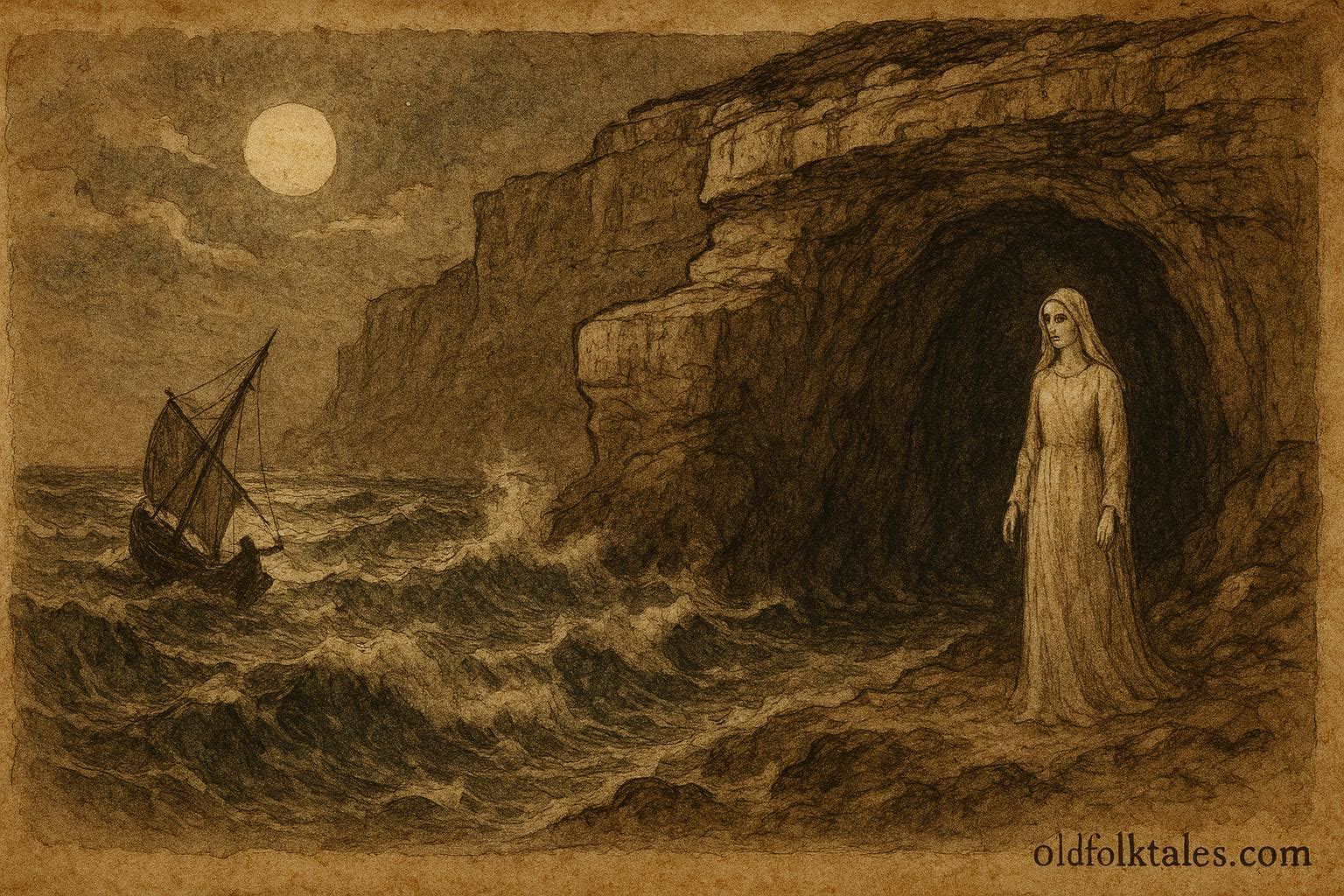
Along the rugged coastline of Malta, where limestone cliffs rise pale and jagged above the restless Mediterranean, there lies a sea cave known only to fishermen and shepherds of the shore. Its mouth yawns darkly at the base of the cliffs, half-hidden by waves and sea foam, revealed fully only when the tide withdraws. This place is called Il-Mara tal-Għar, the Cave of the Woman.
For generations beyond counting, the people of nearby coastal villages have spoken of Il-Mara tal-Għar, the Woman of the Cave. Some say she is as old as the island itself, bound to the rock and water long before harbors were built or nets were cast. Others believe she is the spirit of an ancient guardian, charged with watching over the sea and those who dare to make their living upon it.
Fishermen know her name well, though they speak it softly and only when necessary. Before setting out to sea at dawn, they glance toward the cliffs, offering a silent prayer or a murmured word of respect, not to a saint, but to the unseen presence believed to dwell within the cave. For the sea around Malta is both giver and taker of life, and Il-Mara tal-Għar is said to embody that dual nature.
On calm days, the cave appears empty and silent. Sunlight glances off its wet stone walls, and seabirds nest undisturbed above its entrance. But when storms rise suddenly—as they often do in these waters, the cave seems to awaken.
It is then that Il-Mara tal-Għar is said to appear.
Those who have seen her describe her in different ways, yet always with the same sense of awe and unease. She is tall and pale, her hair dark and heavy like wet seaweed, her eyes reflecting moonlight even on the blackest nights. Sometimes she stands at the cave’s mouth, motionless as stone. At other times, she appears farther out upon the rocks, untouched by the crashing waves.
To fishermen caught in sudden gales, her presence can mean salvation, or ruin.
There are many stories told by the firesides of Malta’s coastal homes. One speaks of a humble fisherman who, years ago, found himself trapped by a rising storm. His small boat was no match for the wind, and the waves drove him toward the cliffs. In his terror, he remembered the old tales and called out, not demanding rescue, but asking only for guidance.
From the darkness ahead, a pale figure emerged. Il-Mara tal-Għar raised her arm and pointed, not toward the cave, but toward a narrow passage between the rocks, barely visible beneath the surging water. Trusting her silent guidance, the fisherman steered his boat as she indicated. The waves eased just enough for him to pass, and by dawn he was safely ashore.
He never spoke boastfully of the event. Instead, he left offerings of bread and oil near the cave, and from that day forward, his nets were said to return full more often than empty.
But not all encounters end so gently.
Another tale tells of men driven not by need, but by greed. These fishermen scoffed at the old warnings and mocked the idea of a guardian spirit. When storms came, they laughed, believing themselves masters of the sea. One night, they claimed to see a woman upon the rocks, calling to them in a voice like wind over water.
Believing her to be a lost traveler, or perhaps something to be exploited, they steered closer. The waves grew wild, the rocks treacherous. By morning, only fragments of their boat washed ashore. The sea had taken the rest.
From such stories, the villagers learned that Il-Mara tal-Għar does not save all who encounter her. She offers protection only to those who approach the sea with humility and respect. To the arrogant and the greedy, she becomes a warning made flesh.
Some elders say she was once human, a woman betrayed or wronged, bound to the land and sea through injustice. Others insist she was never mortal at all, but a spirit born from the meeting of stone and water, created to guard the balance between humans and nature. No one claims certainty, for mystery itself is part of her power.
What is agreed upon is this: Il-Mara tal-Għar watches.
She watches the boats that leave before dawn and the children who play too close to the cliff edges. She listens to the prayers whispered into the wind and the curses shouted in anger. She knows which hearts carry gratitude and which carry hunger without restraint.
In times of calm, she remains unseen, allowing humans to believe themselves alone. But when storms gather, whether of wind or of human intent, she makes herself known.
And so, life along the Maltese coast continues in quiet reverence. Nets are mended with care. The sea is greeted each morning, not challenged. Fishermen teach their children that the water is not an enemy, but a force deserving respect.
For Il-Mara tal-Għar is neither cruel nor kind by human measure. She is the sea’s truth made visible: generous to those who honor it, unforgiving to those who forget their place.
Explore the warmth and wit of Mediterranean storytelling, where love and wisdom intertwine
Moral Lesson
Nature is both protector and judge. Those who approach it with humility, gratitude, and respect may find guidance and safety, but greed and arrogance invite destruction.
Knowledge Check
-
Who is Il-Mara tal-Għar in Maltese folklore?
She is a supernatural guardian spirit believed to dwell in a coastal cave and watch over the sea. -
When does Il-Mara tal-Għar appear?
She is most often seen during storms or moments of danger at sea. -
Why does she help some fishermen and harm others?
She rewards humility and respect while punishing greed and arrogance. -
What does Il-Mara tal-Għar symbolize?
She represents the dual nature of the sea, life-giving yet dangerous. -
Where does this folktale originate?
It comes from coastal Maltese villages and Mediterranean island folklore. -
Who recorded this story in folklore studies?
Joseph Cassar Pullicino documented it in Studies in Maltese Folklore.
Source: Joseph Cassar Pullicino, Studies in Maltese Folklore, 1964
Cultural Origin: Coastal Maltese villages (Mediterranean island folklore)