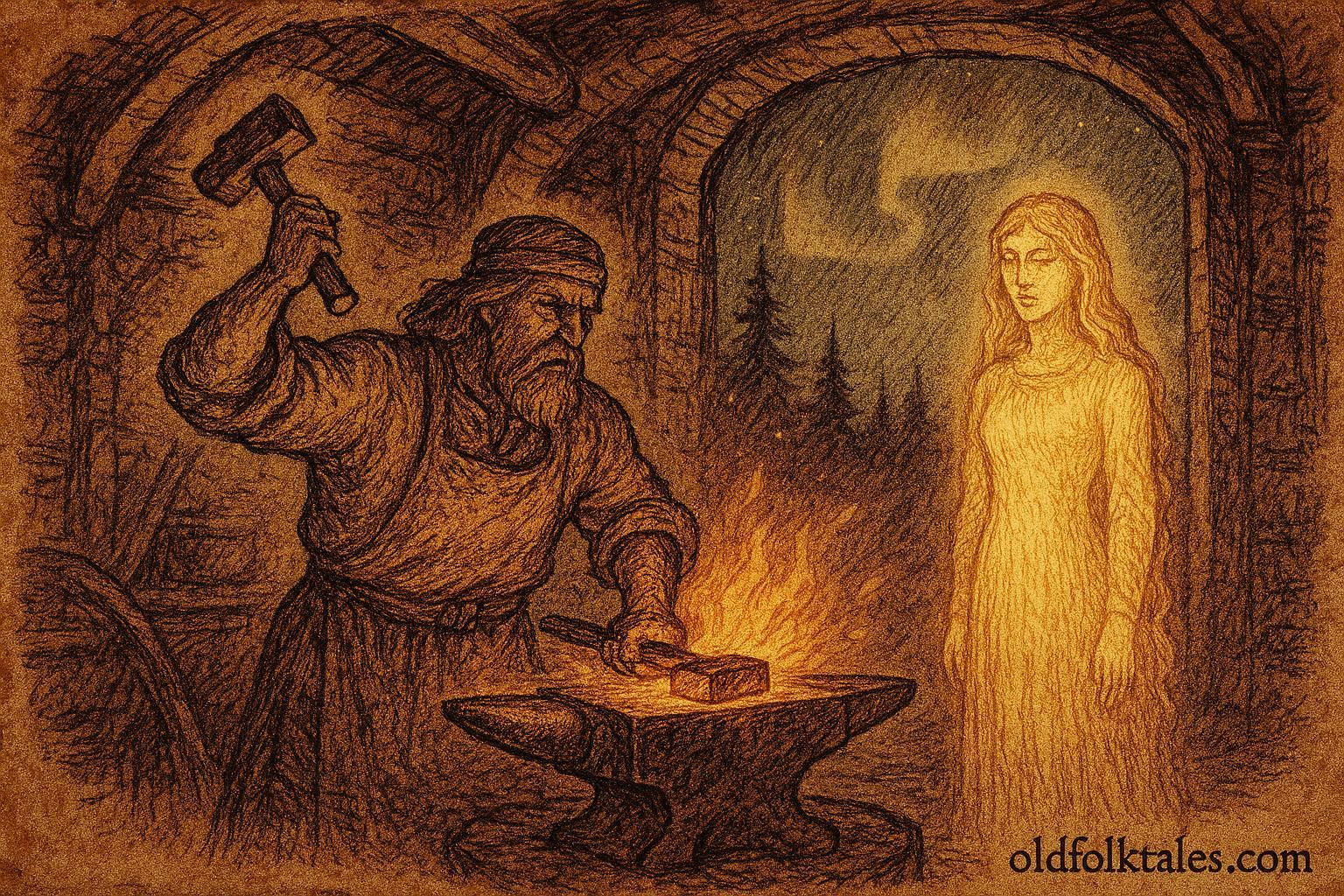
In the far northern lands where forests stretch like dark oceans and lakes mirror the sky, there lived a master smith whose name was known across the snowy plains and pine-covered hills. He was Ilmarinen, eternal hammerer, whose forge-fire glowed brighter than the summer sun and whose skill could bend iron as though it were wax.
Ilmarinen had shaped wonders that no other craftsman could imagine. He had forged the Sampo, that mysterious mill of prosperity. He had hammered out weapons that shone like lightning. He had fashioned ornaments that glimmered like frost on winter mornings. Yet for all his skill, he was not immune to sorrow.
For Ilmarinen had once loved.
The maiden he cherished was gentle and wise, and her laughter warmed his heart more than any flame from his forge. But fate in the northern lands is not kind to happiness. She was taken from him, lost to death and silence. Whether through illness, cruel accident, or the quiet decree of destiny, she passed beyond the reach of hammer and anvil.
And Ilmarinen, who could conquer iron, could not conquer grief.
For many days he worked without rest. The ringing of his hammer echoed across the valleys. Sparks flew like stars torn from the sky. Yet no matter how fiercely he labored, the emptiness within him remained.
At last, a thought entered his mind, bold, impossible, and desperate.
If he could forge the Sampo…
If he could shape iron into marvels…
Why could he not forge a bride?
So began the most ambitious and tragic work of his life.
The Forging of the Golden Maiden
Ilmarinen gathered gold from distant traders and silver from hidden veins beneath the earth. He piled them high beside his forge. He stoked the bellows until the fire roared like a winter storm through the pines. The metal melted, glowing red, then white.
With steady hands and eyes sharpened by grief, he began.
He shaped slender arms and delicate fingers from purest gold. He formed a graceful neck and shoulders from silver so bright they reflected the flames. He crafted lips fine as carved ivory and hair that shimmered like sunlight upon new snow.
Every strike of the hammer rang with longing.
He worked through nights when the northern lights shimmered above the forest. He labored through mornings when frost glazed the earth. Slowly, piece by shining piece, the maiden took form.
When at last she stood complete before him, she was flawless.
Her face was smooth and serene. Her features perfect. Jewels adorned her brow. Gold and silver blended in harmony, reflecting the firelight in dazzling brilliance.
She was beautiful, more beautiful, perhaps, than any living woman.
Ilmarinen stepped back and gazed upon his creation. His heart pounded with something that felt like hope.
“Now,” he whispered, “I shall no longer be alone.”
He reached for her hand.
It was cold.
The Silence of Perfection
Ilmarinen told himself that metal was always cold at first. He placed her beside the hearth, hoping the warmth would soften her. He spoke to her as he once had to his beloved. He told her stories of distant lands and northern skies. He described the music of the wind through birch trees and the shimmer of moonlight upon the lakes.
The golden bride did not answer.
Her eyes remained fixed and unblinking. Her lips did not curve in laughter. Her hands did not return his touch.
He dressed her in fine garments. He adorned her with ornaments worthy of a queen. He seated her at his table as though she might share bread and drink.
Still, she was silent.
The more he looked upon her, the more he saw what was missing.
Her beauty was without warmth.
Her perfection was without breath.
Her face, though lovely, held no memory, no thought, no soul.
She could not feel the softness of spring grass. She could not hear the songs of birds. She could not weep, nor rejoice, nor love.
Ilmarinen, master smith, had forged gold into the shape of life, but he had not forged life itself.
At night, when the fire died low, he lay beside her. The cold of her form seeped into him like winter frost. He realized that no amount of gold could replace the warmth of living skin, no skill of hammer could recreate the spark that lives within the human heart.
His grief deepened, but now it was joined by understanding.
The Limits of Craftsmanship
Ilmarinen had believed that his skill could overcome sorrow. That with enough metal, enough fire, enough precision, he could mend what fate had broken.
But the forge, mighty as it was, could not create a soul.
He looked upon the golden maiden one final time. Her beauty no longer dazzled him. It only reminded him of what could not be restored.
In some tellings of the tale, Ilmarinen attempts to offer the golden bride to another, perhaps hoping someone else might find value in what he could not love. But none desire her. Who would choose a lifeless statue over a breathing companion? Even kings and warriors prefer warmth over perfection.
At last, Ilmarinen accepted what his grief had resisted.
He dismantled his creation.
The gold returned to the crucible.
The silver melted back into shapeless brightness.
The jewels were removed and set aside.
The maiden vanished into metal once more.
Ilmarinen stood alone in his forge, the fire burning low.
Yet something within him had changed.
A Lesson Tempered by Flame
From that day forward, Ilmarinen worked with renewed understanding. He continued to forge wondrous objects, but he no longer sought to conquer sorrow with metal.
He understood that craftsmanship has limits.
A smith may shape iron.
A builder may raise towers.
A king may command armies.
But love cannot be hammered into existence.
Warmth cannot be cast in a mold.
Life cannot be assembled from gold and silver.
True companionship is born of breath, spirit, and shared suffering, not perfection of form.
The master smith learned that human warmth, fragile, flawed, and fleeting, is worth more than the brightest treasure forged by fire.
And so the story of Ilmarinen and the Golden Bride endured among the Karelian singers and Finnish storytellers, carried in verse and song. It became a reminder that even the greatest skill cannot replace the living heart.
Moral Lesson
The tale of Ilmarinen teaches that no craft, wealth, or skill can substitute for genuine human connection. Perfection without soul is emptiness. True warmth comes not from flawless creation, but from living hearts capable of love, grief, and change.
Knowledge Check
1. Who is Ilmarinen in Finnish folklore?
Ilmarinen is a legendary master smith from Finnish epic tradition, known for forging magical objects such as the Sampo in the Kalevala.
2. Why does Ilmarinen forge a golden bride?
He attempts to replace his lost beloved, believing his craftsmanship can overcome grief and loneliness.
3. What materials are used to create the golden maiden?
She is forged from gold and silver, shaped and adorned to resemble a flawless human bride.
4. Why does the golden bride fail to bring Ilmarinen comfort?
Though beautiful, she is cold and lifeless, lacking warmth, breath, and a human soul.
5. What central theme does the story convey?
The tale emphasizes the limits of skill and the idea that love and humanity cannot be artificially created.
6. What cultural tradition does this story come from?
It originates from Finnish and Karelian epic poetry, preserved in the Kalevala.
Source: Kalevala, compiled by Elias Lönnrot, 1835.
Cultural Origin: Finland (Karelian epic poetry tradition).