In the heart of rural Malta, far from the salt-stung coasts and bustling harbors, there lies a stretch of abandoned farmland where stone walls crumble and weeds choke the furrows once cut by careful hands. By day, the land appears merely neglected, sun-bleached soil, broken carob trees, and the faint outlines of terraces built generations ago. But by night, the fields belong to something else entirely. Villagers whisper of Ir-Raġel tan-Nar, the Man of Fire.
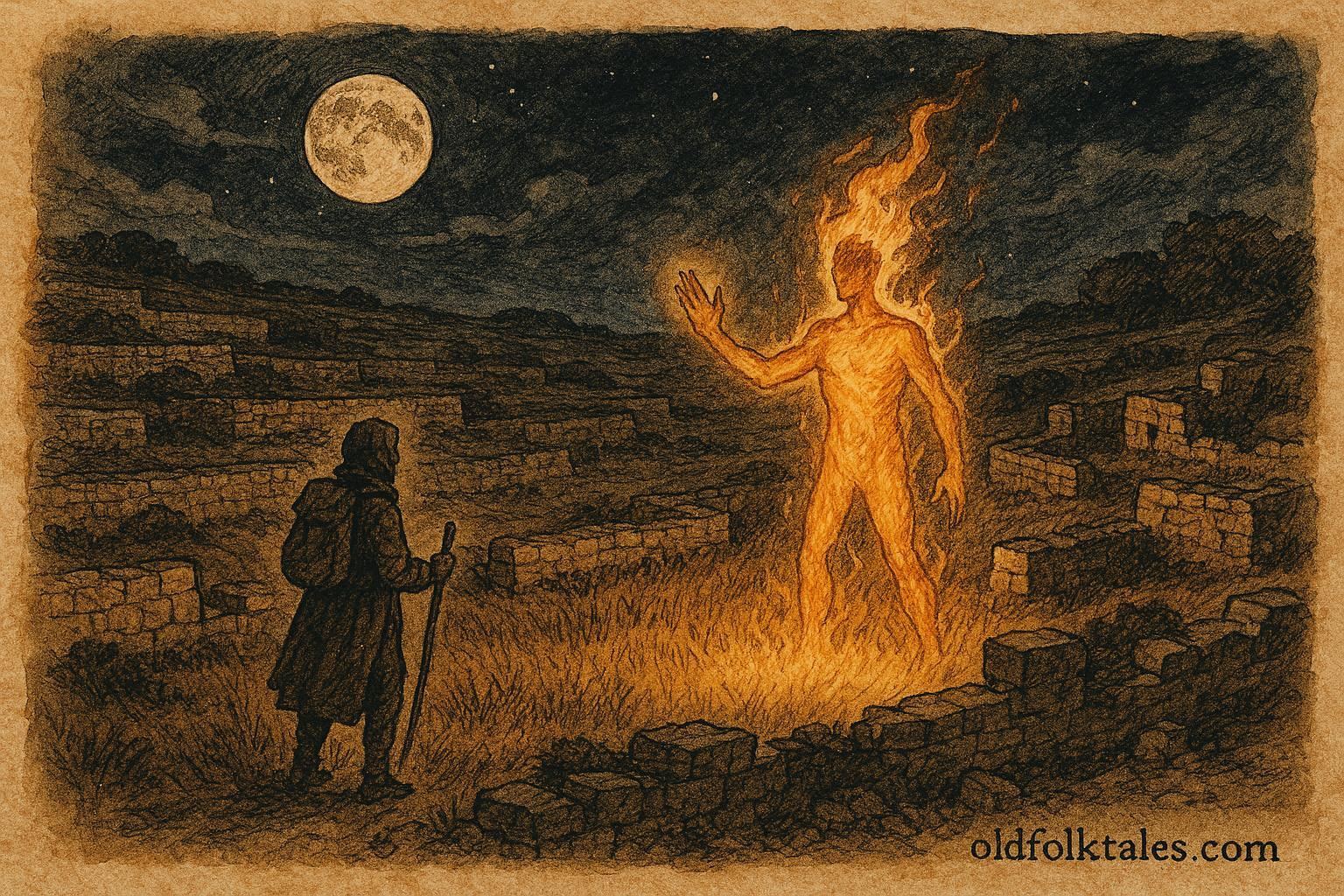
He is said to appear after dusk, when the bells have fallen silent and the last lamps are extinguished. A blazing human figure, neither fully flame nor fully flesh, wanders the old boundaries of the land. His body burns without smoke. His steps leave no ash. And yet, the air around him shimmers with heat, as if the earth itself recoils from his presence.
Older farmers insist he does not chase, threaten, or cry out. Instead, he warns.
Those who see him often describe the same sight: a tall figure of fire standing at the edge of a field, raising an arm, not in menace, but in solemn caution. Travelers who turn away at that moment return home safely, shaken but unharmed. Those who ignore the warning, however, are said to lose their way, fall ill, or wander until dawn, their strength drained as though the night itself had consumed them.
Long before the fields were abandoned, they belonged to a landowner whose name is no longer spoken. He was wealthy, powerful, and feared. Though the soil was fertile, the laborers who worked it were not treated with care. Rents were harsh. Water rights were withheld. Boundaries were shifted in secret, stealing land inch by inch from neighboring families who depended on every measure of earth to survive.
The elders say that when the landowner died, he was buried with ceremony and prayer. But the land remembered.
Soon after his burial, strange things began to happen. Crops failed where once they flourished. Animals refused to graze near certain walls. At night, shepherds saw flickers of light moving where no torch should burn.
Then came the first sighting.
A young man returning late from a neighboring village crossed the fields to shorten his journey. As he stepped over a fallen wall, the air grew suddenly hot. Before him stood a man entirely aflame, silent and unmoving. Terrified, the traveler ran. He reached home before midnight, pale and shaking, but alive.
Others were not so fortunate.
One farmer, stubborn and dismissive of superstition, claimed the tales were meant to frighten children. One evening, he crossed the cursed land deliberately, mocking the warnings. He was found the next morning collapsed near the boundary stones, feverish and unable to speak for days. When his voice returned, he said only this:
“The fire watched me.”
Over time, the story took shape.
The blazing figure was believed to be the spirit of the landowner himself, condemned after death to guard the very land he had exploited. In life, he took without restraint. In death, he was bound to restitution, forced to warn others away from what could no longer be possessed.
He could not leave the fields.
He could not rest.
He could only burn.
Some said the fire was punishment. Others believed it was purification. But all agreed: the land had reclaimed its justice.
Parents warned children never to wander after dark. Farmers marked the old boundaries with fresh stones, out of respect. Even skeptics avoided the fields at night, for in Malta, the line between the living and the dead has always been thin, especially where land, labor, and memory intertwine.
To this day, some claim that on certain nights, when the wind is still and the moon hangs low, a solitary flame can be seen pacing the terraces, standing guard where greed once ruled.
And if you see him, the elders say, do not test your courage.
Turn back.
Give the land its due.
And let the fire keep its watch.
Moral Lesson
Ir-Raġel tan-Nar teaches that exploitation leaves lasting scars, not only on people, but on the land itself. Wealth gained through injustice binds the soul long after death, while respect for boundaries, labor, and community brings peace. Some debts, if unpaid in life, must be repaid forever.
Knowledge Check
1. Who is Ir-Raġel tan-Nar in Maltese folklore?
He is a ghostly figure of fire believed to be the spirit of a corrupt landowner condemned to guard cursed land.
2. What role does the burning figure play in the story?
He serves as a warning spirit, cautioning travelers away from dangerous, cursed ground.
3. Why is the land considered cursed?
Because it was exploited unfairly in life, leading to spiritual punishment after the landowner’s death.
4. What happens to those who ignore the Man of Fire’s warning?
They fall ill, lose their way, or wander until dawn, weakened by the night.
5. What cultural belief does this story reflect in Malta?
That land holds memory and moral weight, and injustice disrupts spiritual balance.
6. What is the central lesson of Ir-Raġel tan-Nar?
Exploitation has consequences that extend beyond death, and respect for land and boundaries is sacred.
Source: Documented in Studies in Maltese Folklore by Joseph Cassar Pullicino (1964)
Cultural Origin: Rural inland Malta, agrarian ghost belief and land-based moral folklore