In a humble village on the edge of rolling English countryside, there lived a boy named Jack with his widowed mother. Their home was small and worn, the wooden beams darkened by age, and the hearth only just warm enough to fend off the chill of winter. They owned little beyond a single milk cow, whose gentle lowing provided them with the means to survive. Life was simple, though often difficult, and their hearts were bound tightly together by love and endurance.
One morning, as Jack led the cow to the market, his mother called after him. “Sell the cow for a fair price, Jack! We need money for food and firewood,” she urged. Jack nodded and set off with a light heart, hoping to secure enough to ease their hardships.
At the market, Jack met a curious old man with bright, twinkling eyes and a crooked smile. The man offered Jack a handful of beans, glimmering in hues of emerald and sapphire, and said they were magic beans, far more valuable than any coin. “Plant them, and wonders will grow beyond your imagination,” the stranger promised.
Jack, enchanted by the glittering beans and the promise of adventure, traded the cow for them. When he returned home, his mother’s face fell. “Magic beans?” she cried. “You foolish boy! We are left with nothing!” In despair, she flung the beans out the window and sent Jack to bed without supper.
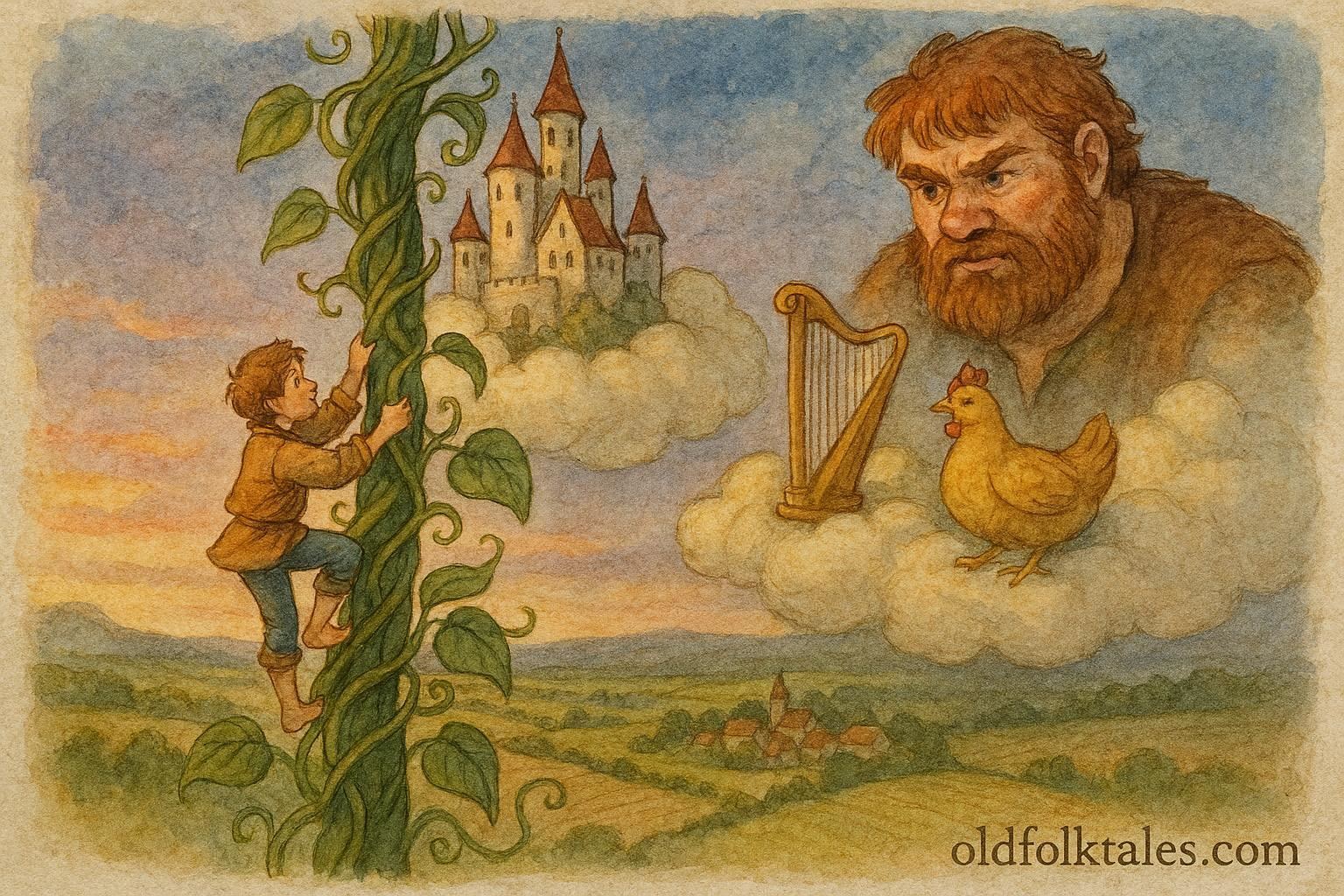
The next morning, however, the world had changed. A beanstalk had grown overnight, stretching far above the clouds. Its massive green stems twisted toward the sky, leaves the size of sails swaying in the breeze. Jack’s eyes widened in wonder. Could such magic truly exist? Could adventure, and perhaps fortune, await him at the top?
Without hesitation, Jack began to climb. Higher and higher he went, the village shrinking below him, forests and rivers becoming tiny threads of green and silver. Birds circled around him, their calls echoing like songs from another world. Finally, his hands gripping the last leafy branch, Jack pulled himself over the edge of a cloud, and before him stood a castle, immense and shining with gilded towers, smoke curling from chimneys like whispered secrets.
Inside, the castle was both grand and eerie. Tapestries of gold and velvet hung along the walls, silver goblets gleamed on tables, and the air was thick with the scent of roasted meats and burning fires. Jack hid behind a column, peering cautiously. And there he saw the giant.
A fearsome creature, enormous in every way, broad shoulders, hands as large as barrels, a booming voice that shook the floor. He stomped through the hall, counting coins, polishing treasures, and sometimes speaking to himself in a deep, rumbling tone. Jack realized immediately that the giant possessed unimaginable wealth, and that cleverness, courage, and caution would be required to obtain it.
Jack remembered the stories his mother had told him of giants and tricksters. He would need to be quick, silent, and inventive. His first opportunity came when the giant left a golden harp on a pedestal, singing softly to itself as though alive. Jack crept forward, heart pounding, and lifted the harp. The moment he touched it, however, it cried out, and the giant thundered back into the room. Jack darted behind a column, holding his breath as the creature’s booming voice demanded: “Fee-fi-fo-fum! I smell the blood of an Englishman!”
Jack, quick-thinking and brave, whispered to the harp: “Sing quietly, and you shall be safe.” Miraculously, the harp obeyed, quieting its cries just in time. The giant, irritated but distracted by his other treasures, stomped off, leaving Jack free to escape with the first prize. Carefully, he descended the beanstalk, bringing the golden harp back to his home, where it played sweet melodies, filling their humble house with warmth and light.
But Jack was not satisfied. He saw the riches of the castle, gold coins, bags of silver, and magical chickens that laid golden eggs. His family still needed prosperity, and Jack resolved to climb the beanstalk again. Each ascent was more dangerous than the last, requiring cunning and patience. He timed his movements to the giant’s routines, hid among shadows, and learned to predict the giant’s moods.
On his second visit, Jack stole a bag of gold coins, concealing it in his jacket as he crept back down the beanstalk. The villagers were astonished when he revealed the treasure. His mother’s eyes filled with tears of relief, and the home that had once known hunger and hardship began to flourish. Yet Jack knew that to secure lasting prosperity, the magic of the castle must be fully understood, and that meant one final, daring journey.
This time, Jack aimed for the ultimate prize: the hen that laid golden eggs. He watched the giant carefully, noting its sleep patterns and the creaking of the enormous doors. When the giant retired for the night, Jack tiptoed across the hall, approaching the golden hen. It clucked softly, as though sensing his intentions, but Jack whispered kindly, “I mean you no harm. Come with me to help my family.” Miraculously, the hen allowed itself to be lifted, and Jack crept back to the beanstalk, heart racing with excitement and fear.
But the giant, having grown suspicious, awoke as Jack began his descent. “Fee-fi-fo-fum! I smell the blood of an Englishman!” it bellowed, its shadow stretching across the clouds. Jack scrambled, clutching the hen, the harp, and the bag of gold, weaving between branches and pulling himself higher and higher. The giant followed, thundering down the beanstalk with every step shaking the earth above the village.
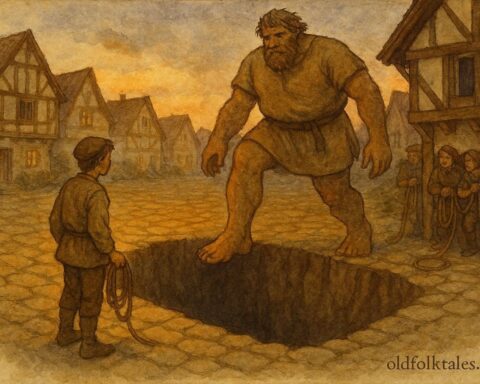
Jack’s cleverness and courage shone through. As he reached the base of the beanstalk, he called upon the villagers to assist. With axes, ropes, and determination, they worked together to chop the beanstalk while Jack held on, the giant looming overhead. With one final heave, the beanstalk fell with a mighty crash, and the giant tumbled to the earth, never to trouble Wiltz, or England, again.
The village erupted in celebration. Jack’s daring exploits became legend, and his family’s home transformed from a modest cottage into a place of comfort and joy. The golden harp sang sweetly every morning, the hen provided endless golden eggs, and the bag of gold ensured that no winter would bring hunger again. But more than wealth, Jack brought courage, cleverness, and hope to the hearts of all who had once trembled in fear.
Years later, storytellers recounted Jack’s tale by firesides, in village squares, and at market fairs. Children imagined the towering beanstalk, the shimmering castle in the clouds, and the enormous giant, learning that bravery, cleverness, and bold action could overcome even the most frightening challenges. Jack himself never grew boastful. He used his cleverness to help others, teaching that courage and ingenuity, combined with kindness, were the truest forms of wealth.
Through the tale of Jack and the Beanstalk, generations learned that even the smallest, humblest person could achieve greatness if they embraced opportunity, used their mind wisely, and acted with courage. The giant may have been enormous, but Jack’s cleverness was larger still, a reminder that intelligence and bravery often triumph over size and strength.
Moral Lesson
Jack and the Beanstalk teaches that courage, cleverness, and resourcefulness can turn adversity into opportunity. Even the humblest person can overcome challenges and achieve prosperity when they act bravely and think wisely.
Knowledge Check
- Who is the protagonist of the story?
- Jack, a poor but clever and brave young boy.
- What magical element initiates Jack’s adventure?
- Magic beans that grow into a giant beanstalk overnight.
- How does Jack defeat the giant?
- By using cleverness to steal treasures, timing his moves carefully, and ultimately chopping down the beanstalk with the villagers’ help.
- What themes are central to this English folktale?
- Courage and ingenuity, the triumph of the underdog, taking risks, and the rewards of cleverness.
- What treasures does Jack obtain from the giant?
- A golden harp, a hen that lays golden eggs, and bags of gold.
- What cultural elements are highlighted in the tale?
- English village life, folklore of giants and magic, rural landscapes, and moral lessons on bravery and cleverness.
Source: Joseph Jacobs, English Fairy Tales, 1890, England.
Cultural Origin: English