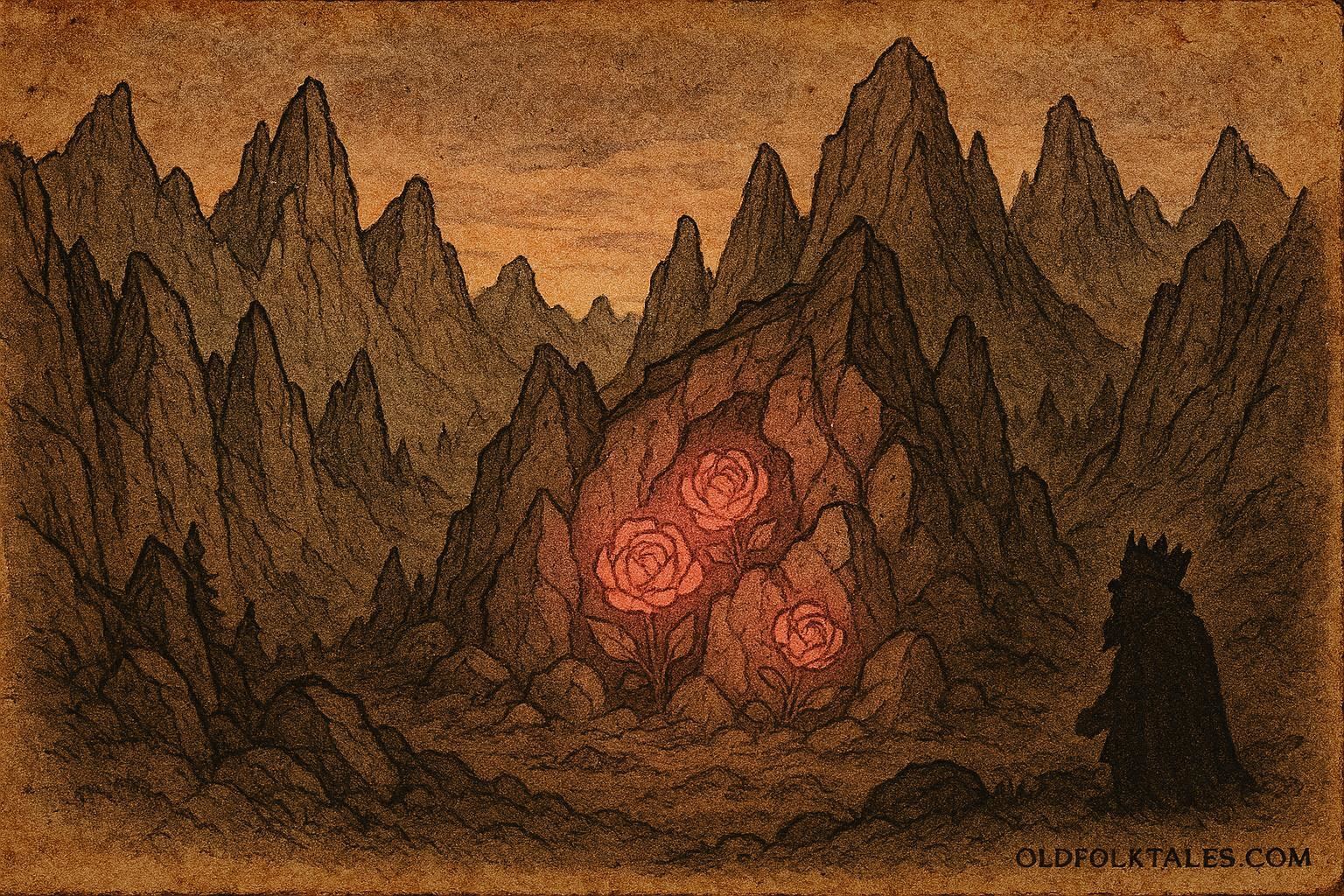
High in the Dolomite Mountains, where pale stone towers rise like frozen flames against the sky, there once ruled a king unlike any other. His name was Laurin, and though he was small in stature, he was great in power. Laurin was a dwarf king, lord of the hidden places beneath the mountains, and his realm lay deep within the rock and shadow of the Alps.
Laurin’s halls were carved from stone and crystal, lit by veins of glowing minerals and guarded by ancient enchantments. His people were skilled smiths and keepers of old magic, bound by strict laws of honor and oath. Though they rarely showed themselves to humans, they watched the mountain passes closely, for the world above was dangerous and careless.
Yet among all Laurin’s possessions, there was one treasure he loved above gold, weapons, or crown.
At the foot of the Dolomites, in a high and sheltered place, Laurin had created a rose garden unlike any seen in the lands of men. Thousands upon thousands of roses bloomed there, red as embers, pink as dawn, and pale as mountain snow touched by sunset. No frost withered them, no storm bent their stems. The garden was bound by powerful spells that kept it forever in bloom, untouched by time or season.
Laurin loved this garden fiercely. It was a symbol of his pride, his artistry, and his dominion over both stone and living beauty. To protect it, he wove strong enchantments: no blade could cut the roses, no fire could burn them, and no enemy could enter without consequence.
But Laurin’s pride was as sharp as his magic.
Word of the rose garden spread beyond the mountains. Travelers spoke of a glowing field of flowers hidden among the cliffs, and soon the tale reached the ears of human knights—men accustomed to conquest, who believed nothing sacred unless claimed by strength.
A band of knights, bound by oaths to one another but careless of promises not their own, rode into the mountains seeking glory. They did not ask leave of the land, nor did they heed warnings whispered by shepherds and villagers below. When they found the rose garden, they marveled only briefly before riding straight through it.
Horses trampled the enchanted blooms. Iron hooves crushed petals that had never known decay. Laughter rang out where silence had once ruled.
The earth itself seemed to shudder.
Laurin felt the violation as though it were a wound in his own flesh. From his hidden halls, he sensed the breaking of his enchantments and the breaking of trust between worlds. Rage rose within him, hot, blinding, and absolute.
When the knights later encountered Laurin, they underestimated him at once. They saw only a small figure, richly clad but no taller than a child, and they mocked him. Yet Laurin’s strength was not in size, but in sorcery and ancient power. He fought them with weapons forged in the depths of the mountains and with magic bound to the stone itself.
Still, pride clouded his judgment.
Though Laurin fought fiercely, the knights eventually overcame him, not through honor, but through treachery and broken oaths. Bound and defeated, Laurin was taken away from his mountains, his rose garden left ruined behind him.
As he was led away, bitterness replaced fury.
Laurin knew his garden could never be what it had been. Even if the roses bloomed again, the innocence of their beauty was lost. In that moment, his grief hardened into vengeance, not against the knights alone, but against the world that had allowed such disrespect.
Raising his hands toward the mountains, Laurin spoke a final, terrible spell.
He cursed the rose garden so that it could never again be seen by human eyes. He declared that it would vanish from sight both by day and by night, hidden forever from those who had trampled it without reverence.
The spell took hold immediately. The garden disappeared, as though swallowed by the mountain itself.
Yet Laurin, in his wrath, overlooked one thing.
He had cursed the garden to be unseen by day.
He had cursed it to be unseen by night.
But he had not spoken of twilight.
And so, at dawn and at dusk, when day and night briefly share the sky, the roses still reveal themselves.
To this day, when the sun sinks low and the Dolomites glow with a soft pink and fiery red light, the people say it is Laurin’s rose garden shining through the stone. The mountains blush as the roses once did, bathed in the colors of magic, pride, and sorrow.
The knights are long gone. Laurin’s fate fades into legend. But the glow remains, a reminder written not in words, but in light upon stone.
Moral Lesson
King Laurin and the Rose Garden teaches that pride and unchecked wrath can cause lasting harm beyond the moment of injury. Beauty protected by force alone is fragile, and vengeance, once spoken, cannot be fully undone. Even so, the story reminds us that nature remembers, and sometimes transforms sorrow into wonder.
Knowledge Check
-
Who is King Laurin in the folktale?
King Laurin is a dwarf king who rules beneath the Dolomite Mountains. -
What makes Laurin’s rose garden magical?
The garden is eternally in bloom and protected by powerful enchantments. -
Why does King Laurin curse the rose garden?
Human knights trample the roses, violating the garden and Laurin’s honor. -
Why can the rose garden still be seen at twilight?
Laurin’s curse excluded twilight, allowing the garden’s glow to appear at dawn and dusk. -
What natural phenomenon does the legend explain?
The pink alpenglow that lights the Dolomites at sunrise and sunset. -
What is the main theme of the story?
The cost of pride and revenge, and myth as an explanation of nature.
Source: Part of the Dietrich von Bern heroic saga cycle, recorded in Middle High German epics and chronicles (c. 13th century).
Cultural Origin: Tyrol / South Tyrol (historically Austrian Alpine folklore)