Long ago, in the rolling hills and quiet villages of central and northern Italy, children eagerly awaited the eve of Epiphany, the night when the stars shone bright and magic seemed to stir in the crisp winter air. For generations, they whispered about a kindly old woman named La Befana, who traveled the skies on her broomstick, bringing gifts to those who had been good throughout the year and teaching lessons to those who had strayed from the path of virtue.
La Befana was said to live alone in a small cottage perched atop a hill, surrounded by gardens of herbs and flowers that thrived even in the coldest months. Her house was modest but warm, with a fireplace that glowed like the heart of the sun and shelves lined with jars of sugar, cinnamon, dried fruits, and tiny handmade trinkets. Despite her solitude, she was deeply connected to the villages below, moving among the people with quiet care, unseen but always present.
The story tells that La Befana had once been visited by travelers on a fateful night. They were not ordinary wanderers, but the three kings, wise and noble, seeking a newborn child of great promise. They asked La Befana to join them on their journey to see the infant king, to bring him gifts and pay homage. She hesitated, tending to her home and her daily routines, and asked the kings to leave without her. That night, however, she could not sleep. A feeling of regret tugged at her heart. She realized that she had turned away from an opportunity to do good, to participate in a moment of profound importance.
When morning came, the kings were gone, and La Befana hurried to find the child, carrying with her the small gifts she had gathered, sweets, fabrics, and trinkets from her cottage. She searched the roads and villages, asking travelers and merchants, knocking on doors, but the child had already moved far from her reach. Though she never found the young king, La Befana decided that she would not rest on Epiphany Eve in the years to come. Each year, she would ride through the skies, leaving gifts for children, hoping to bring joy and to honor the lesson she had learned: that kindness and generosity must be offered freely, without hesitation.
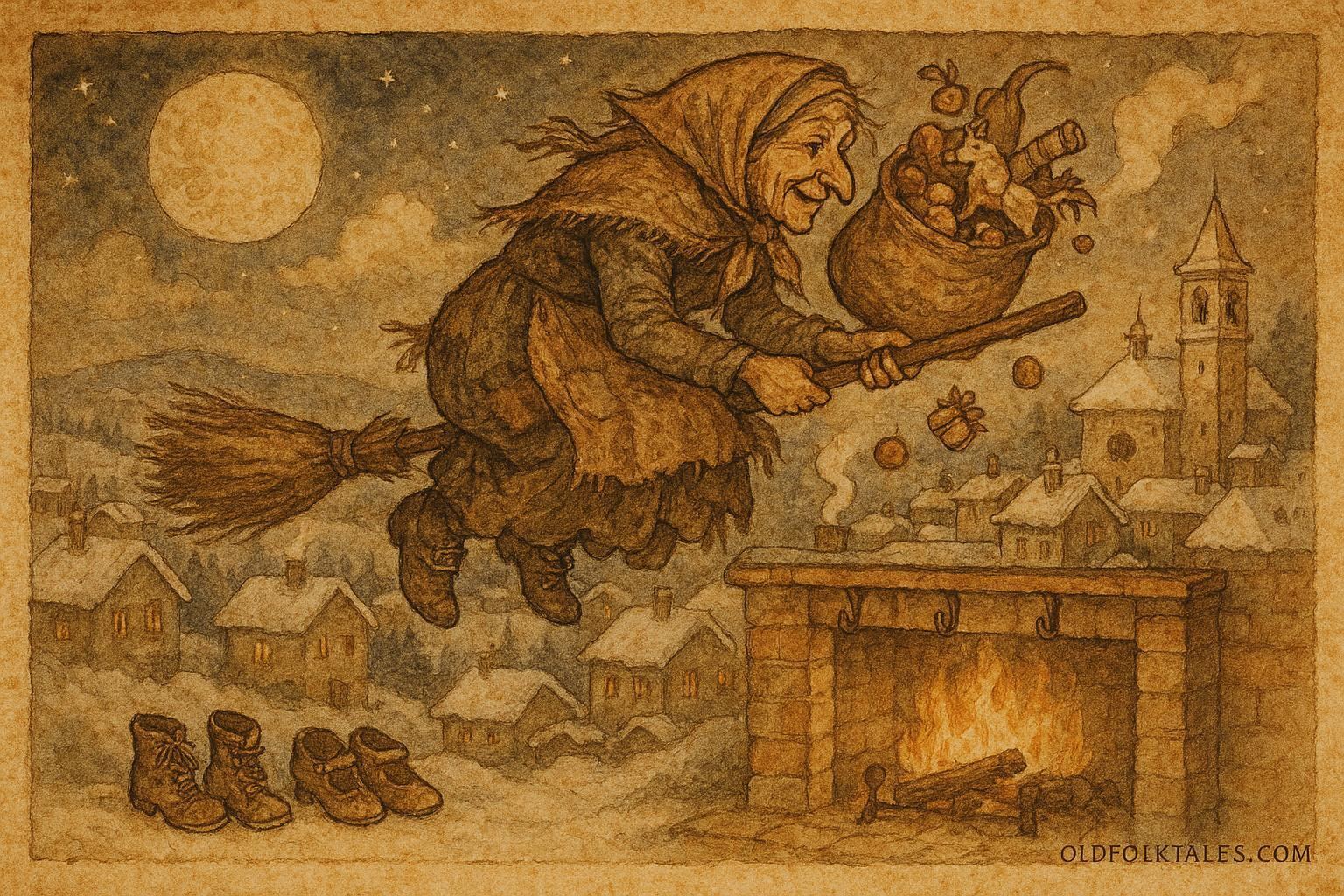
From that day forward, children eagerly prepared for her arrival. On the night before Epiphany, they polished their shoes and placed them by the fireplace or windowsill, hoping to receive treats. Families baked sweets, filled small bags with dried fruits, and wrote gentle notes of gratitude. The children knew that if they had been mischievous during the year, La Befana might leave a piece of coal in their shoes, a symbol not of cruelty, but of the lesson that behavior carries consequences.
La Befana herself was a figure both magical and approachable. She wore a shawl over her shoulders, patched with the colors of countless seasons, and her hat was wide and slightly crooked, giving her a look both whimsical and wise. Her broomstick, carried lightly under her arm, allowed her to glide silently over rooftops and through the night air. She traveled with a sack slung over her back, filled with sweets, fruits, small toys, and sometimes tiny books of stories or songs for the children she visited.
One particularly harsh winter, the snow fell so heavily that even the bravest of villagers struggled to walk through the streets. Yet La Befana’s presence was undeterred. She guided herself with the stars, navigating the mountains and valleys with the skill that only centuries of practice could bring. In one village, a small boy named Matteo had spent the year quarrelling with his friends and refusing to help at home. Though he had been troublesome, La Befana knew that every child could change and grow. In his shoe, she left a piece of coal, alongside a small candy and a note that read, “Remember kindness, for it brightens the hearts of others and your own.” Matteo awoke to find the gifts and, after reading her words, felt the stirrings of remorse and inspiration. He resolved to help his mother with chores and to treat his friends with care, learning that even a small act of thoughtfulness could create joy.
In another village, two young sisters, Lucia and Rosa, had spent the year quietly helping their neighbors, caring for their younger siblings, and tending to the animals. For them, La Befana left almonds, oranges, and tiny wooden toys, and in one shoe she tucked a note that said, “Your goodness shines like the Epiphany star. Continue to share your heart with the world.” The girls’ eyes sparkled as they discovered the treats, feeling a warmth not only from the sweets but from the recognition that their efforts mattered, that virtue was noticed and celebrated.
La Befana’s visits were not only for children. On occasion, she left small herbs or remedies for the sick or elderly, guiding them to heal naturally and reminding villagers of the interconnectedness of all living things. Her magic, subtle yet powerful, was a blend of practical wisdom and gentle enchantment. She taught that generosity was not only in giving objects but in offering guidance, protection, and understanding.
The villagers soon learned that her lessons were never harsh or punitive. Coal was never left out of cruelty, but as a sign that one’s choices affected others, and that reflection and improvement were always possible. Treats, on the other hand, rewarded thoughtfulness, kindness, and cooperation. Through these acts, La Befana became a bridge between generations, linking children to their families, communities, and traditions.
Over the years, stories of La Befana spread far and wide. In some villages, children would gather near the church before Epiphany, singing songs that had been taught by their parents, calling her name into the crisp winter air. Candles flickered in windows, illuminating the paths and welcoming her presence. Merchants and travelers often marveled at the quiet miracles that seemed to happen, gifts appearing, minor disputes resolved, small illnesses eased, and whispered of the old witch who traveled the skies, spreading wisdom and joy.
Some nights, when the wind whistled and the snow swirled in eddies, the villagers claimed to see a shadowy figure moving across the rooftops. A broom glinted briefly under the moonlight, and a muffled laugh, light and melodic, drifted through the cold air. Even the most skeptical adults felt a warmth of reassurance, a reminder that kindness persisted in the world, and that the lessons of Epiphany were not confined to the church or classroom but carried on wings of generosity and thoughtfulness.
Through the centuries, La Befana’s legend endured, becoming an essential part of Italian culture and the Epiphany celebration. Parents told their children of her journey each year, teaching them about the rewards of good behavior, the importance of helping others, and the joy found in generosity. Her story reminded communities that the small acts of caring, sharing a treat, helping a neighbor, speaking kindly, were as magical and meaningful as the gifts she delivered from her sack.
Even today, in towns and villages across central and northern Italy, children leave their shoes by the hearth on the eve of January 5th, hoping that La Befana will visit. Families bake sweets, fill stockings with dried fruits and small tokens, and recount tales of her wisdom and kindness. She remains a symbol not of fear, but of the enduring power of generosity, moral guidance, and the celebration of community and tradition.
Thus, the tale of La Befana teaches children and adults alike that true magic lies not in spells or enchantments, but in acts of thoughtfulness, courage, and goodwill. Through her visits each year, she reminds all who live in her villages that generosity, understanding, and moral reflection are gifts that outshine any treasure, and that each child, guided by kindness and wisdom, can grow into a person of virtue and compassion.
Moral Lesson
Generosity and kindness are virtues to be celebrated; good behavior is rewarded, while mistakes are opportunities for reflection and growth. Tradition preserves moral lessons, reminding us that thoughtfulness and goodwill enrich both giver and receiver.
Knowledge Check
1. Who is La Befana in Italian folklore?
An elderly woman who delivers gifts to children on Epiphany Eve, rewarding good behavior and teaching moral lessons.
2. Why do some children receive coal from La Befana?
Coal symbolizes lessons about misbehavior, encouraging reflection and improvement rather than punishment.
3. What magical tool does La Befana use to travel?
Her broomstick, which allows her to fly across villages and hills in the night sky.
4. How did La Befana begin her tradition of gift-giving?
After missing the opportunity to visit the newborn king with the three wise men, she vowed to deliver gifts to children each year.
5. What qualities does La Befana teach through her visits?
Kindness, generosity, reflection, moral responsibility, and the importance of helping others.
6. Which regions of Italy is this folktale most associated with?
Central and northern Italian villages, where Epiphany celebrations preserve the tradition.
Source: Thomas Frederick Crane, Italian Folk Tales, 1885
Cultural Origin: Italy (Central and Northern regions)